
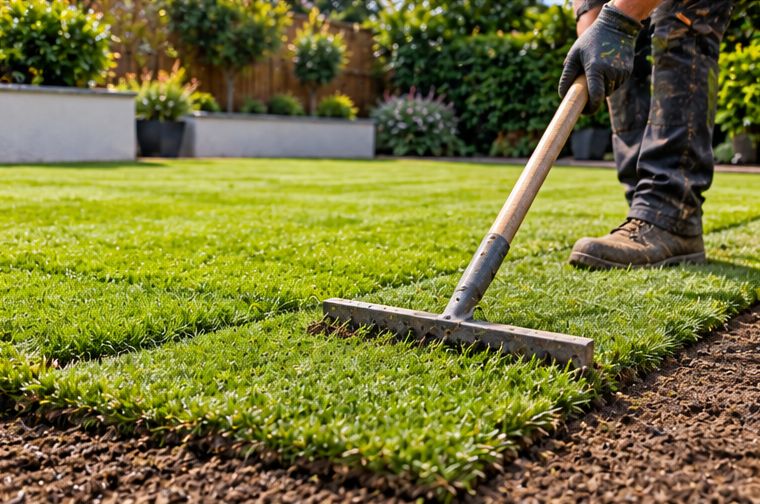
A lot of Chepstow lawns are not flat. Some tilt gently towards the house, others fall away steeply to the bottom wall, and a few are really banks that someone once sowed with grass. New turf can look perfect on the day it goes down on ground like this and then creep, split at the joints or slide in the first heavy rain.
The good news is that a sloping lawn in Chepstow can be turfed successfully if the slope is within reason and the work is done in the right order. This guide explains how. For the turf service itself, see our turf laying page.
Why new turf moves on a slope
Freshly laid turf is heavy, especially once it has been watered, and for the first couple of weeks it has almost no roots in the soil below. On a slope, gravity pulls that weight downhill. If the soil underneath is loose or fluffy, or has a slick, compacted surface, the turf has nothing to grip.
Water adds to the problem. Rain runs down a bank rather than soaking in, carrying fine soil with it and leaving gaps under the turf at the top. At the foot of the slope the ground can stay soft, so the bottom rows sink and the whole lawn sags. Most slipping turf we see comes down to one of these causes rather than poor turf.
Is the slope too steep for a lawn?
Before any turf is ordered, it is worth asking whether grass is the right answer. A useful rule of thumb is that slopes much steeper than about one in three become hard to mow safely and hard to keep watered. Grass will grow on them, but living with it is another matter.
On the steepest Chepstow gardens, a better plan is often to ease the gradient, or to split the garden into level terraces with a lawn on one of them. Our guides to landscaping a steep Chepstow garden and terracing with sleepers show how that works. Very steep banks can also be planted with ground cover shrubs instead of grass.
Shaping the ground first
Good preparation matters on any lawn, and on a slope it matters twice over. The general steps are covered in our guide on preparing the ground before laying turf; on a Chepstow bank we add a few extras:
- Smooth out the humps and hollows. Dips on a slope collect water and bumps get scalped by the mower, so we aim for one even gradient.
- Round off the top and bottom. A sharp change of angle where the slope meets flat ground is where turf tears and dries out.
- Firm the soil evenly. Treading or rolling in several directions takes out soft pockets that would later sink.
- Rake the surface lightly. A slightly open top layer gives new roots something to grip.
- Add good topsoil where it is thin. Ground varies around Chepstow, and a stony or shallow bank needs a decent layer for roots to go into.
Deal with the water before it deals with the turf
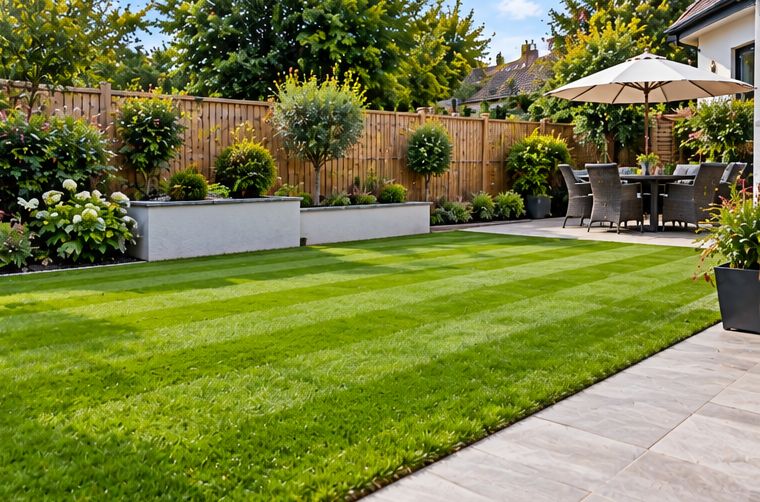
Look at where water enters the lawn and where it leaves. Rain off a patio or path above the lawn should not pour straight onto the new turf; a channel or gravel strip along the top edge can catch it. At the bottom, a lawn that ends against an old stone wall needs somewhere for water to go, or it will sit against the wall and keep the lowest rows soft.
Where the foot of a slope stays wet through winter, a land drain or soakaway may be worth fitting before turfing. Our article on how to stop a garden waterlogging explains the main options.
Laying: across the slope, from the bottom up
Turf on a slope is laid in rows running across the gradient, not up and down it, so each row supports the next. We start at the bottom and work upwards, standing on boards laid over the turf already down rather than on the prepared soil. The joints are staggered like brickwork so there is no continuous seam for water to run along.
Each roll is butted up tightly to its neighbour and firmed down so the roots touch the soil all over. Small offcuts are kept away from the edges, where they would dry out and lift; a full piece goes at the edge and any small bits are worked into the middle.
Pegging the steeper parts
On steeper sections the turf can be held in place with pegs until the roots take over. Wooden or biodegradable pegs pushed through the turf into the soil below are common, a few per roll, and can usually be left to rot away. On very steep banks, a biodegradable mesh laid under or over the turf can add grip for the first season.
Along the top edge, where turf meets a path, patio or wall, a firm edge matters. We tuck the turf tight against it and keep the soil level just below, so mowers glide over and water does not get under the first row. At the bottom, the turf should finish against something solid rather than a loose soil edge that can crumble away.
Pegs do not replace good preparation, but they buy time. Once the roots have knitted into the soil, usually after a few weeks of good growing weather, the turf holds itself.
Watering and the first few weeks
A sloping lawn loses water faster at the top than at the bottom, so it needs watering slowly and more than once, letting each pass soak in rather than run off. A sprinkler on a low setting or a hose with a spray head, moved often, works better than a heavy soaking in one spot. Check the top rows most carefully; if the edges start to shrink or curl, they need more water.
Keep off the lawn until it has rooted, and make the first cut high. Our guide to caring for new turf in the first six weeks has the details, and the best time to lay turf explains why spring and autumn are easiest.
If you are weighing up a sloping lawn in Chepstow, see our landscaping in Chepstow page, or ask for a free quote and we will look at the gradient with you.
Talk to T J Landscapes about your garden
Free quotes and honest advice across South Wales.
Questions People Ask
How steep is too steep for a turfed lawn?
It depends on the ground and who will mow it, but slopes steeper than about one in three are often hard to mow and keep watered. On Chepstow gardens that steep, we usually suggest terracing or planting part of the bank instead.
Do I need pegs to hold turf on a slope?
On gentle slopes, good preparation and careful laying are enough. On steeper banks, pegs hold the turf in place for the first few weeks until the roots take over.
Why is my new lawn drying out at the top and soggy at the bottom?
Water runs downhill before it soaks in. Watering slowly in several passes helps the top, and drainage at the foot of the slope helps the bottom.
Can you re-turf a lawn that has already slipped?
Yes. We lift the slipped turf, reshape and firm the ground, sort out any water problem and lay fresh turf across the slope.
Do you do the whole job, from clearing to laying?
Yes. Tony and the team can clear the old lawn, shape the ground, bring in topsoil and lay the turf, then tell you how to look after it.