
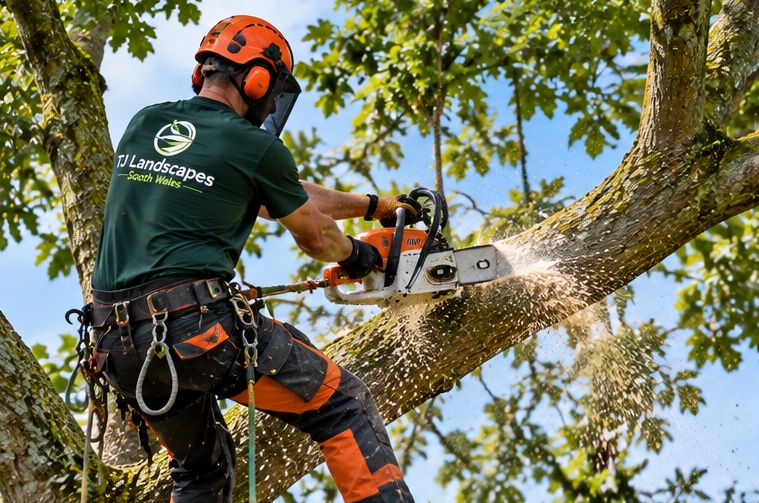
Many of the trees that cause worry in Chepstow gardens are not in the middle of the lawn. They sit on the edge, rooted beside an old wall, leaning over a neighbour's roof or shading the garden one level down the hill. Because the town is built on steep ground, a branch that looks harmless from your side can hang right over someone else's patio.
This guide covers what to think about before any work on a boundary tree in Chepstow: ownership, permission, the effect on walls and the practical side of working on a slope. Our tree surgery and hedge care page explains the services Tony and the team offer.
Start by working out whose tree it is
It sounds obvious, but it is often unclear. A tree belongs to the owner of the land its trunk grows from. Where a trunk sits right on the line, or an old wall has been built around it, the tree may be shared. Deeds and plans sometimes help, and a friendly conversation with next door usually helps more.
If the tree is your neighbour's, you can generally cut back branches that overhang your side to the boundary line, but no further, and you should not harm the health of the tree. Strictly, the cut wood belongs to the tree's owner, so it is polite to ask what they would like done with it. When a tree is shared or the work affects both gardens, agreeing a plan together saves a great deal of bad feeling later.
Check for protection before anything is cut
Parts of Chepstow are covered by a conservation area, and some trees in and around the town may carry a tree preservation order. In a conservation area you normally have to give the council notice, usually six weeks, before most work on trees above a small size. A protected tree needs consent. The rules have exceptions and details, so the safe step is to check with Monmouthshire County Council before booking any tree work.
Nesting birds are protected too, whether or not the tree is. Most hedge and tree work is best planned for outside the main nesting season, roughly March to August, and any work in spring should start with a careful look for active nests. Our guide to whether you need permission to cut down a tree in Wales sets out the general position. We are landscapers rather than planners or solicitors, so we point you to the council for a firm answer.
Roots, old stone walls and the ground below
Chepstow's old stone walls were often built without deep footings, and many of them retain soil. A tree growing right beside one can lift the base, push the stones outwards or open the joints as its roots thicken. Ivy climbing the face adds weight and holds damp against the mortar.
The answer is not always to fell the tree. Removing a large tree beside a retaining wall can leave rotting roots in the bank behind it, and the ground may settle or hold more water once the tree stops drinking from it. Sometimes a crown reduction and a watchful eye is the better plan, and sometimes the wall needs rebuilding once the tree has gone. Our article on repairing old stone garden walls in Chepstow looks at the wall side of the problem.
Choosing the right kind of cut
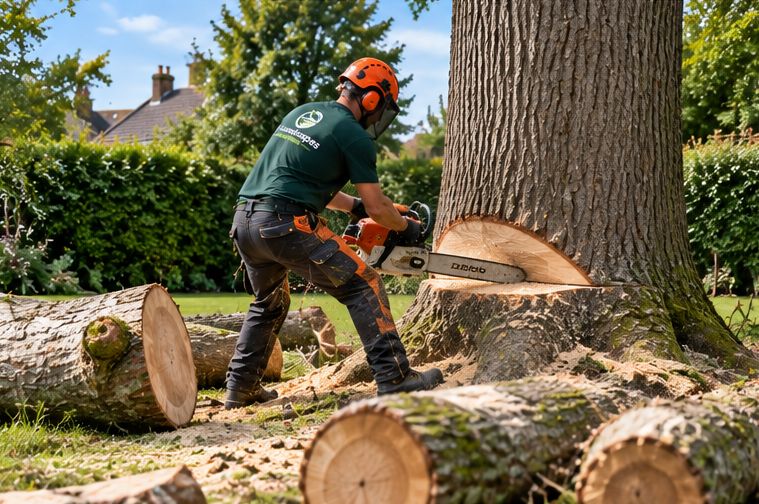
Most boundary problems can be solved without taking the whole tree down. The common options are:
- Cutting back overhang: taking branches back to a suitable point near the boundary to clear a roof, gutter or path next door.
- Crown lifting: removing lower branches so light reaches the garden below and people can walk under the tree.
- Crown thinning: removing some inner growth so wind and light pass through, without changing the tree's outline much.
- Crown reduction: reducing the height and spread, useful where a tree has outgrown a small town garden.
- Felling: for trees that are dead, dangerous, or simply in the wrong place, subject to any permission needed.
How the work is done on a hillside
On a flat plot, a branch can sometimes be dropped into open space. On a Chepstow hillside that space is often a neighbour's garden, a conservatory roof or a flight of steps. Branches are usually cut in small sections and lowered on ropes, and the order of cuts is planned so nothing swings into a wall or fence.
Access matters just as much. Timber and brash have to leave the garden, and on a steep plot that may mean carrying it up steps or passing it through a side gate. We plan the route before we start and agree with you, and your neighbour if needed, where things will be stacked. The day a tree surgeon visits guide describes what to expect.
Hedges on the boundary line
Boundary hedges in Chepstow range from neat privet and laurel on newer streets to old mixed hedges along the backs of older gardens. Both need trimming from both sides, which means agreeing access with next door if you cannot reach the far face. A hedge that has been left to grow tall can be reduced in stages over a couple of seasons so it does not end up bare.
Where a neighbour's very tall evergreen hedge is blocking light and talking has not helped, Welsh councils have a formal high hedges complaints process, though it is meant as a last resort. See our hedge trimming guide for timing.
Getting advice before you decide
The simplest first step is to have someone look at the tree, the wall and the ground together. Tony and the team can visit, explain what we would suggest and why, and give you a free quote. If the tree is on a boundary we are also happy to explain the plan to your neighbour.
For more on gardens in the town, see our landscaping in Chepstow page, read choosing gates and fencing for a Chepstow home if the boundary needs work afterwards, or ask for a free quote.
Talk to T J Landscapes about your garden
Free quotes and honest advice across South Wales.
Questions People Ask
Can I cut my neighbour's branches that hang over my Chepstow garden?
Generally you can cut overhanging branches back to the boundary, as long as the tree is not protected and the work does not harm its health. Talk to your neighbour first and offer them the cuttings, as the wood strictly belongs to them.
How do I know if a tree in Chepstow is protected?
Ask Monmouthshire County Council whether the tree has a preservation order or stands in a conservation area. Do this before booking work, because notice or consent may be needed.
Will cutting down a tree fix my bulging wall?
Not on its own. Removing the tree stops further root pressure, but the wall may still need repair or rebuilding, and the ground behind can change once the tree has gone. We look at both before recommending anything.
Can the work be done without going into my neighbour's garden?
Sometimes, but not always. Cutting back overhang and lowering sections on a slope often needs access from the other side. We will tell you at the quote stage if that is likely.
Do you take the wood and branches away?
Yes. Branches, brash and timber are cleared and taken away, unless you would like logs left for your own use.