
Ask anyone who has had a fence fail and the story is nearly always about the posts. Panels and boards get the attention when you are choosing a fence, but they only stay up as long as the posts holding them do. In a climate as wet as ours, with plenty of heavy clay and damp valley ground, that means the posts are worth a proper decision rather than whatever the last fence had.
Here we compare concrete and timber posts honestly, including the drawbacks of each, and explain how the way a post is set matters just as much as what it is made of.
The problem posts have to solve
A fence post spends its life with its base buried in wet soil and its top in the wind. The section just above and below ground level is the danger zone: it is constantly wet, it gets air as well, and that combination is exactly what fungal rot needs. Timber posts rarely rot at the top or deep underground. They go at the collar, just where you cannot easily see.
Posts also carry leverage. Every gust that hits the fence is transferred down into the footing, so a post needs enough depth, and a firm enough bed of concrete or compacted ground, to resist being rocked back and forth over many winters.
Concrete posts: the case for
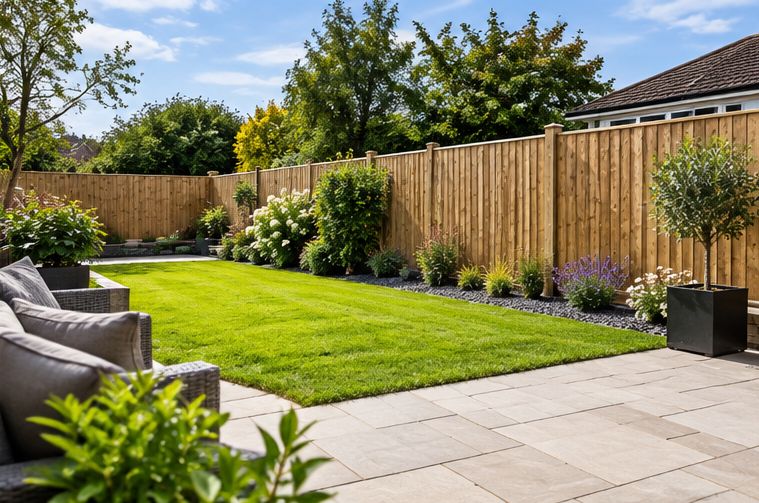
Concrete fence posts are reinforced with steel and simply do not rot. For panel fencing, slotted concrete posts are a very common choice, and they come as intermediate, end and corner posts so a run can turn and finish neatly. The panels drop into the slots, which also makes replacing a damaged panel straightforward.
- They last far longer than timber in wet ground, and many outlive several sets of panels.
- They pair with concrete gravel boards, which keep the timber panels clear of the soil.
- Panels can move slightly in the slots in high wind, rather than tearing fixings out.
- Concrete mortice posts are available for close board fencing, with holes for the rails.
Concrete posts: the drawbacks
They are heavy, which makes them harder to carry through a narrow side passage or up a flight of garden steps, a real consideration on many terraced streets. They are also not easy to cut, so the post spacing has to be planned carefully to suit the panel widths.
Then there is the look. Grey concrete is practical rather than attractive, and on a smart modern fence or a cottage garden it can feel out of place. Climbers and planting soften them quickly, and some people paint or stain the visible faces, but if the posts are going to be on show every day, it is worth weighing that up.
Finally, concrete posts suit panel and close board fencing best. For slatted or horizontal board designs, where boards are screwed to the face of each post, timber is normally the better fit.
Timber posts: the case for
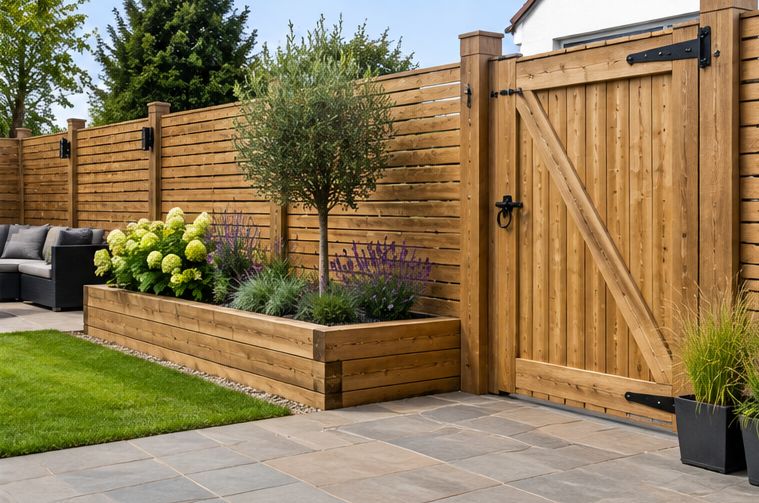
A good timber post looks right with a timber fence. It can be cut to height on site, notched for rails, and fixed to directly, which gives far more freedom with design. Slatted screens, hit-and-miss fences, close board with a capping rail, and most gates all tend to be built on timber.
The key is buying the right post. For fencing, you want posts that have been pressure treated for ground contact, often labelled Use Class 4 or UC4, not just dipped or brushed with preservative. A heavier section, such as a 100mm square post rather than a slimmer one, is stiffer and has more timber to lose before it becomes weak. Gate posts should be heavier still.
Timber posts: the drawbacks
Even well-treated timber will rot eventually at ground level, especially in the wet clays common across the valleys and around Caerphilly and Newport. How long that takes depends on the treatment, the soil and how well the post was set, which is why two fences of the same age can be in very different condition.
Cutting a treated post exposes untreated timber inside, so any cut end needs an end-grain preservative. Timber can also twist or split as it dries, which is one more reason to choose a good grade and store it properly before it goes in.
How a post is set matters as much as the material
A concrete post set badly will lean just as surely as a timber one. Whatever we use, the principles are the same:
- Dig deep enough to reach firm ground, and deeper for taller fences, gate posts and exposed spots.
- Put a little gravel at the bottom of the hole so water can drain away from the base of the post.
- Surround the post with concrete and shape the top to slope away from it, so rain runs off rather than pooling against the timber.
- Check each post for line and plumb as it goes in, because correcting a crooked post later means digging it out.
- Give the concrete time to go off before hanging heavy panels or gates.
Other options worth knowing about
There are a few in-between answers. A concrete repair spur is a short concrete post bolted alongside a timber post that has rotted at the base, which can be a sensible fix when the rest of the post and fence are sound. We cover that in fence repair or replacement.
Metal post spikes, driven in rather than concreted, are sold widely. In our experience they rarely hold firm for long in stony, clay or made-up ground, and they are not something we would rely on for a garden boundary in an exposed spot. Galvanised steel posts are also used on some fence systems, particularly for slatted and composite screens.
So which should you choose?
As a rough guide, concrete posts suit panel fences, exposed boundaries, very wet ground and anyone who wants the posts to outlast the fence. Timber posts suit close board, slatted designs, gates and gardens where the look of the posts matters. Both can give many years of service if they are properly set. Our guide to fences in Welsh wind explains how exposure changes the picture.
If you would like a second opinion on your own boundary, Tony and the team will happily look at the ground and the fence you have in mind. Find out more on our fencing services page, or book a free quote.
Talk to T J Landscapes about your garden
Free quotes and honest advice across South Wales.
Questions People Ask
Do concrete fence posts ever need replacing?
Rarely, unless they are cracked, knocked over or were set too shallow. The steel inside can rust if the concrete is badly damaged, but a sound concrete post usually outlives the panels it holds.
Can you put timber panels in concrete posts?
Yes, and it is one of the most popular combinations for a garden boundary. The panels slide into the slotted posts and sit on a concrete gravel board, which keeps the timber off the ground.
What size timber post should I use?
For most garden fences a heavier square post, pressure treated for ground contact, is the safer choice. Gate posts and tall fences need a larger section again. We will suggest a size to suit the height and exposure.
Is bagged rapid-set post mix as good as mixed concrete?
Rapid-setting post mix is widely used and works well when the hole is the right size and it is used as the maker intends. For heavy gate posts or poor ground we often prefer a mixed concrete footing.
Can I paint concrete fence posts?
You can use a masonry paint or stain made for concrete. It does not change how they perform, but it can help them blend in with the fence or planting.