
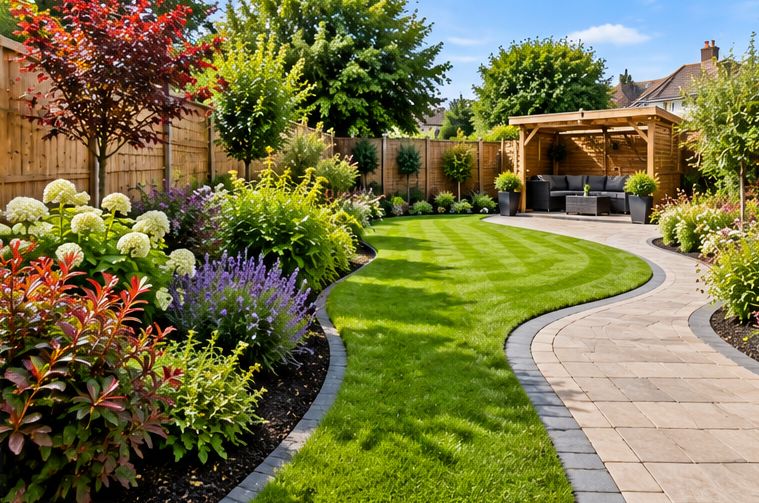
Ask anyone with a garden in Ebbw Vale about their lawn and the word "wet" comes up fast. The town sits high at the head of the Ebbw Fawr valley, where rain arrives often and the ground has less chance to dry between showers. Add slopes, heavy soils and some thin new-build topsoil, and it is no wonder so many plots squelch from autumn to spring.
This guide is about diagnosing the problem in your own garden and matching it to a fix. The general drainage methods are explained in our main guide, how to stop a garden waterlogging, so here we focus on what we tend to find in Ebbw Vale and how we approach it.
Four places the water comes from
Before choosing a drain, it pays to know which kind of water you are dealing with. In Ebbw Vale it is usually one of these, and often two at once.
- Rain that cannot soak in. Compacted or clay-rich soil holds rain at the surface. It is common where heavy machinery has driven over the ground during building work.
- Run-off from above. On the valley sides, water drains down from the hillside, the street or the garden next door and collects against your back wall or at the bottom of the lawn.
- Ground water. In a long wet spell the soil fills up from below, and low spots stay wet even when it has not rained for a day or two.
- Water from the house. Broken gutters, overflowing water butts and downpipes that empty onto the lawn can soak one corner of a garden on their own.
The last one is worth ruling out first because it is often the simplest to put right. Walk round the house in heavy rain and check every downpipe ends up somewhere sensible.
A simple test you can do yourself
Dig a hole about a spade deep in the wettest part of the garden and fill it with water. Come back after a few hours, and again the following morning. If it has drained away, the problem is mostly at the surface. If it is still sitting there, or water is seeping in from the sides, the ground itself is saturated and surface fixes will not be enough on their own.
Look at what comes out of the hole too. Grey or bluish sticky clay, a layer of hardcore just below the grass or a smell of stale water all tell us something. We do the same checks when we visit, and they shape everything we recommend.
What we find on the older streets
Ebbw Vale's older terraces climb the valley sides, so the typical back garden is narrow, stepped and fed by water from further up the slope. Old walls often have no drainage behind them, so water builds up and seeps through the face or pushes the wall out of line.
Here the answer is usually to intercept the water before it reaches the areas you use. A gravel-filled cut-off drain along the top of the garden, weep holes or a drain behind a retaining wall, and a patio laid with a fall to a channel at the bottom of the steps can transform a plot. If the garden needs levelling as well, our guide on making a sloping Ebbw Vale garden usable covers the terracing side.
What we find on newer estates
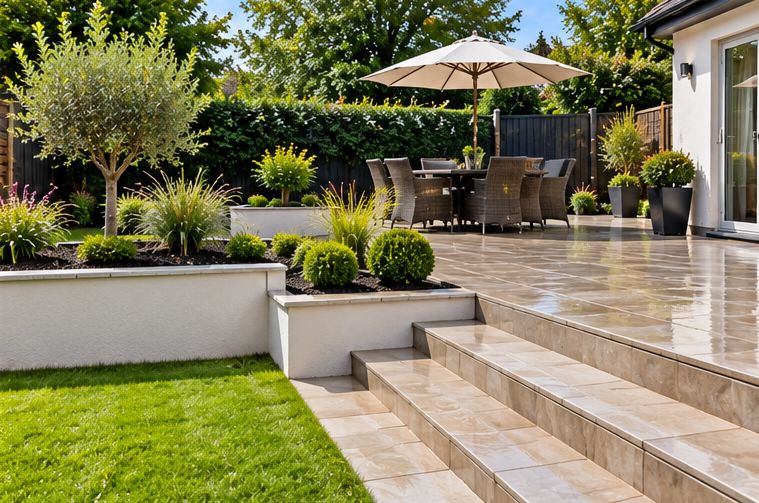
Homes built more recently, including those on and around the former steelworks site, tend to have flatter gardens. The common problem there is what lies underneath. A thin layer of topsoil can sit over compacted subsoil, clay or leftover building rubble, so rain has nowhere to go and the lawn turns to moss.
Sometimes the best fix is to lift the turf, break up the compacted layer, remove rubble, add good topsoil and relay. Where the subsoil is heavy clay, a network of land drains in gravel trenches may be needed to carry water to a suitable outfall.
Matching the fix to the problem
These are the approaches we use most in Ebbw Vale gardens, roughly from lightest to heaviest.
- Re-levelling so surfaces shed water towards a border, gravel strip or drain rather than the house.
- Soil improvement: breaking up compaction, removing rubble and adding topsoil and grit.
- Trench or French drains: gravel-filled trenches, often with a perforated pipe, along the low side of a lawn or path.
- Channel drains across the edge of a patio or driveway.
- Land drain networks under a lawn, running to a soakaway or an existing surface water drain.
- Raised beds and planting that lift what you grow above the wet, or use moisture-loving plants in a spot that will always be damp.
Where the water can go
Collecting water only helps if it has somewhere to end up. A soakaway works well in free-draining ground but can simply fill up and stay full in saturated upland clay, so we test before relying on one. Water must not be sent onto a neighbour's land, and rainwater should not go into the foul sewer.
If you plan to connect to an existing drain and are unsure what it is for, check with your water company or Blaenau Gwent council first. We are landscapers rather than drainage engineers, so for larger schemes or anything near a public sewer we will say when outside advice is needed.
Getting drainage right before other work
Drainage is not glamorous, but it protects everything built on top of it. We always sort the water before laying a new lawn or patio, because both fail quickly on waterlogged ground. For the wider picture of planning a garden around the rain and wind up here, see gardens that cope with Ebbw Vale’s upland weather.
If your garden is wet and you are not sure why, Tony and the team can come and take a look. Drainage is part of our landscaping and garden design work, and you can read about the rest of what we do locally on our Ebbw Vale page. Get in touch for free advice and a free quote.
Talk to T J Landscapes about your garden
Free quotes and honest advice across South Wales.
Questions People Ask
Why is my new-build garden in Ebbw Vale so wet?
Usually because the topsoil is thin and the ground beneath was compacted by machinery during building. Water cannot pass through it, so it sits at the surface. Breaking up the compacted layer and improving the soil often helps a great deal, with land drains added where the subsoil is heavy clay.
Will a soakaway work in my garden?
It depends on the ground. In free-draining soil, yes. In heavy clay or ground that is already saturated in winter, a soakaway can fill and stay full. We test how quickly water drains away before recommending one.
Can I just put gravel down instead of fixing the lawn?
Gravel or bark can be a sensible answer for a patch that will always be damp or shaded, as long as the base beneath it drains. On its own over compacted clay, gravel will still sit in water, so the ground usually needs some work first.
Water comes through my back wall from the garden above. What can be done?
That is a sign water is building up behind the wall. A drain behind it, weep holes or a cut-off drain higher up the slope can relieve the pressure. If the wall is bulging or leaning, it may need rebuilding, and a tall retaining wall may need engineering advice.
How long does drainage work take?
Small jobs such as a channel drain or a short trench can be done in a day or two. A full lawn drainage scheme with regrading and new turf takes longer. We will give you a clear idea of timing with your free quote.