
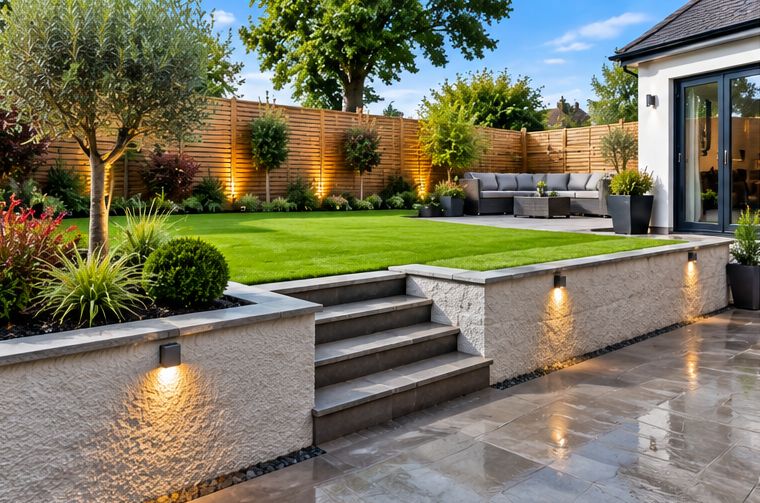
Ebbw Vale was built up the sides of the Ebbw Fawr valley, so a lot of its back gardens climb or drop away from the house. On the older terraced streets the plot is often a long, narrow strip with a few worn concrete steps and a bank of grass that nobody mows twice. On some of the newer estates the ground was shaped by the builder and then left, so a garden can have a sudden bank at the back that is too steep to use.
Add the extra rain and the colder, windier weather that comes with the altitude, and a slope in Ebbw Vale behaves differently from one lower down the valleys. This guide looks at how we approach these gardens. For an overview of the work we do in the town, see our landscaping in Ebbw Vale page, and for the general principles on any hillside plot, our guide to landscaping a sloping valleys garden.
Start with the list, not the slope
Before thinking about walls or sleepers, write down what you actually want to do outside. Most households in Ebbw Vale come up with a short list: a spot to sit with a brew when the sun does come out, somewhere for children or a dog, room to dry washing, and a tidy place for bins and a shed. A few want raised beds for vegetables.
Each of those needs a flat patch of a certain size. Once you know how many flat patches you need and roughly how big, the slope becomes a puzzle about where to put them, which is much easier to solve than a vague wish to “sort the garden out”.
Fewer, wider tiers work better up here
It is tempting to cut a steep garden into lots of thin steps. In practice, narrow terraces are fiddly to mow, hard to furnish and quick to get muddy along their edges. Two or three generous levels usually give a better garden than five mean ones.
On a typical terraced plot in Ebbw Vale we often see a sensible split: a paved level by the back door for bins and a small table, a middle level for lawn or play, and a top level for a shed, a greenhouse or planting. The heights between them decide what holds each one up, which our guide to retaining walls for Ebbw Vale hillside gardens covers in detail.
- Lower tier: hard-wearing and close to the house, so it gets used even on grey days.
- Middle tier: lawn, artificial grass or gravel, depending on how wet the ground is.
- Upper tier: often the sunniest spot and the best place for a bench with a view down the valley.
Steps that are safe when they are wet
In a town that sees as much rain as Ebbw Vale, the steps between levels get wet more often than they are dry. Smooth slabs, painted concrete and timber treads that sit in shade all turn slippery. We use textured paving, brick or stone treads with a slight fall so water runs off, and we keep each rise the same height so nobody misjudges a step in poor light.
Where a slope is long, a landing halfway up gives you somewhere to pause with a full basket or a mower. A handrail is worth fitting on anything more than a few steps, and low lighting along the edges helps on dark winter evenings. Our general guide to garden steps in brick and stone explains how the rise and going are worked out.
Catching the water between levels
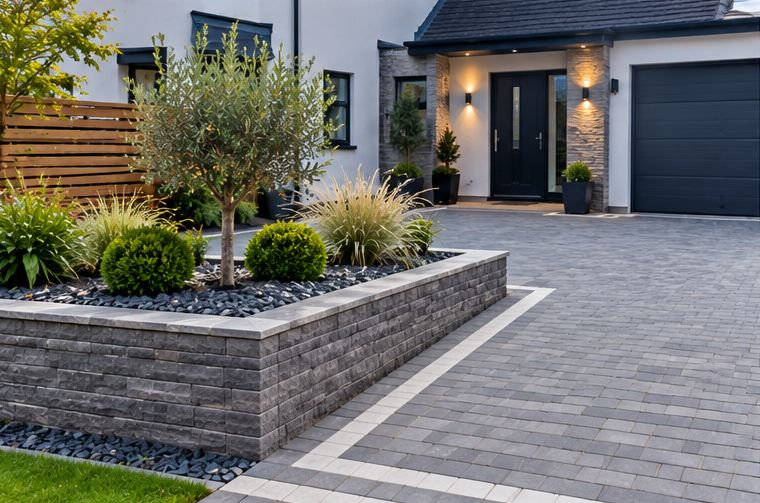
Rain falling on a sloping garden does not stay where it lands. It runs down the surface, soaks through the soil and comes out at the next wall or the back of the house. On the higher, wetter ground around Ebbw Vale this can be a lot of water, and it is the main reason we see bulging walls and patios that stay green with algae.
Each tier should have a slight fall and somewhere for water to go: a gravel strip at the foot of a wall, a drain at the back of a patio, or a trench drain at the low edge of a lawn. Walls get free-draining stone behind them and weep holes to let water out. If your garden already has wet patches, our guide to drainage for wet gardens in Ebbw Vale is a good place to start.
Finding shelter on an exposed slope
The higher parts of a sloping plot tend to catch the best light and the worst wind. A bench at the top may have a fine view across the hillside, but it will not be used if the wind cuts straight through it. A low wall, a hedge or a slatted screen on the windward side can make that spot comfortable without blocking the outlook.
Planting helps too. Tough shrubs and grasses on the banks between tiers slow the wind, hold the soil and mean fewer awkward strips of grass to mow. Bark or gravel between plants keeps weeds down and stops soil washing onto the path below in heavy rain.
Access and the order of work
Many Ebbw Vale terraces have no side access, so everything comes through the house or along a rear lane. That affects how materials arrive and how spoil leaves, and it shapes the order we build in. Usually we clear the plot first, set out the levels, build the retaining, put in drainage, then lay steps and paths so the site is safe to work on before the finishing surfaces go down.
If the garden is badly overgrown to start with, a proper clearance comes first; see garden clearance for Ebbw Vale homes. You can read more about how a whole project runs on our landscaping and garden design page.
Getting a plan for your garden
You do not need drawings. Photos of the garden from the top and bottom, a note of anything that already floods or moves, and your list of what you want to use the space for are plenty. Tony and the team will walk the slope with you, suggest where the levels should go and give you a free quote. Use the enquiry form to get in touch.
Talk to T J Landscapes about your garden
Free quotes and honest advice across South Wales.
Questions People Ask
Is it worth levelling a very steep Ebbw Vale garden?
Almost always, as long as the levels are chosen sensibly. Even one good flat area near the house changes how often a garden gets used. We will tell you honestly if a part of the slope is better left as a planted bank.
Can I use sleepers instead of walls?
For low level changes, timber sleepers are a good choice and quick to build. For taller drops, or where the ground is very wet, masonry lasts longer. Many gardens use both.
Would decking be easier than digging out a level?
Sometimes. A deck on posts can create a flat area over a slope without moving much soil, but in the damp at this altitude it needs good airflow and grip. Our guide to decking or paving for an Ebbw Vale garden compares the two.
What affects the cost of terracing a slope?
The height of the fall, how much soil has to move and where it goes, the type of retaining, drainage, the finishes you choose and access to the garden. We explain all of this in a free quote after seeing the site.
Do I need permission to change my garden levels?
Ordinary terracing usually does not, but raised platforms near a boundary, tall walls by a road or work affecting a neighbour can raise questions. We are landscapers, not planners, so check with Blaenau Gwent council if you are unsure.