
Look along the back of almost any row of houses in Pontypridd and you will see boundaries that rise and fall with the valley side. Some climb steadily from the house to a rear lane, some drop in a series of old walls, and many tilt sideways because the next garden sits higher or lower than yours. A fence that looks fine in a catalogue can end up with gaps, leaning posts or a line that zigzags awkwardly once it meets that ground.
This guide covers the choices that matter on a sloping boundary. For fence types in general, our guide to close board, panel or slatted fencing is the place to start, and our fencing and gates page shows the full range of work.
Two ways to meet a slope
There are really only two approaches, and most Pontypridd boundaries suit one better than the other.
- Stepped: each panel sits level, and the fence drops or climbs in even steps from post to post. It works with ready-made panels and looks tidy on a steady, gentle slope. The catch is the triangle of open space under each panel on the downhill side, which has to be filled.
- Raked: the rails run parallel to the ground and the boards stand upright, so the top of the fence follows the hill in a smooth line. Closeboard built on site is ideal for this, and it copes well with slopes that change angle partway along.
On a boundary with a short, sharp rise, a mix of the two can work: raked through the steep part, stepped where the ground eases off.
Closing the gaps at the bottom
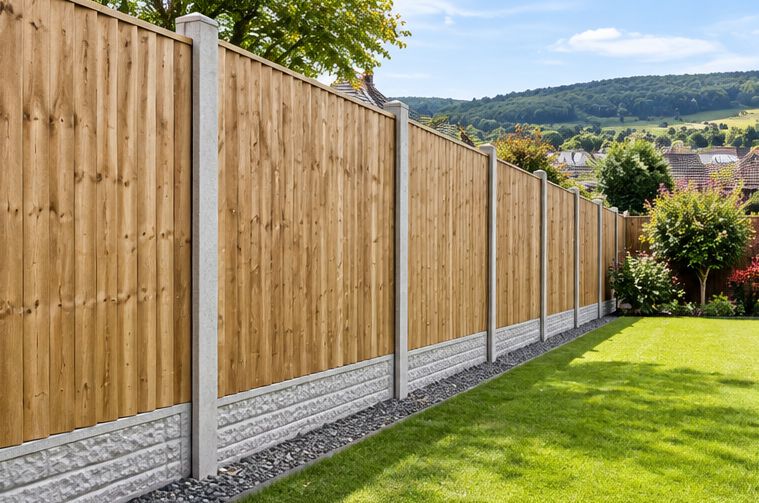
With stepped panels, the gaps beneath need dealing with or pets and weeds will find their way through. Gravel boards are the neat answer. On a steeper run, two gravel boards can be stacked, or the ground can be shaped with a small retaining edge so the soil does not wash out under the fence.
Concrete gravel boards last well in wet ground, which suits Pontypridd, where boundaries at the foot of a bank can stay damp for months. Timber boards look softer but should be treated and kept clear of soil where possible.
Where a garden next door sits noticeably higher than yours, the soil on their side may be banked right up against the fence. Timber was never meant to hold back earth, and boards in constant contact with wet soil soften and bow. In that situation we would usually suggest a low retaining edge or wall along the line first, with the fence fixed above it, so the fence only has to deal with wind and not the weight of the ground.
Posts that stay upright on a bank
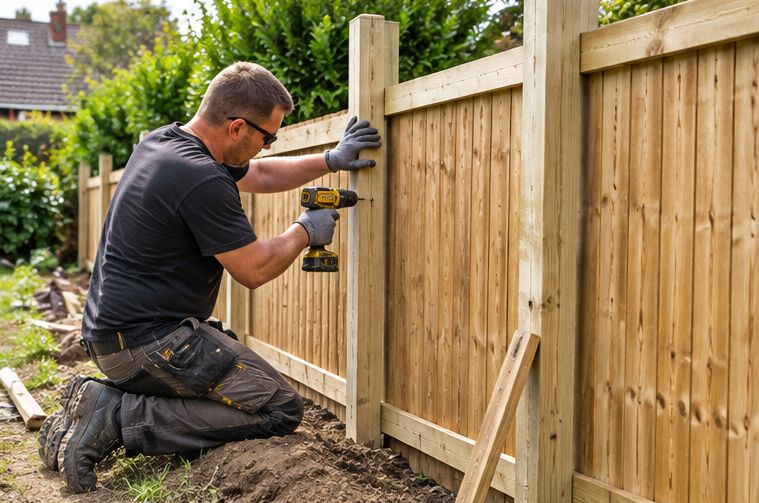
Loose soil on a slope gives a post less to push against, and wind on a hillside is often stronger than in the valley bottom. That means deeper holes, a generous collar of concrete and posts spaced so that no panel catches too much wind. On the downhill side of a post the ground falls away, so we set the hole deeper there to keep enough depth all round.
Concrete posts are a popular choice here because they will not rot, while timber posts are easier to cut to varying heights along a slope. Our guide to concrete or timber posts weighs the two up.
Fences on top of retaining walls
In a terraced Pontypridd garden it is common for a fence to sit on a wall rather than on open ground. That is fine when it is planned, but a tall fence acts like a sail and puts extra load on the wall below, especially an old one that was only built to hold soil. Fixing posts to the top of a weak wall can loosen it over time.
We look at the wall first. A sound modern wall can often take brackets or posts set into its top; an older or bulging one may need repair, or the fence set back behind it in the soil. If the wall is doing a lot of work, our guide on retaining walls in Pontypridd explains when to rebuild rather than patch.
Height, privacy and the neighbours
On a hill, height is relative. A fence that is a sensible height on your side may look tall from the lower garden next door, and a house above you may see straight over it. Rather than simply going higher, it can be better to put a screen or trellis close to the seating area, where privacy actually matters.
Fence heights are controlled by planning rules, and the limits are usually lower next to a road or footpath than between back gardens. Check with Rhondda Cynon Taf Council before putting up anything tall, and talk to your neighbour before work starts on a shared boundary. It is also worth being clear about who owns the boundary, as deeds do not always say.
Rear lanes and gates
Many Pontypridd terraces have a lane behind them, and the gate onto it is often the main way in for bins, bikes and deliveries. On a slope, the gate has to be hung so it clears the ground as it swings, which may mean it opens outwards or has a raised threshold. Heavy gates need solid posts and good hinges, or they drop and drag within a season.
Our guide to choosing and fitting a garden gate goes through styles and fittings. A lockable gate is well worth it on a lane that sees passing traffic.
How we go about it
We walk the boundary with you, check levels along its length and look at any walls or old fences that are staying. Then we suggest stepped, raked or mixed, and the posts to suit. Old panels and concrete are taken away as part of the job, carried down the garden if there is no lane access. Details of our local fencing are on the fencing in Pontypridd page, and the rest of our work in the town is on the Pontypridd landscaping page.
Talk to T J Landscapes about your garden
Free quotes and honest advice across South Wales.
Questions People Ask
Can you use ordinary panels on a steep slope?
Yes, stepped, with gravel boards filling the gaps. On very steep or uneven ground, a raked closeboard fence usually looks neater and leaves fewer gaps to fill.
Will a fence make my old wall worse?
It can, if a tall fence is fixed to a weak wall. We check the wall before recommending anything and will say if it needs repair first.
Who is responsible for the fence between two gardens?
It depends on the deeds and any agreement between neighbours. We are not able to settle ownership questions, so check your paperwork or seek advice if it is unclear.
What affects the cost of fencing a sloping boundary?
The length, the steepness, the fence style, post type, whether walls need work first, old fencing to remove and access. Tony will give you a free quote after a visit.
How do I book a visit?
Fill in the contact form with a photo or two of the boundary and we will arrange a time.