
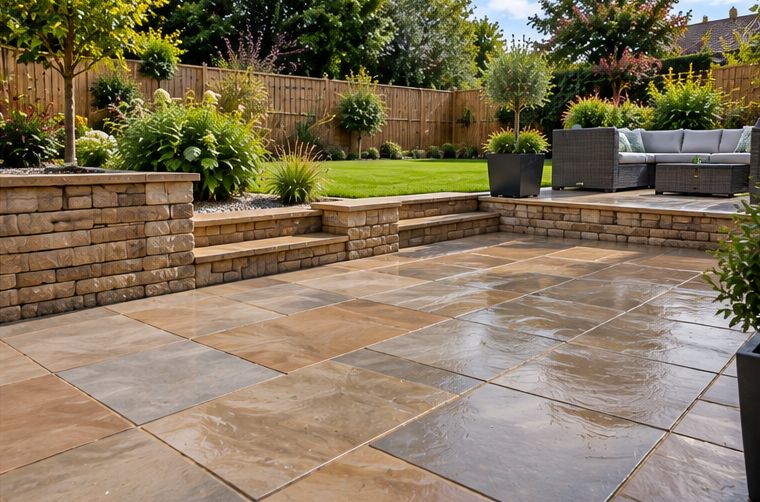
Pontypridd is built on hillsides. The terraces climb away from the rivers in every direction, and many back gardens rise or fall steeply from the house. That is why so many people in the town ask us the same question when they plan a patio, a lawn or a set of steps: do I actually need a retaining wall here, or can I get away without one?
This guide is about making that decision. It does not replace a proper look at the site, and it is not engineering advice, but it should help you understand what we are weighing up when we visit. For more on planning the whole garden, see our landscaping in Pontypridd page.
Three situations where a wall is usually the answer
In most Pontypridd gardens the need for a retaining wall comes from one of three things.
- You are cutting into the slope to make a flat patio or lawn. The dug face behind it will slump over time unless it is held.
- You are building up the lower part of the garden with soil to create a level. The raised edge needs holding in the same way.
- An existing bank is moving. Soil creeping onto a path, cracks opening at the top of a slope, or an old wall that has partly collapsed are all signs the ground is no longer stable on its own.
If none of those applies, and the slope is gentle and grassed or planted, a wall may not be needed at all.
When a bank or a row of sleepers will do
A gentle, well-planted bank can be perfectly stable. Roots bind the soil, and the slope sheds water without it building up behind anything. Where a change in level is small, a row of timber sleepers, a low stone edge or a single course of block is often enough to form a neat step between two tiers.
Sleepers suit a lot of Pontypridd gardens because they can be carried up steps easily and set without heavy machinery. They have a shorter life than masonry, and they are for low changes in level rather than tall ones. Our guide to terracing with sleepers explains how they are fixed. If you would rather plant the bank than build on it, see planting ideas for a sunny Pontypridd slope.
Why height changes everything
The pressure behind a retaining wall rises quickly as the wall gets taller, and faster still when the soil is soaked. A wall holding back a small step of soil is a garden job. A wall holding back the height of a person is a structure that has to be designed.
As a rough guide, the questions get more serious once a wall is retaining more than about knee height, or has anything above it: a path people walk on, a parked car, a shed, a building, or a neighbour’s garden. Walls like that may need a structural engineer’s design, and we will say so plainly if we think yours does. Our guide on when a retaining wall needs engineering advice sets out the usual signs.
The old stone walls behind the terraces
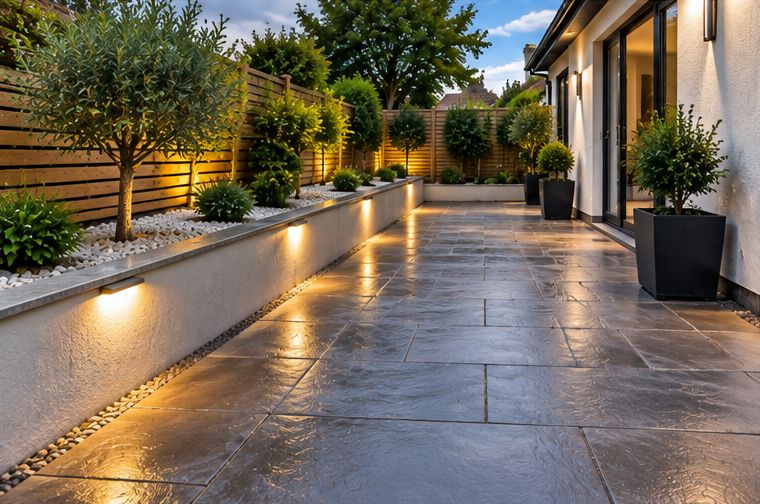
Many Pontypridd terraces already have retaining walls, often in the grey local stone the houses are built from. Plenty are still sound. Others have been loaded up over the years with raised beds, sheds and extra soil, or have lost their mortar and started to bulge.
If you are planning new work next to one of these walls, it is worth having it looked at first. Building a patio against the foot of an old wall, or piling more soil behind it, adds load it was never meant to carry. Sometimes the right answer is to repoint it, sometimes to rebuild a section on a proper footing, and sometimes to leave it alone and plan the new level a little further away.
Water coming down the hill
On a valley side, rain soaks into the hill above you and moves down through the ground. A wall with no way for that water to escape acts like a dam, and the pressure behind it can push it over in a wet winter. That is one of the main reasons old walls fail.
Any wall we build has free-draining stone behind it, a pipe at the base where needed, and weep holes to let water out. We also look for springs and wet patches further up the garden, which are common on Pontypridd hillsides, and deal with them before they reach the wall. Our guide on garden wall foundations covers the footing that goes underneath.
Permission, boundaries and neighbours
Most low garden retaining walls do not need permission, but that is not true of every wall. A wall beside a road or public path, a tall wall, or one that holds up a neighbour’s ground may need approval, and some properties have extra restrictions. Check with Rhondda Cynon Taf council before building, and talk to your neighbours early if the wall runs along a shared boundary.
Where ownership of an old boundary wall is unclear, or where party wall rules might apply, take advice from a surveyor or solicitor. We are landscapers, and we will build to whatever design and approvals are needed, but we are not the people to settle a legal question about a boundary.
Choosing what to build it from
Stone suits the older streets and sits well beside existing walls. Brick gives a crisp edge next to a patio and can be matched to the house. Concrete block, faced or rendered, is strong and practical for taller walls. We explain the options in person and in our guide to choosing bricks and coping.
Retaining walls usually go hand in hand with steps and a patio, so it pays to plan them together. Our guide to patio levels and steps for Pontypridd terraces shows how. You can see more of our wall building on the brickwork and garden walls page or on brickwork in Pontypridd, and arrange a free visit through the enquiry form.
Talk to T J Landscapes about your garden
Free quotes and honest advice across South Wales.
Questions People Ask
My garden slopes, but nothing is moving. Do I need a wall?
Not necessarily. A stable, planted slope can stay as it is. A wall usually comes in when you dig into the slope or build it up to create a level, or when the ground has started to move.
Can I build a retaining wall myself?
A very low edge of sleepers or stone is a manageable DIY job. Anything taller, or anything near a path, building or boundary, needs a proper footing and drainage, and often a design, so it is worth getting advice first.
My old wall is bulging. Is it dangerous?
It might be. Keep people, children and heavy loads away from it and have it looked at. A bulge usually means water or extra soil is pushing on it, and it can get worse quickly in wet weather.
What affects the cost of a retaining wall in Pontypridd?
The height and length, the material, how deep the footing has to go, drainage, how much soil moves, whether an old wall comes down first, and how easy it is to get materials up to the garden. We quote for free after a visit.
Can you put a fence on top of a retaining wall?
Often, if the wall is designed for the extra wind load. We plan the two together, as described in fencing steep boundaries in Pontypridd.