
The houses of Pontypridd climb away from the rivers on every side, so a flat back garden is the exception here. Some plots rise from the kitchen door in a long bank, some drop to a rear lane far below, and plenty of them slope across the width as well as down the length. Owners tend to live with this for years, using a small yard by the house and leaving the rest to grass and brambles.
This guide is about turning that slope into a garden you actually use. It covers what we look at first on a Pontypridd hillside, the decisions that shape the design and the order the work usually follows. For the wider picture of our work in the town, see landscaping in Pontypridd, and for general principles on any valley plot, our guide on how to landscape a sloping valleys garden.
Start by reading the hill, not the brochure
Before thinking about materials, spend a little time noticing how your garden behaves. Stand at the top and the bottom at different times of day. Where does the sun reach first, and where does it linger in the evening? Where does water run or sit after heavy rain? Which parts are overlooked by the houses above or below?
On the hills around Pontypridd the answers often surprise people. The highest part of a garden is frequently the sunniest and has the best outlook across the valley, while the yard by the house sits in shade for much of the day. That can turn the usual plan upside down, with the main seating area going at the top and the space by the back door kept for bins, storage and a path.
- Note the sunny spots in the morning, at midday and in the early evening.
- Mark any wet patches, springs or places where the soil slumps.
- Take a photo from each end, looking up and looking down.
- Measure roughly how far the ground rises or falls from the house to the far boundary.
Decide what the garden is for
A hillside can hold a lot, but not everything at once, because each flat area costs digging and walling. It helps to put your wishes in order. Somewhere to sit and eat outside is top of most lists in Pontypridd. After that it might be a patch of lawn for children, a place to grow vegetables, a shed, room to dry washing or simply a garden that needs very little looking after.
Once you know the priorities, we can match each one to a part of the slope. A lawn wants the widest level you can make. Raised beds cope happily with narrower terraces. Seating wants sun and a view. Storage can tuck into the shadiest corner. Getting this right on paper is far cheaper than moving things later.
Levels, walls and steps in outline
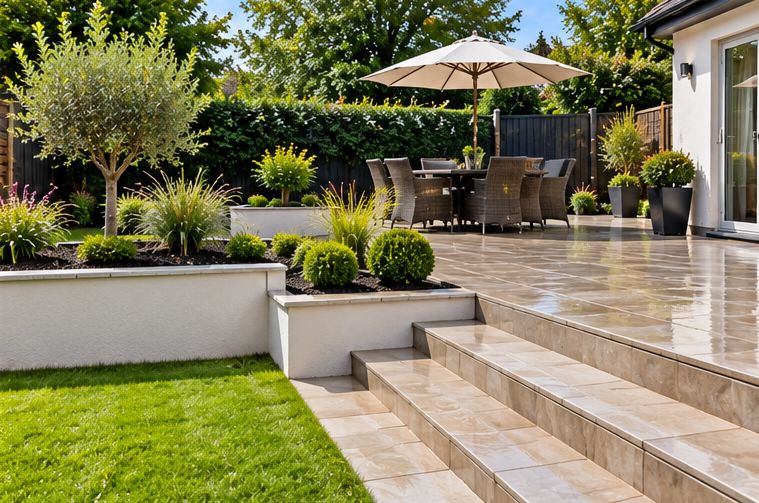
Most hillside gardens end up as a series of level spaces joined by steps, with a retaining wall or sleeper edge holding each change in height. We usually suggest fewer, deeper levels rather than many thin strips, because a narrow terrace is hard to furnish and harder to mow. The soil dug from one level can often build up the next, which keeps the number of bags going down the steps to a minimum.
We have written separately about the detail. Patio Levels and Steps for Pontypridd Terraces covers the area by the house and the flights between levels, and Retaining Walls in Pontypridd: When You Need One explains what holds each tier up. Where digging out would be a very big job, Decking to Level Out a Pontypridd Garden looks at building a level area over the slope instead.
Water on a valley side
Rain falls often in Rhondda Cynon Taf, and on a slope it keeps moving. It runs over the surface and through the soil until it meets something in its way, which on a newly terraced plot means the back of a wall or the edge of a patio. If it is not given a route, it softens foundations, stains paving and makes steps slippery.
The fixes are not complicated when they are planned from the start: free-draining stone behind walls, outlets at their base, paving laid with a gentle fall and, where water collects, a gully or soakaway. Our guide on how to stop a garden waterlogging sets out the options in more depth.
How materials get up (and down) the garden
Access shapes a Pontypridd project more than almost anything else. Many terraced houses have no side way, so everything goes through the house or comes in from a rear lane, and some gardens are reached only by a flight of old steps. Slabs, sleepers, stone and bags of sub-base are carried by hand or in small barrows, and waste goes out the same way.
We plan around this rather than being caught out by it, as we do on all our landscaping and garden design work. That can mean choosing materials that come in manageable sizes, building the lower levels last so there is still room to work, or clearing the garden first so there is space to stack deliveries. If the plot is heavily overgrown, our garden clearance visit is often the sensible first step.
Softening the slope with planting
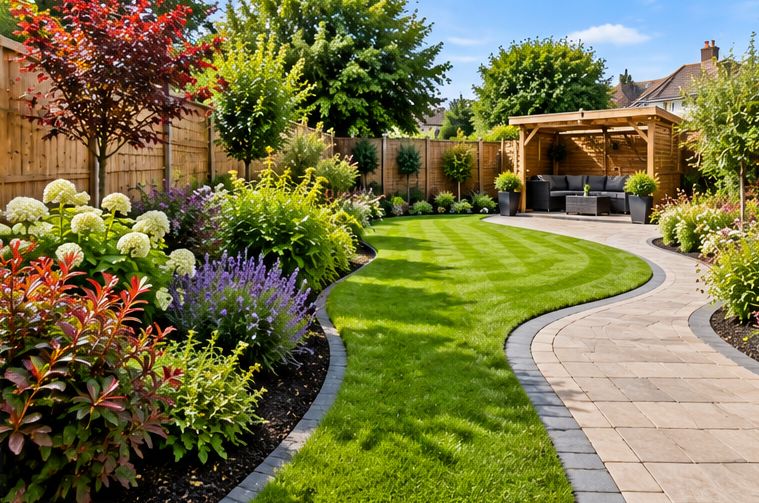
Hard landscaping gives the garden its shape, but planting is what makes a hillside feel settled. The banks and wall tops between levels are ideal for plants that trail, spread or knit the soil together, and they save you mowing a slope that is awkward to reach. On a sunny face, tough Mediterranean herbs and grasses do well; in shade, ferns and ground cover are more reliable.
We cover plant choices for warm, open slopes in Planting Ideas for a Sunny Pontypridd Slope. Bark mulch around new plants keeps weeds down and holds moisture while they establish.
The usual order of work
Every garden is different, but on a Pontypridd hillside the sequence tends to run like this:
- Clear the site and take away green waste and rubbish.
- Set out the levels with pegs and string lines so you can see the shape.
- Dig, build retaining walls and put in drainage behind them.
- Build the steps and paths between levels.
- Lay the patio, deck or other surfaces.
- Finish with turf, gravel, topsoil, planting and any lighting.
Talk to T J Landscapes about your garden
Free quotes and honest advice across South Wales.
Questions People Ask
Can a steep garden be done in stages?
Yes. We draw up the whole layout first so that each stage fits the next, then build the structural parts such as walls and steps before the finishes. Many Pontypridd owners spread the work over a couple of seasons this way.
What affects the cost of landscaping a slope?
The steepness, the number of levels, how much soil has to move or leave the site, wall heights, materials, drainage and how easy it is to get in. A free quote after a visit is the only reliable way to put these together for your garden.
Is it worth having a lawn on a hillside?
If you have space for a reasonably wide level, yes, and children and dogs will use it. On narrow terraces, gravel, planting or paving is usually easier to live with. Our turf laying page covers what a new lawn needs.
Do I need permission to reshape my garden?
Most garden landscaping does not, but tall retaining walls, big changes in ground level and work near a road or a neighbour's property can. If in doubt, ask Rhondda Cynon Taf Council before work starts.
How do we get started?
Send a few photos through the contact form, including the access, and Tony will arrange a visit to talk it through and give you a free quote.