
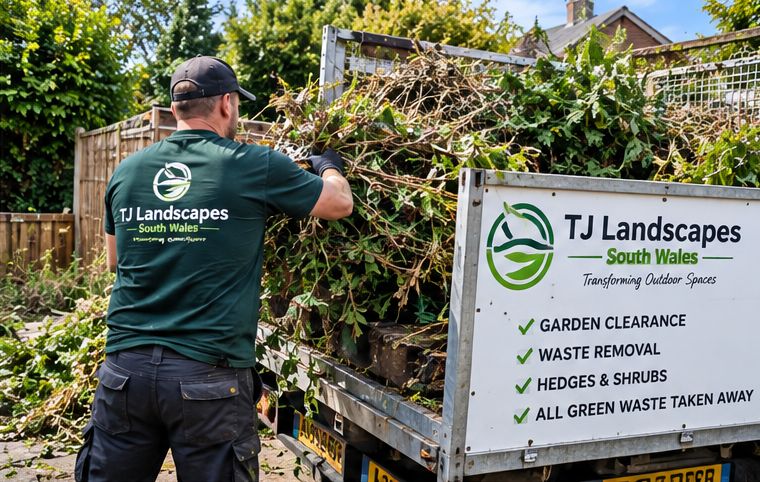
It is tempting to jump straight to the exciting part of a makeover: the patio, the new lawn, the planting. But almost every garden in Caerphilly has something that has to come out first. On an older semi it might be a cracked concrete patio, a rotten shed and a conifer screen that has taken over. On a newer estate home it might be failing turf, a pile of builders' leftovers behind the fence and a row of shrubs that never suited the space.
Clearing properly before the build means you see the real garden, with its true levels and soil, and it stops problems being buried under new work. This guide explains how we approach a pre-makeover clearance in Caerphilly. For the service itself, see our garden clearance page.
Decide what stays before anything goes
A clearance is easier to reverse in your head than on the ground. Before we start, we walk the garden with you and agree what is staying. It is surprising how often a mature shrub, a good bit of old wall or some reclaimable slabs turn out to be worth keeping once the clutter around them has gone.
- Trees and shrubs you want to keep, and any that need pruning rather than removing.
- Paving, bricks or edging that could be cleaned and reused.
- Plants you would like lifted and potted to replant later.
- Anything belonging to a neighbour, such as a shared fence or a tree on the boundary.
If you have not settled on a design yet, our guide to garden landscaping ideas for Caerphilly semis may help you decide what the new layout needs before anything is taken away.
What usually comes out of an older semi
Gardens behind the interwar and post-war semis in Caerphilly have often been added to by several owners over the years. Layers build up: a concrete path laid over an older one, a greenhouse base nobody uses, a shed on a slab, an old coal bunker and a conifer row that shades half the lawn.
Breaking out old concrete and hauling away sheds is heavy work, and it is where most of the waste comes from. Tall conifers and overgrown trees are best dealt with at the start too, because felling or reducing them after a new lawn goes down risks damaging it. Our tree pruning guide for Caerphilly gardens explains how we decide between pruning and removal.
What usually comes out of a newer estate garden
On a new-build plot there is less to demolish but often more to dig up. Failing turf is lifted, and the ground beneath is checked for compaction, clay and buried debris. It is common to find pieces of brick, concrete, plastic sheeting and packaging a few inches under the surface. All of it needs to come out before new soil and turf go down.
We cover what tends to be hiding in these gardens in What Lies Under a New-Build Garden in Caerphilly. Clearing and checking the ground at this stage is what makes the difference between a lawn that thrives and one that goes bald again in its second summer.
The order of work
A good clearance follows the same logic as the build that comes after it. Working from the top down and from the back of the garden forwards keeps the site tidy and stops cleared areas being walked back over.
- Tree and hedge work first, so branches and logs are not dropped onto cleared ground.
- Sheds, greenhouses and outbuildings next, including their bases.
- Old paving, concrete and paths broken out and removed.
- Weeds, brambles and unwanted shrubs dug out, roots and all where possible.
- Turf lifted and debris picked out of the soil.
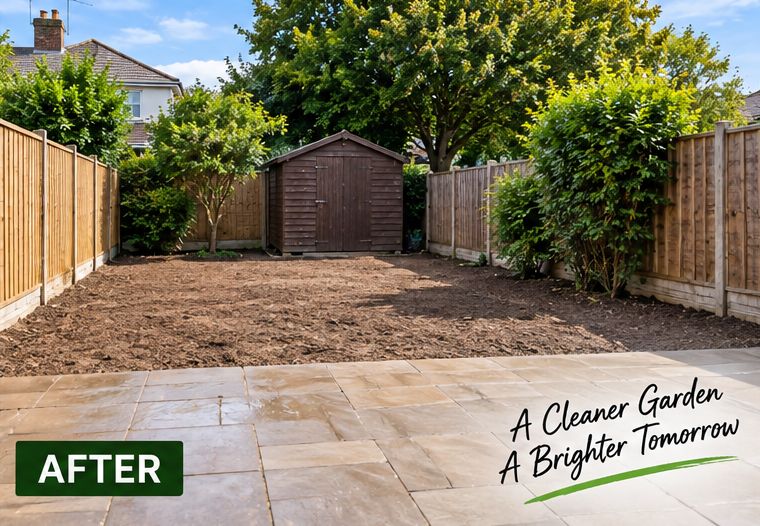
- A final tidy so the levels and ground are clear to see.
Leaving the garden in this state means we, or you, can set out the new design accurately. Shed clearances have their own points to watch, which we go through in shed and outbuilding clearance.
Access, parking and waste
In Caerphilly, most back gardens are reached down the side of a semi or through a side gate on an estate home. That shapes how the waste gets out. A narrow side path means barrowing everything to the front, and a wide drive gives space for a trailer or skip. If a skip has to go on the road, it needs a permit from the council, which is worth arranging early.
Green waste, rubble, timber and general rubbish are kept separate so as much as possible can be recycled or composted. Some things, such as asbestos, paint, chemicals and gas bottles, cannot go in a normal garden clearance and need to be dealt with separately. Our guide what can and cannot go in a garden clearance lists the usual exceptions, and garden waste: where it goes explains what happens to it after it leaves.
Timing the clearance
Clearance can be done at almost any time of year, but a few things are worth bearing in mind. Hedges and shrubs should be checked for nesting birds in spring and summer, and cutting waits if birds are nesting. Heavy clay ground is best not churned up in the wettest weeks, as it compacts easily. And if you are replacing a lawn, clearing in late summer or early autumn sets you up nicely for turfing while the soil is still warm.
It usually makes sense for the clearance to run straight into the build, so the ground is not left open to the weather. We can plan both together.
Getting started
What shapes the quote for a clearance is the amount of material, how much of it is hard waste such as concrete, how easy it is to get it out to the road, and whether any tree work is involved. Tony and the team can clear the garden and carry on with the patio, lawn, fencing or planting afterwards, which keeps everything in one plan. See our garden clearance in Caerphilly page and our Caerphilly landscaping page for more, or send us a message with a few photos for free advice and a free quote.
Talk to T J Landscapes about your garden
Free quotes and honest advice across South Wales.
Questions People Ask
Do I need to clear the garden before you quote for a Caerphilly makeover?
No. It is better if you do not, because we can see what is there and price the clearance and the build together. Just tell us what you would like to keep.
Can you break out an old concrete patio?
Yes. Breaking out and removing old concrete, slabs and bases is a regular part of our clearance work, and the ground underneath is then prepared for whatever comes next.
Do you take the waste away?
Yes. We take green waste, rubble and general garden rubbish away and sort it so as much as possible can be recycled or composted. Hazardous items such as asbestos need to be handled separately.
Can you reuse anything from the old garden?
Often. Sound slabs, bricks and stone can be cleaned and used for edging, paths or raised beds, and some plants can be lifted and replanted. We will point out anything worth saving.
How long does a clearance take?
It depends on the size of the garden, the amount of hard waste and the access. We can give you a realistic idea once we have seen it.