
It is one of the first things people ask when we visit, and a fair question. You may have a holiday, a party or a new baby to plan around, or you just want to know how long the side passage will be full of sand. The honest answer is that it depends, but the things it depends on are fairly predictable.
This guide breaks a typical landscaping job into its stages, gives rough ideas of how long each tends to take, and explains why a job in the city often runs differently from one in a village with a wide drive. Every garden is different, so treat the timings as a guide rather than a promise. For the wider picture of our work in the capital, see our Cardiff landscaping page.
Before any work starts
The clock starts well before the first spade goes in. After an enquiry, we visit to see the garden, talk through ideas and measure up. A written quote follows. For a straightforward job that can be quick. For a full redesign, there may be a bit of back and forth while you settle on materials and layout.
Then there is the diary. Like most landscapers, we are usually booked some weeks ahead, and spring and early summer are the busiest times. If you want a garden ready for a date in summer, it helps to get in touch in winter or early spring.
Some jobs have their own lead time. Tree work in a conservation area normally needs six weeks' notice to the council, as our guide to tree work in Cardiff conservation areas explains. A new driveway may need a dropped kerb or planning permission first; see should a Cardiff front garden become a driveway? for what to check.
Rough timings for common jobs
These are typical ranges for an average-sized garden with reasonable access, working in fair weather. A tight terrace garden with everything carried through the house can take noticeably longer.
- Garden clearance: often a day for a small yard, two or three for a large, overgrown plot.
- New fence along one boundary: commonly one to two days.
- Turfing a prepared lawn: the laying is quick; preparation is where the time goes, often a day or two in all.
- A patio: usually several days to a week or more, depending on size, levels and the stone chosen.
- A deck: typically a few days for a simple ground-level deck, longer for raised decking with steps.
- Garden walls and raised beds: brickwork takes time to lay and set, so allow several days for anything substantial.
- A full makeover: combining several of these, often two to four weeks, sometimes more.
Why access matters so much in the city
In many Cardiff terraces there is no side passage and the rear lane, if there is one, is too narrow or too busy for a van. Every bag of sand, every slab and every barrow of soil comes through the front door and out the back. Doing that carefully, with floors protected, adds real time.
Parking is the other factor. Much of inner Cardiff has permit parking or double yellow lines, and bulk deliveries cannot always be dropped outside the house. Materials may need to be brought in smaller loads, and a skip on the road needs a council permit. We plan these things before starting so they do not hold up the work.
Out in the suburbs, with side access and a drive, the same job can move faster simply because a mini digger or a dumper can get in.
The order a full makeover usually follows
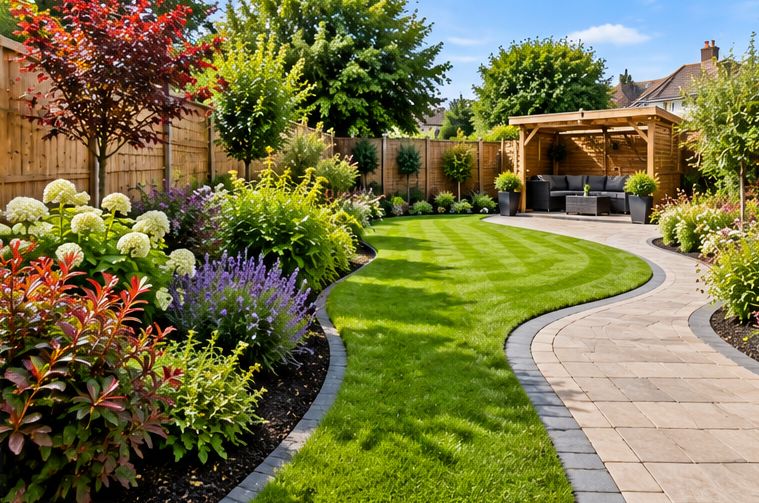
Most bigger jobs go through the same broad stages. Knowing them helps you understand where the time goes and when the garden is at its messiest.
- Clear and strip: old paving, turf, sheds and plants come out, and waste goes away.
- Groundwork: digging out, levelling, and putting in drainage where needed.
- Structures: walls, steps, raised beds and fence posts, which need time to set before loading.
- Surfaces: patio, paths, decking and edging.
- Soft landscaping: topsoil, turf, planting, bark and finishing touches such as lighting.
- Clean up: jet washing, sweeping and a final walk round with you.
Our home guide to what affects the cost of garden landscaping covers many of the same factors, since time and cost tend to move together.
Weather and the time of year
Cardiff is milder than the valleys but still wet, and rain affects some stages more than others. Digging clay in a downpour, laying patio bedding on waterlogged ground or pointing joints before a storm all risk a poor result, so on those days we may switch to other tasks or stop. Frost stops mortar work altogether.
Late spring through early autumn gives the steadiest progress, and it is also the best time for planting and turfing. Winter works well for clearance, fencing and some groundwork, which can then be followed by paving and planting as the weather improves. For lawn timing, see the best time to lay turf in South Wales.
Surprises that can add time
Most jobs run to plan, but older city gardens can hide things. Lifting a concrete yard behind a Victorian terrace sometimes reveals old drains, buried rubble or foundations of long-gone outbuildings. A wall that looked sound may turn out to need rebuilding once the ivy is off. When something like that turns up, we stop, show you, and agree what to do before carrying on.
How to keep your makeover on track
Decide on materials early, because a change of paving halfway through can mean waiting for a new delivery. Let neighbours know when work is starting, especially if a shared lane will be busy. Clear the route through the house of rugs and furniture on the first morning. And ask us anything as the job goes along.
If you are planning a smaller space, our guides to making the most of a small Cardiff terrace garden and raised beds and planters are good places to start. When you are ready, Tony and the team can visit and give you a free quote with a realistic idea of timings, and you can see what other customers have said on our reviews page.
Talk to T J Landscapes about your garden
Free quotes and honest advice across South Wales.
Questions People Ask
Do I need to be at home while the work is done?
Not all the time. If materials come through the house we need access each day, so many people leave a key. We will want to walk round with you at the start and the end.
Will I be able to use the garden during the work?
Usually only in part. During groundwork it is a building site. On longer jobs we try to finish one area before starting the next so you have some usable space.
Can you work on my Cardiff garden in winter?
Yes, for many jobs. Clearance, fencing and some groundwork carry on through winter. Mortar work stops in frost, and turfing and planting are better timed for milder months.
What happens if it rains for a week?
We work around it where we can and let you know if the finish date moves. Rushing paving or pointing in the wet leads to problems later, so a short delay is the better option.
How far ahead should I book?
Several weeks is sensible, and more for spring and summer. Get in touch early if you have a date in mind.