
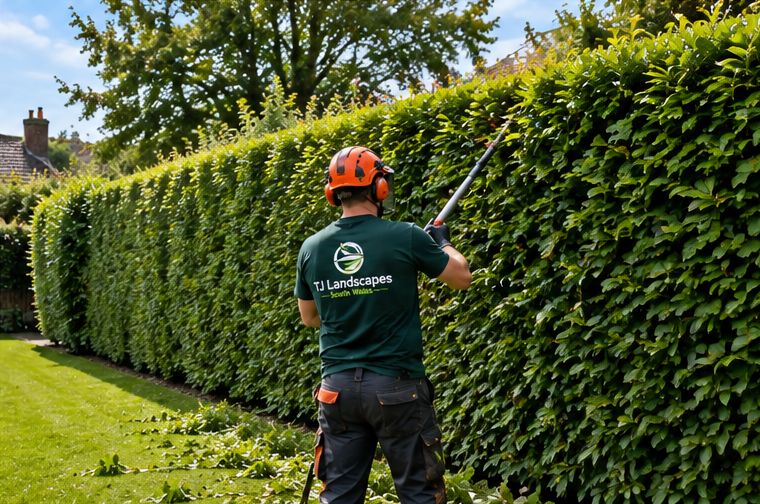
Because so many Pontypridd gardens rise steeply behind the house, trees at the top of the plot sit higher than the roof line. A sycamore that would be a pleasant size in a flat garden can block the light from every window at the back, drop leaves into the gutters and push against the old walls that hold the garden up.
This guide looks at the tree work we are asked to do most often in Pontypridd, how we decide between pruning and felling, and what is involved on a steep terrace. It links to our general guides where they cover the details. For the rest of our work in the town, see landscaping in Pontypridd.
The trees we are usually asked about
Most of the trees we see in Pontypridd gardens were never planted on purpose. The banks at the top of long terrace gardens, and the strips of land along back lanes, are good at growing self-seeded trees, and a few years of neglect is all it takes.
- Sycamore and ash that have seeded into banks, walls and corners and are now much taller than anyone expected.
- Conifers and fast hedging planted as screens that have outgrown the space.
- Fruit trees and ornamental trees that need shaping rather than removing.
- Trees growing out of old walls, where the roots are prising the stones apart.
Pruning first, where it makes sense
Plenty of trees do not need to come down. Crown lifting removes the lower branches so light gets under the canopy and you can walk beneath it. Thinning takes out some of the inner growth so the tree lets more light through and catches less wind. A reduction brings the overall size down while keeping a natural shape.
On a terrace where the tree sits above the house, even a modest crown lift or thin can make a noticeable difference to how bright the kitchen feels. Our guide to crown lifting, thinning and reduction explains each one, and when trees should be pruned covers timing.
When felling is the better choice
Sometimes a tree is simply in the wrong place. A sycamore growing out of the foot of a retaining wall, a tree whose roots are lifting a path, or a conifer that has been topped so many times it has lost its shape are all cases where removal can be the honest advice.
Ash dieback has also affected a lot of ash trees across Wales, and a badly affected ash near a house, path or boundary may need to come down before it becomes brittle. We look at the tree, what is around it and what you want from the garden, and explain our reasons. Our guide on tree felling or pruning goes through the decision.
Where a tree has been holding a bank together, we also think about what happens after it goes. The stump and roots can often be left in the ground to keep the soil stable, and the bank may need planting or a low wall. Our guide to retaining walls in Pontypridd covers that side.
Working on a steep terrace
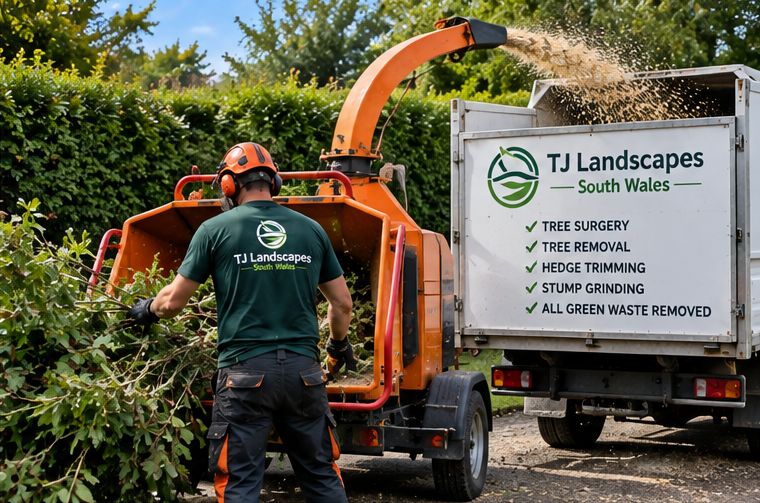
In a flat garden, a tree can sometimes be dropped in one piece. On a Pontypridd hillside that is rarely possible. There are houses below, walls and greenhouses close by, and the ground itself is uneven, so most trees are taken down in sections, with larger pieces lowered on ropes rather than dropped.
The waste then has to get out. If there is no room for a chipper at the top of the garden, branches are cut to a size that can be carried down the steps or along the lane. We plan all of this when we visit, which is why photos of the access help so much. Our guide to what happens on the day a tree surgeon visits describes a typical day.
Check before any cutting starts
Some trees are protected by a Tree Preservation Order, and trees in a conservation area usually need notice given to the council before work. Before any significant work, check with Rhondda Cynon Taf council whether your tree is protected. We will remind you, but the check has to be made before we start.
Nesting birds are protected by law, so trees and hedges should be checked before cutting in spring and summer, and work may need to wait. Our guide on permission to cut down a tree in Wales explains the main points in general terms.
Overhanging branches and shared boundaries
On close-packed terraces, a tree in one garden often hangs over two or three others. The usual approach is to talk to the owner first. Branches that cross the boundary can generally be cut back to the line, but it is courteous, and wiser, to agree it with your neighbour before anything is done, and to offer back what is cut.
If the tree is on land owned by the council or another body, contact them rather than cutting it yourself.
Hedges between terraces raise the same questions. A tall conifer screen on the uphill side of a boundary can cast a long shadow over the garden below, and regular trimming is much easier than a hard cut back once it has got away. Our guide to hedge trimming covers how often and when.
Taking it all away
We remove branches, logs and green waste as part of the job, unless you want to keep some logs. Where a tree has been cleared from an overgrown bank, it often makes sense to deal with the brambles and ivy at the same time. Our guide to garden clearance for Pontypridd houses covers that, and our tree surgery and hedge care page, and tree surgery in Pontypridd, describe the rest of our tree work. For a free visit and quote, use the enquiry form.
Talk to T J Landscapes about your garden
Free quotes and honest advice across South Wales.
Questions People Ask
Can you prune a tree that sits at the top of a steep garden?
Yes. We climb or use access equipment suited to the site, and plan how the cut material comes down safely. Access is the main thing we look at when we visit a Pontypridd hillside garden.
Will taking a tree out make my bank unstable?
It can, if the roots were holding the soil. We often leave the stump in place, and we will tell you if the bank needs planting or a wall afterwards.
When is the best time for tree work?
Many trees are best pruned in late autumn or winter, when they are dormant and birds are not nesting, though some species are better done at other times. We will advise on your tree.
What affects the cost of tree work?
The size of the tree, where it stands, what is below it, how it has to be taken down, how far the waste has to be carried and whether the stump stays. We give a free quote after seeing it.
Can a tree growing out of an old wall be saved?
Occasionally, if it is small. Usually the roots will keep widening the gaps, so the kinder long-term answer for the wall is to remove the tree and repair the stonework.