
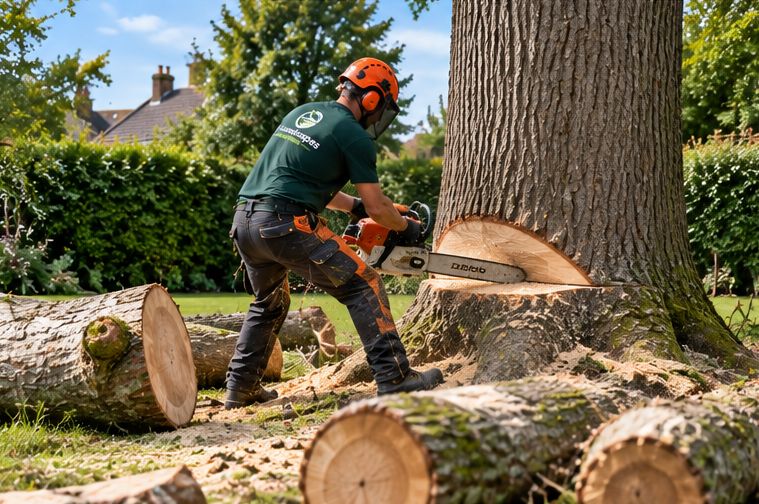
Walk along almost any older road in Penarth and you will see them: sycamores, limes, beeches and pines, planted when the Victorian and Edwardian villas were new and now towering over the roofs. They give privacy, shade and, on the more exposed streets, real shelter from the wind off the Channel. They also block light, drop leaves into gutters, crowd out lawns and worry neighbours when a gale is forecast.
The good news is that most problems with a big tree can be eased by careful pruning rather than felling. The part that trips people up in Penarth is what they are allowed to do, because parts of the town’s older housing sit in conservation areas and some individual trees carry preservation orders. This guide sets out the checks, then the kinds of work that tend to suit large trees near the coast. It is general guidance only: we are landscapers and tree workers, not planners or solicitors.
First check: is the tree protected?
Two things can put a garden tree under the council’s control. A Tree Preservation Order protects a named tree or group, and normally means you need written consent before pruning as well as felling. A conservation area protects most trees above a small size within its boundary, and usually means giving the council written notice before work so it can decide whether to protect the tree. In Penarth the authority for both is the Vale of Glamorgan Council.
You cannot tell from looking at a tree whether either applies, and conservation area boundaries do not always follow the obvious streets. The council can confirm for your address. Our general guide, do you need permission to cut down a tree in Wales?, explains the rules in more depth, including felling licences and the narrow exceptions for dead or dangerous trees.
Second check: birds, bats and timing
Whatever the council says, wild birds and their active nests are protected by law in every garden, so heavy pruning is best planned outside the main nesting season. Late autumn and winter suit most large deciduous trees anyway: the leaves are off, we can see the structure clearly, and there is less stress on the tree. Our guide on when trees should be pruned covers the exceptions, such as species that bleed sap if cut at the wrong time.
Old trees with hollows, cracks or loose bark can also hold bat roosts, and bats are protected too. If there is any sign of them, work stops until advice has been taken.
Pruning that keeps the shelter
On a windy Penarth plot, a big tree is often doing a useful job. Taking it right back can expose the garden, the house and the neighbours’ fences to the full force of the wind. It can also leave the tree weaker: heavy cuts on an old tree invite decay, and the fast regrowth that follows is often more brittle than the original branches. That is why we do not recommend topping.
The more useful options are usually lighter ones, explained in detail in crown lifting, thinning and reduction explained:
- Crown lifting removes lower branches to let light under the tree and clear paths, lawns and roofs, while leaving the upper canopy to break the wind.
- Crown thinning takes out a proportion of the smaller inner branches so wind passes through more easily, which can reduce the strain on a tree in a gale without changing its outline much.
- Crown reduction shortens the longest branches back to suitable side growth, bringing the overall size down in a balanced way.
- Deadwood removal takes out dead and broken branches that could fall, which is often the first priority on an old tree.
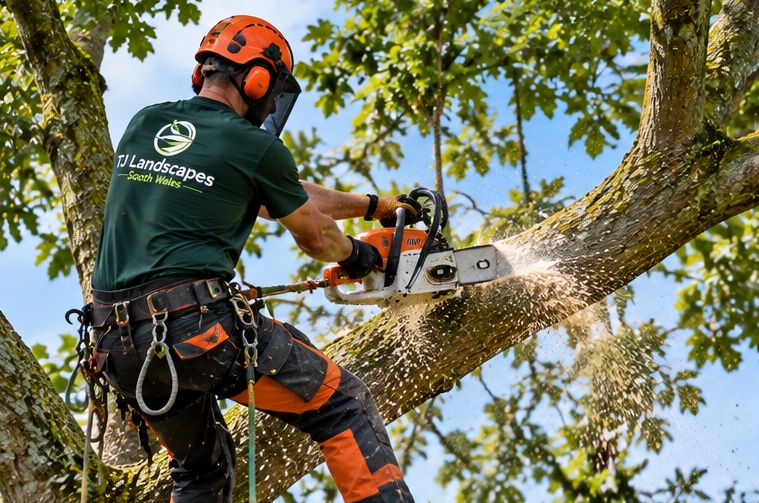
Trees that lean away from the sea
Coastal trees grow to the conditions. On exposed plots you often see a crown that is thinner and shorter on the seaward side, with most of the growth pushed inland. That shape is the tree’s own response to the wind and is not usually a problem in itself. What we look for is anything that has changed: a new lean, cracks where big limbs join the trunk, lifting soil at the base, fungus at the roots or large dead branches in the crown.
Where a tree looks lopsided, a careful reduction on the heavy side can rebalance it. Where there are signs of real structural trouble, felling may be the safer choice, and our guide on tree felling or pruning explains how we weigh that up.
Old walls and next door
Big trees in Penarth often stand close to old garden walls, and roots and trunks can push brick and stone out of line over the years. If a wall is leaning near a tree, it is worth sorting the tree and the wall together; our guide on restoring an Edwardian garden wall in Penarth covers the masonry side.
Where branches overhang from next door, you can generally cut them back to the boundary, but a preservation order or conservation area still applies to your neighbour’s tree. Talking to them first avoids a lot of bad feeling, and many people are glad to share the job.
What a visit from us involves
Tony will look at the tree from the ground, talk through what you want to achieve, and suggest the lightest work that will do it. If a check with the council is needed, we will say so and wait until it is done. On the day, we set up around your garden, lower heavy limbs carefully rather than dropping them onto borders and paths, and take the cuttings away. What happens on the day a tree surgeon visits explains it step by step.
You can see the range of work on our tree surgery and hedge care page, and how tree work fits into a bigger plan on our landscaping in Penarth page.
Talk to T J Landscapes about your garden
Free quotes and honest advice across South Wales.
Questions People Ask
How do I find out if my Penarth tree has a preservation order?
Ask the Vale of Glamorgan Council. They can confirm whether the tree has an order and whether your address is inside a conservation area. Do this before booking any work.
Can I just cut a big sycamore back hard to make it smaller?
Heavy topping is not something we recommend. It tends to weaken the tree and produce dense, weak regrowth. A planned crown reduction usually achieves a smaller, safer tree without those problems, subject to any council consent.
Is winter the only time to prune?
No, but it is the most common time for large work on deciduous trees, partly because of nesting birds. Light pruning can sometimes be done at other times after a careful check.
Will pruning make the garden windier?
It can if too much is taken off. We aim to keep enough canopy to break the wind while dealing with the problem you called us about, whether that is light, clearance or dead branches.
Do you take the branches away?
Yes. Cuttings are removed from site as part of the job, and larger wood can be left in logs if you would like it. Ask for a free quote and let us know which you prefer.