
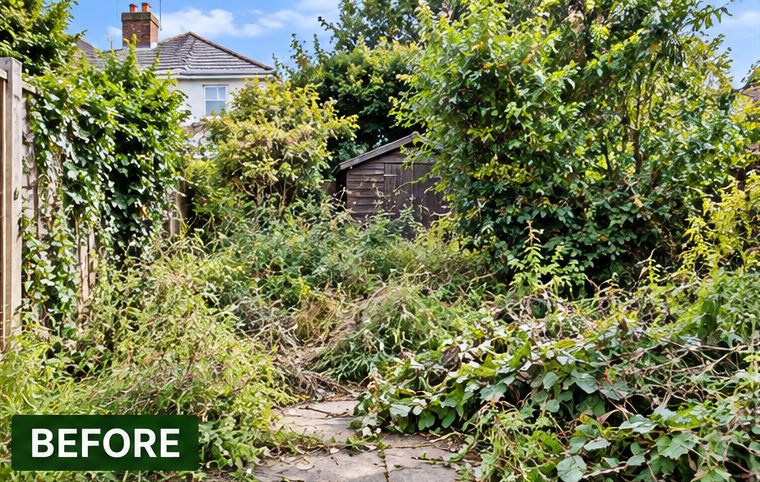
Big gardens go wild quickly. A long Penarth plot behind a period house, left for a few seasons while a house is empty, on the market or simply too much for its owner, can disappear under brambles, ivy, self-sown sycamore and laurel grown to the size of a small tree. People often ring us once they can no longer see the far end.
The temptation is to flatten everything and start from bare soil. Sometimes that is right, but in older Penarth gardens there is often something under the growth worth finding: a stone path, a set of steps, an old wall, a fine shrub or a tree that shelters the whole garden from the wind. This guide explains how we tackle a long-neglected garden, and the choices worth making before the work starts. Our garden clearance page covers the service in general.
Walk it before you cut it
The first job is a slow look round, with you if possible. In a garden that has been left for years, we are looking for what is hidden as much as what is growing:
- Edges of old paths, steps and paving, which often survive intact under a layer of moss and leaf litter.
- Garden walls and their condition, because heavy ivy is sometimes the only thing holding a loose top course in place.
- Old greenhouses, cold frames and glass, and anything sharp buried in the undergrowth.
- Ponds, drains and manhole covers that could be a trip or a drop.
- Plants worth saving: established shrubs, fruit trees, roses and specimen trees.
- Signs of nesting birds or other wildlife, which affect when some work can be done.
It also tells us whether anything needs a check with the council before it is touched, such as a large tree that may be protected.
What to keep, what to cut back, what to remove
Not everything in an overgrown garden is a weed. Many Penarth gardens were planted generously when the houses were new, and a shrub that has grown out of shape can often be cut back hard and will regrow into something useful. Mature trees and hedges on the seaward side may be doing a valuable job as a windbreak, even if they need a tidy.
As a rough rule, we suggest you keep anything healthy that gives shelter or structure, cut back anything overgrown but sound, and remove what is dead, damaged, invasive or simply in the wrong place. Self-sown saplings next to walls and buildings are usually best out before they get any bigger, because their roots and trunks only get harder to remove and do more damage every year. Where larger trees are involved, pruning large trees in Penarth gardens explains what may need permission.
The order we work in
Clearing a big plot in the right order saves time and avoids damage to the things you want to keep. Broadly, we:
- Mark the plants, features and edges being kept, so nobody clears them by mistake.
- Cut down brambles, nettles and tall weeds to get access and see the ground.
- Cut ivy at the base and deal with climbers on walls and fences, taking care with loose masonry.
- Take out unwanted shrubs, saplings and stumps where agreed.
- Clear rubbish, old timber and broken structures.
- Rake the ground over and leave the garden tidy and ready for the next stage.
Getting an overgrown garden back under control covers the general method in more detail, and what happens during a garden clearance explains a typical day.
Getting the waste out of a long garden
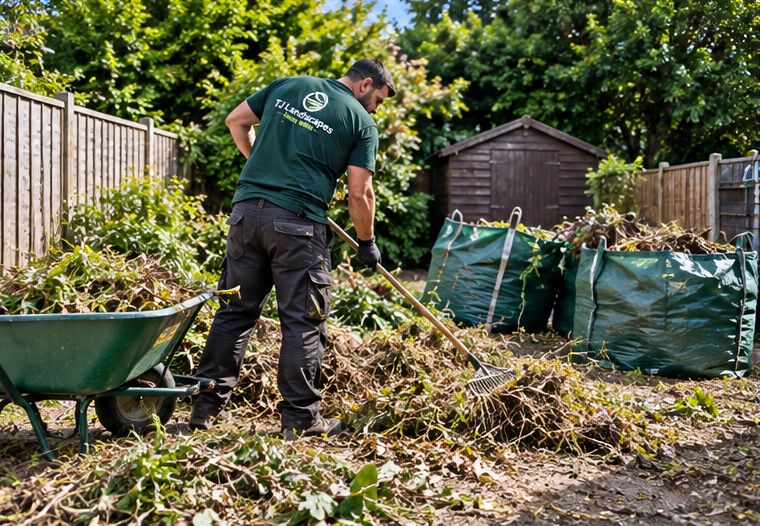
With a big neglected garden, the volume of green waste is usually the biggest surprise. Brambles and ivy bulk up enormously once cut, and a few overgrown laurels can fill a vehicle on their own. Getting it all from the back of a long Penarth garden to the road is often the slowest part of the job, especially where the only route is through a narrow side passage or, in some terraces, through the house.
We plan the route on the first visit, protect floors and paths if waste has to pass through, and take everything away. Green waste goes for composting where possible rather than to landfill. Our guides on where garden waste goes and what can and cannot go in a clearance explain what we can take.
Knotweed and other unwelcome finds
Occasionally a long-neglected garden turns up Japanese knotweed, which has to be handled and disposed of under strict rules and should not be cut and thrown on a heap. If we suspect it, we stop, point it out and talk through the options before going further. The same goes for asbestos sheeting on old sheds and garages, which should be dealt with by people trained and equipped to remove it safely and is not something to break up with a hammer. We leave it untouched and tell you what we have found.
Most finds are more pleasant: an old path in good shape, a forgotten flight of steps or a wall that only needs repointing. If the masonry needs work, restoring an Edwardian garden wall in Penarth covers the options.
Once the ground is clear
A cleared garden is a blank page for a short while, and weeds move back in fast, so it pays to decide the next step soon. Some people simply want it lawned and tidy before selling or letting, which our guide on clearing a garden before selling or letting covers. Others use the moment to plan a new layout with shelter from the wind, paving and planting; our coastal garden design ideas for Penarth homes is a good starting point, and the landscaping in Penarth page shows the full range of what we do locally.
Talk to T J Landscapes about your garden
Free quotes and honest advice across South Wales.
Questions People Ask
How long does it take to clear a large overgrown garden?
It depends on the size, how thick the growth is and how easy it is to get waste out. A modest plot may take a day, while a long, badly overgrown Penarth garden with difficult access can take several. We will give you an idea when we quote.
Do you take all the waste away?
Yes, green waste and general garden rubbish are removed as part of the clearance. Anything that needs special handling, such as asbestos or knotweed, is discussed with you first.
Can you save some of the plants?
Yes. Tell us what matters to you and we will mark it before we start. We can also point out shrubs and trees that are worth keeping even if they look a mess now.
Can you clear in spring and summer?
We can, but hedges and dense shrubs have to be checked for nesting birds first, and active nests are left alone. Heavier cutting of hedges and trees is often easier to plan for autumn and winter.
How do I book a look at the garden?
Ask for a free quote and let us know roughly how big the garden is and how you get to the back. Photos help, even if they only show a wall of brambles.