
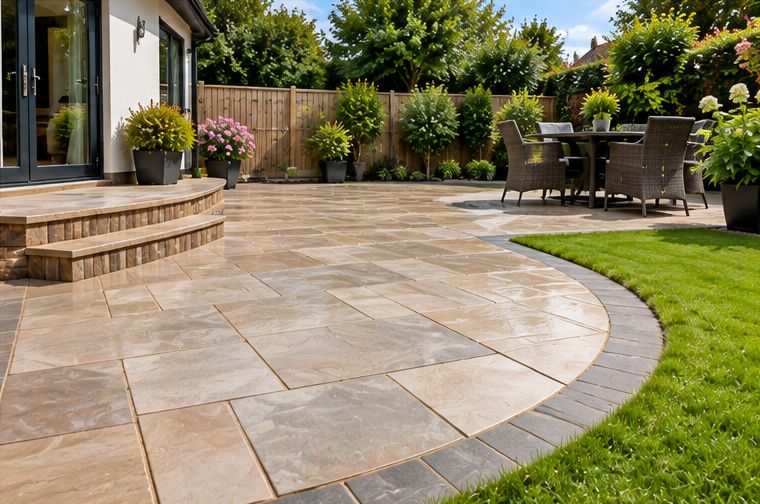
The streets of Roath and Canton are some of the most familiar in Cardiff: long Victorian terraces, bay windows at the front and, at the back, a yard enclosed by brick walls. Many of those yards were concreted or paved decades ago, and the old surface is now cracked, green and sloping the wrong way. Replacing it is one of the most common garden jobs we are asked about in the city.
A patio in a space like this has to work harder than one on an open suburban plot. Below are the ideas and practical points we talk through with owners before any slab is chosen. For more on the city as a whole, see our landscaping in Cardiff page.
Put the seating where the sun is, not where the door is
The instinct is to lay a patio straight off the back door. In a walled Cardiff yard that spot is often the gloomiest, tucked between the rear wall of the house and the side return. Look at where light falls in late afternoon and evening, when you are most likely to sit out, and consider putting the main paved area there instead, with a simple path joining it to the house.
Some owners split the difference: a small landing by the door for bins and a coffee in the morning, then a second seating area at the far end. Linking the two with the same slab keeps it looking like one design.
Choosing slabs for a shady, damp yard
Shade and high walls mean slow drying, and slow drying means algae and moss. That shapes the choice of material more than anything else. A few points hold true in most walled gardens:
- Porcelain absorbs very little water, so it stays cleaner in the shade and wipes down easily. Look for a textured or anti-slip finish; see our page on porcelain paving.
- Indian sandstone has a warm, natural look that suits Victorian brick, but it is more porous and will green over faster in a dark corner unless it is cleaned regularly. More on Indian sandstone paving.
- Pale colours reflect light back into the yard and make it feel larger, though they show dirt sooner.
- Smooth, polished finishes are best avoided outside in shade, where a film of algae can make them slippery.
Our general guide to which patio paving copes best with Welsh rain compares the main options in more detail.
Where does the rain go?
This is the question that decides whether a yard patio works. Behind a terrace there is usually no lawn or border left to soak up water, so every drop that lands on the paving has to be sent somewhere. The patio needs a gentle, even fall away from the house, towards a gully, a channel drain or a planted area that can take it.
Two things we check on every Roath or Canton yard are the height of the house damp proof course and the position of any existing drains. The finished paving should sit well below the damp course, and any air bricks in the house wall must stay clear. Raising the level to hide an old, uneven concrete base is a common mistake that pushes water towards the house. The guide to how a patio should be laid covers falls and bases step by step.
Patterns and layouts that suit a narrow plot
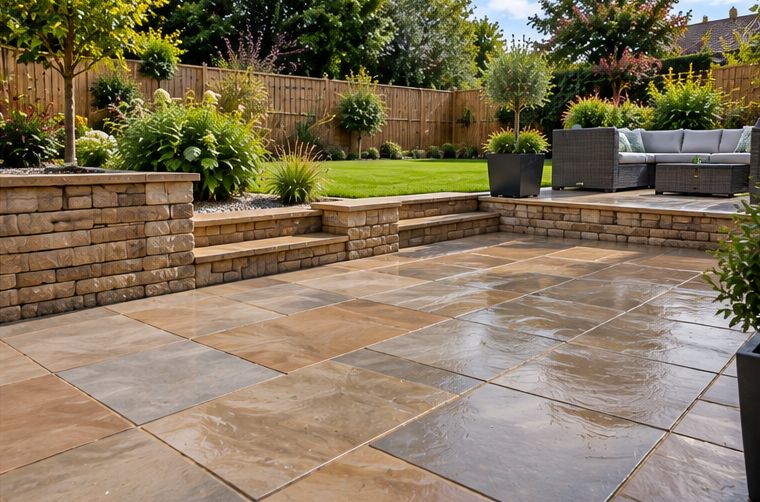
In a long, thin garden, the way the slabs run changes how the space feels. Laying rectangular slabs across the width of the yard makes it look broader. A diagonal pattern breaks up the tunnel effect. Larger slabs mean fewer joints and a calmer finish, though very big units can be hard to get through a terrace hallway.
Leaving a few planting pockets along the walls softens the brickwork and gives rain somewhere to go. A low built-in bench or a raised bed along one side can double as seating, which saves floor space that loose furniture would use up. For more ideas on layout, read making the most of a small Cardiff terrace garden.
Low-level garden lighting is worth planning at this stage too. A couple of soft lights set into a wall or a bed make a small yard usable on autumn evenings, and running the cable before the paving goes down saves lifting slabs later. It is a small detail in a Cardiff yard that is easy to forget until the paving is already down.
Deal with the walls before the paving
Many of the boundary walls in these streets are over a century old. Before a new patio goes down, it is worth looking closely at the brickwork. A wall with a bulge, open joints or a cracked coping is much easier to repair while the ground beside it is open. Once the paving is laid tight to the base, any rebuild means lifting slabs.
Walls on a boundary are often shared, so talk to the neighbour before any major work. Our brickwork service covers repointing, rebuilding and new copings, and we can price the wall and patio together.
Getting the old surface out and the new one in
Breaking out an old concrete yard produces a surprising amount of rubble, and in a mid-terrace house it all has to leave the same way the new materials arrive. Where there is a rear lane, we use it. Where there is not, we protect the hallway, fill bags in the garden and carry them through. A skip or bulk bags on the street may need a permit from the council, which we will talk you through.
It is slower than working on an open drive, but it is perfectly normal work for us. We build the access into the quote from the start rather than adding it on later.
Talk to T J Landscapes about your garden
Free quotes and honest advice across South Wales.
Questions People Ask
What is the best patio material for a shady garden in Cardiff?
There is no single answer, but porcelain with a textured finish is a strong choice for dark, damp yards because it takes in very little water and cleans easily. Natural stone works too, as long as you are happy to clean it now and then.
Can you lay a new patio over my old concrete yard?
Sometimes, if the concrete is sound and the new level stays well below the damp course. More often in these older yards the base is cracked or falls the wrong way, so we break it out and start again.
How do you stop water pooling against the house?
By laying the paving to a steady fall away from the building and giving the water a place to go, such as a gully, channel drain or planted bed. Getting the levels right matters more than the slab you choose.
How long does a small yard patio take?
A small walled yard is often a matter of days, but hand-only access, an old concrete base to remove or wall repairs will add time. We give a realistic timescale with the quote.
Do you work in other parts of Cardiff too?
Yes. We work right across the city, from terraced streets near the centre to the suburbs. See our patio and paving page, or ask for a free quote.