
Big gardens have room for big trees. Terrace yards in Tonypandy mostly do not, yet many of them have one: a sycamore that seeded itself against the back wall, a conifer planted as a small hedge decades ago, or a buddleia that has quietly become a tree. They block light, drop leaves on paving, push at masonry and make the yard feel smaller than it is.
This guide explains how removal works in a tight Rhondda yard, what to check first and what happens to the waste. The work itself is part of our tree surgery and hedge care service, and you can read about it locally on our tree surgery in Tonypandy page.
What tends to grow in Rhondda terrace yards
The plants we are asked to remove in Tonypandy fall into a few familiar groups:
- Self-seeded trees, usually sycamore or ash, that took root in a crack or corner and were never pulled out.
- Buddleia, which grows happily out of old walls and mortar joints and can loosen them.
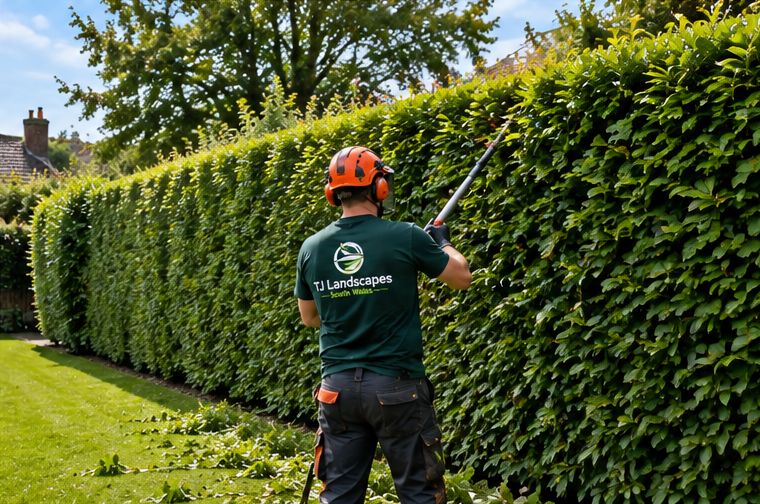
- Conifers such as leylandii, planted as a screen and now far taller and wider than intended.
- Ivy covering walls, sheds and fences, adding weight and hiding what is going on underneath.
- Old shrubs that have outgrown the space and cast the whole yard into shade.
Remove, reduce or keep?
Not every tree needs to go. A healthy tree that simply needs thinning or lifting can sometimes stay, letting in more light while keeping some green. Our guide to felling or pruning sets out how to decide.
In a small Tonypandy yard, though, removal is often the practical answer, especially where roots are close to a wall or the house, the tree will keep growing well beyond the space, or it is a self-seeded species that was never meant to be there. We will give you a straight view on the day.
Check before anything is cut
Some trees are protected, and it is your responsibility as the owner to check. Tree preservation orders and conservation areas can apply in towns as well as the countryside, so if you are unsure, ask Rhondda Cynon Taf Council before work starts. Our general guide to permission to cut down a tree in Wales explains the basics.
Birds nest in shrubs, hedges and ivy from roughly early spring to late summer, and it is an offence to disturb an active nest. We check before cutting and may suggest waiting if birds are using the growth. If the tree is on or near a shared boundary, it is also worth talking to the neighbour first.
How we take it down in a tight space
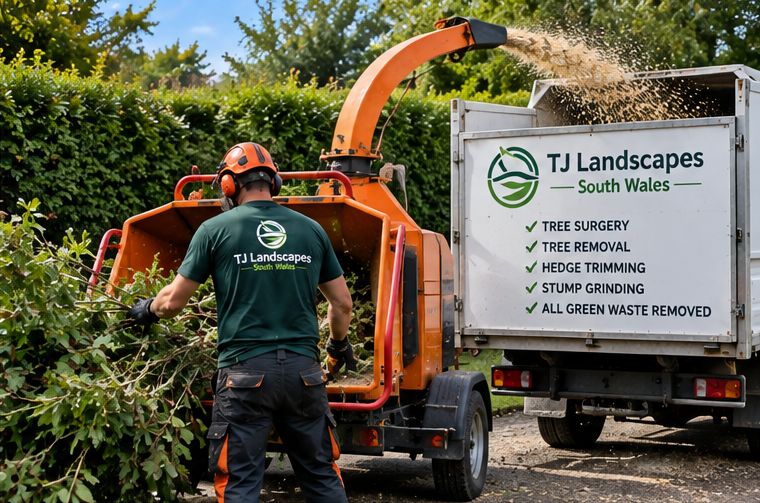
There is rarely room to fell anything in one piece in a Tonypandy yard. Instead, we work from the top down, removing branches and then sections of trunk in manageable pieces and lowering or carrying them so nothing lands on a roof, wall, fence or greenhouse.
Ivy is cut and pulled away carefully from walls, because it can take loose pointing with it. Shrubs growing out of masonry are cut back to the wall, and we look at what the roots have done to the joints once the growth is off.
Roots, stumps and walls
What happens to the stump depends on where it is. A stump in the open can often be dug or ground out so the area can be paved or planted. A stump tight against a back wall or retaining wall is a different matter: pulling it can disturb the wall itself, so it is sometimes better cut low and left to rot while we assess the masonry.
Where roots have pushed a wall out of line, removing the tree is often the first step of a repair. Our guide to rebuilding a back wall in a Tonypandy terrace explains what comes next if the wall needs attention.
What to expect on the day
Before we start, we agree exactly what is coming out and what is staying, and we ask you to move anything fragile from the yard, such as pots, furniture or a washing line. Neighbours on either side appreciate a word beforehand, since branches may need lowering close to their boundary and the lane will be busier than usual for a few hours.
Most removals in a Tonypandy terrace are finished within a day, though a large conifer or a tree growing through a wall can take longer. We keep the lane clear as we work, sweep up at the end and leave the ground tidy, with the stump dealt with as agreed.
- Agree the plan and any stump work in advance.
- Clear the yard of anything that could be damaged.
- Let the neighbours know which day we are coming.
- Keep children and pets indoors while cutting is under way.
Our guide to what happens on the day a tree surgeon visits goes through the process in more detail.
Getting the waste out through the lane
Everything we cut leaves the same way the tools came in: through the gate and along the back lane. We bag or bundle it in the yard, carry it out and take the green waste away with us, so you are not left with a pile of branches. If the job is part of a bigger tidy-up, see garden clearance through a Tonypandy back lane and our garden clearance service.
Afterwards
With a large tree or shrub gone, a Tonypandy yard often looks twice the size and gets sun it has not seen in years. That is a good moment to think about what the space could become, whether that is new paving, a raised bed or a small lawn. Our landscaping in Tonypandy page has ideas, and you can get in touch for a free quote covering the removal and anything you would like to do next.
Talk to T J Landscapes about your garden
Free quotes and honest advice across South Wales.
Questions People Ask
Can you remove a tree if there is no access except the back lane?
Yes. That is how most Tonypandy jobs are done. The tree comes down in sections, and the pieces are carried out through the gate and taken away.
Do I need permission to remove a tree from my yard?
Most garden trees do not need permission, but some are protected by a tree preservation order or a conservation area. If you are not sure, check with Rhondda Cynon Taf Council before the work is booked.
Will removing a tree damage my wall?
Taking the tree down itself should not. Roots against a wall need more care, which is why we sometimes leave a stump close to masonry rather than pull it out. We look at the wall before deciding.
Can you take out a tree in spring or summer?
It can be done, but we check thoroughly for nesting birds first and will hold off if a nest is active. Autumn and winter are often easier for larger removals.
What affects the cost of tree removal?
The size of the tree, how close it is to walls and buildings, how the pieces have to be lowered and carried, whether the stump is removed, and the volume of waste. We explain all of that in a free quote.