
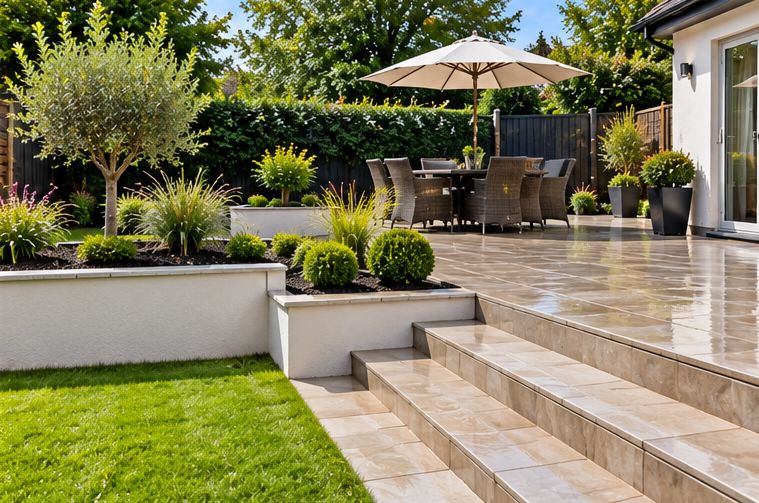
Most people who ask us for an easy garden in Tonypandy are not after a bare yard. They want somewhere pleasant to sit, a few plants, and the washing line, without spending every other Saturday weeding cracks and scraping moss off steps. On a steep, wet hillside that takes some planning, because the slope and the rain create work of their own.
Below are the principles we use when we lay out a terrace garden in Tonypandy and the rest of the Rhondda Fawr to look after itself as far as possible. The design side is part of our landscaping and garden design service.
Where the work in a terrace garden actually comes from
Before choosing anything, it helps to be honest about what eats your time now. In the terrace yards we visit, it is nearly always the same list:
- Weeds in joints between old slabs, concrete and walls.
- Moss and algae on shaded paving and steps, which also makes them slippery.
- Soil washing down the slope after heavy rain, onto paths and against the house.
- Overgrown shrubs and self-seeded trees that need cutting back every year.
- A small lawn that needs mowing, edging and a mower stored somewhere.
Tackle those five and most of the upkeep goes with them.
Sort the water before anything else
The Rhondda gets a lot of rain, and on a hillside it all moves downhill. In a sloping Tonypandy yard it gathers against back walls, soaks the bottom step and sits in any low patch of paving. Damp surfaces grow moss and weeds much faster than dry ones, so drainage is the first low-maintenance decision, not an extra.
That can mean paving laid with a proper fall, a channel drain across the yard before the back door, gravel strips along walls, or weep holes in a retaining wall so it does not push outwards. Our general guide to drainage for wet gardens explains the options.
Fewer, bigger surfaces
A patchwork of old concrete, slabs, gravel and a strip of grass has a lot of edges, and every edge collects weeds. Replacing it with one or two well-laid surfaces makes a small yard look larger and gives the weeds less to work with.
Large-format slabs with tight, properly filled joints are the easiest to keep clean. Porcelain in particular shrugs off moss and wipes down well, which suits a shaded Rhondda yard. Our guide to paving a sloping Tonypandy back yard covers levels, and patio slabbing and paving has more on the materials.
Lift the planting up
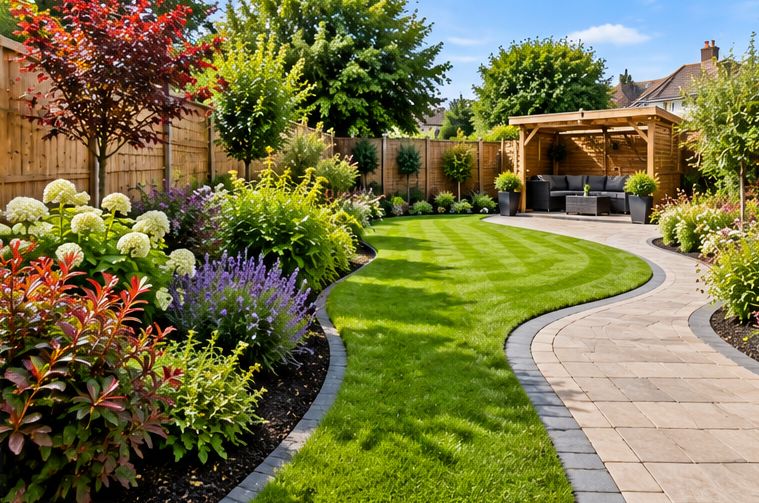
Raised beds are the terrace gardener’s friend. A bed built from sleepers, brick or block along the top wall of a Tonypandy yard keeps soil off the paving, drains better than the clay below, puts the plants at a comfortable height and gives you a neat edge that needs no trimming.
Fill them with plants that cope with wind, rain and a bit of shade and do not need constant attention: evergreen grasses, hardy geraniums, ferns for the dark corners, lavender or rosemary where the sun reaches, and a small shrub or two chosen to stay small. A bark mulch on top keeps weeds down and holds moisture in the rare dry spell.
Boundaries and storage that look after themselves
Fences and gates in a terrace yard take a battering from wind funnelling along the valley and from rain that barely lets up in winter. A cheap panel fence may need staining every couple of years and replacing not long after. Pressure-treated close board on concrete posts, or a rendered or brick wall where one already exists, asks far less of you over time.
The same goes for the gate onto the lane. A solid, well-hung gate with decent hinges and a proper latch will not sag and drag, which is one less job each spring. Our fencing in Tonypandy page covers the local options, and fencing and gates onto a Tonypandy back lane goes into gates in more detail.
Clutter creates its own upkeep. Bins left in the middle of the yard, tools leaning on walls and bags of compost in corners all trap leaves and damp and make sweeping awkward. A slim bin store by the gate, a narrow shed or wall-mounted storage against the house, and a hose reel on a bracket keep the floor clear, so a quick brush is all the yard needs.
Grass: keep it, change it or lose it
A tiny lawn is often the most time-consuming thing in a terrace garden for the space it takes up. Some people love it enough to keep it; others are happy to see it go. There are three sensible routes: keep real grass where it gets sun, replace it with artificial grass on a good base, or swap it for paving and planting. We compare the first two in artificial grass or turf for a Tonypandy yard.
Deal with the big growth once
Buddleia, sycamore seedlings, ivy and overgrown conifers turn up in plenty of Rhondda yards, often rooted right against a wall. Cutting them back every year is a chore, and some will damage masonry as they grow. Removing them properly, roots and all where possible, is usually a better long-term answer. Our guide to tree and shrub removal in Tonypandy explains how we go about it in tight spaces.
A simple layout that tends to work
Every yard is different, but a low-upkeep Tonypandy terrace garden often ends up looking something like this: a level paved area by the house with a drain across the doorway, a few steps to a second level, a raised sleeper bed along the top wall, a slim bin store near the gate, and a straight path to the lane.
It is not complicated, and that is the point. For ideas on squeezing more into a small plot, read making a small Tonypandy terrace garden work harder. For local examples of what we do, see landscaping in Tonypandy, and when you are ready, ask us for a free quote.
Talk to T J Landscapes about your garden
Free quotes and honest advice across South Wales.
Questions People Ask
Is a gravel yard low maintenance?
It can be, on a flat area with a good membrane underneath and firm edging. On a slope, gravel tends to migrate downhill in heavy rain, and leaves are harder to clear from it, so paving is often easier in a Rhondda yard.
What plants survive a shady, wet terrace garden?
Ferns, hellebores, hardy geraniums, some evergreen grasses and shade-tolerant shrubs all do well in Rhondda conditions. The key is a raised bed or improved soil so the roots are not sitting in cold, waterlogged clay.
How do I stop moss on my steps?
Moss thrives where surfaces stay damp and shaded. Better drainage, a slight fall on each tread, and a surface that is easy to brush all help. Cutting back overhanging growth to let in light makes a real difference too.
Can you do a low-maintenance makeover in stages?
Yes. Drainage and levels usually come first, then paving, then beds and planting. Our guide to planning a Tonypandy garden makeover on a budget explains how to phase it.
Will a low-maintenance garden still look good?
It should. Fewer materials, tidy edges and a handful of well-chosen plants usually look better in a small terrace yard than a busy mix of surfaces. The aim is less work, not less garden.