
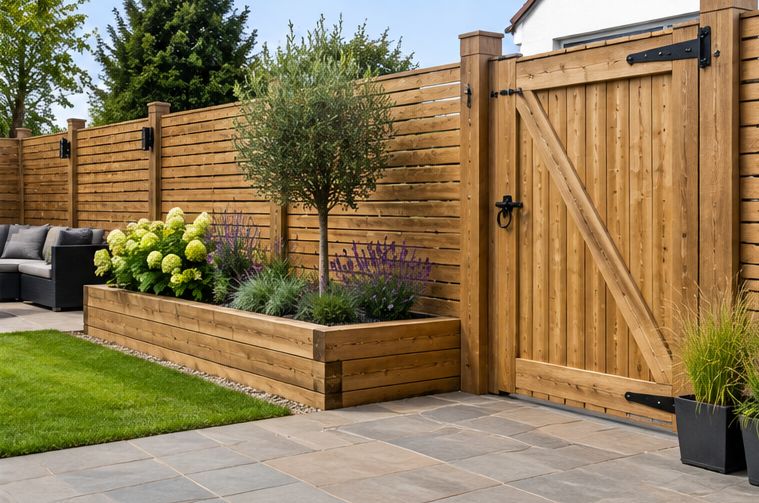
Ask most people in Chepstow what their boundary is made of and the honest answer is "a bit of everything". A length of stone wall, a tired run of panels, a hedge at the bottom and a gate that has not shut properly for years. Replacing it all with one neat fence can work, but it is often not the right answer.
This guide looks at fencing and gates from a Chepstow point of view: sloping plots, period and newer houses side by side, and old stonework worth keeping. For the general pros and cons of each fence type, our guide to close board, panel or slatted fencing covers the basics, and our fencing and gates page shows the work Tony and the team do.
Look at the whole boundary first
Before choosing a fence, walk the full length of the boundary and note what each stretch is doing. Some lengths only mark the line. Others hold up soil from next door, screen a window or keep a dog in. In Chepstow, where gardens often sit above or below the neighbours, the same boundary can be doing three different jobs along its length.
It helps to sort each stretch into one of three piles:
- Keep: sound stone or brick walls and healthy hedges that give privacy and shelter already.
- Repair: walls with loose coping or open joints, and fences where only a post or two has gone.
- Replace: rotten panels, leaning runs and anything patched so many times it no longer does its job.
Suiting the fence to the age of the house
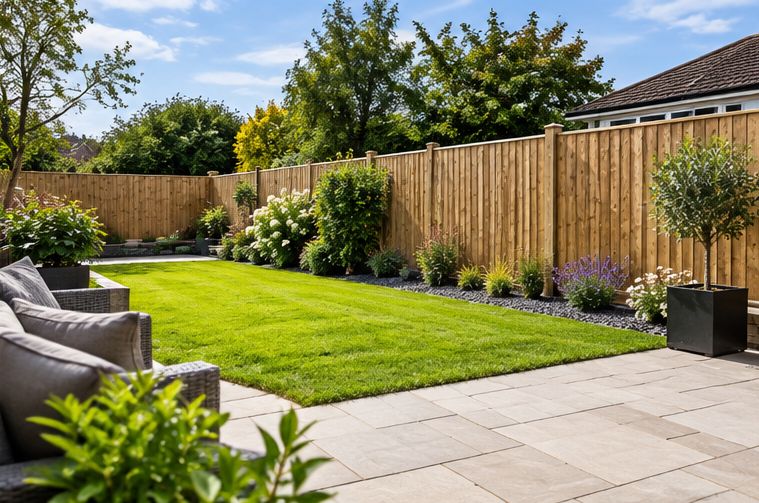
Chepstow has older homes in and around the centre and newer houses further out, and a fence that looks right on one can look out of place on the other. On a period property, a timber picket or a simple painted palisade at the front usually sits better than solid panels. At the back, featheredge close board in a natural or muted stain tends to blend with old stone.
On a newer house, slatted horizontal fencing or crisp close board with concrete posts often suits the cleaner lines. Front gardens on newer streets are sometimes open-plan, so check your deeds before putting a fence across one, as some developments carry restrictions.
Following a slope: stepped or raked
On a hillside plot there are two ways to run a fence downhill. A stepped fence keeps every panel level and drops each one a little lower than the last, leaving small triangular gaps at the bottom that are filled with gravel boards cut to shape. A raked fence follows the ground in a smooth line, which is easier with featheredge boards fixed to rails that run with the slope.
Stepped fencing is neater with panels and suits moderate slopes. Raked close board suits steeper or uneven ground, because the boards can be cut to follow every dip. On very steep Chepstow gardens the posts also need to go deeper on the downhill side, where the soil is shallower and more exposed.
Where new fencing meets old stone
The awkward spot is usually the join. A fence post set tight against an old stone wall can split loose stones or disturb the footing when it goes in. We normally set the last post a short distance off the wall and close the gap with a cut board, or fix a timber post to sound stonework with suitable fixings rather than digging next to it.
If the wall itself is loose, fix that first. A new fence leaning on a failing wall only hides the problem for a while. Our article on repairing old stone garden walls in Chepstow explains what can usually be saved, and our brickwork and garden walls service covers the repairs.
Gates that work on a hill
A gate on sloping ground is the part most likely to go wrong. If the path rises on the side the gate swings towards, the bottom rail catches the ground before the gate is fully open. The usual fixes are to hang it so it swings towards the downhill side, to raise it with a larger gap underneath, or to lay a small level landing where it opens.
Side gates in Chepstow often lead to steps rather than a flat path, and that matters for bins. A gate that opens straight onto the top step leaves nowhere to stand while you push a bin through. A short level pad before the steps makes the weekly bin run much safer. Our guide to garden paths and steps for Chepstow's hilly streets covers that side of it, and choosing and fitting a garden gate goes into widths, hinges and latches.
For older houses with stone or brick piers at the front, a metal gate or a framed timber gate hung on the piers often suits best. The piers need to be solid, because every swing of the gate works at the hinge fixings.
Heights, neighbours and the council
As a broad rule, fences and gates up to about two metres at the back, and about one metre next to a road, do not usually need planning permission. There are exceptions, though. Listed buildings, some conservation areas and planning conditions on newer estates can all change the picture, so check with Monmouthshire County Council if your Chepstow home falls into any of those.
On a slope, height is measured from the ground, and the ground on either side of a boundary can be at very different levels. It is worth talking to your neighbour before work starts, especially where the fence stands on or near a shared line. We are landscapers rather than planners, so we point you to the council when a question needs a firm answer.
Posts, wind and making it last
Some Chepstow gardens sit high on the hillside with little shelter, while others are tucked behind walls. Exposed runs are better with concrete posts or heavy timber posts set in concrete, and close board or slatted designs that let the fence be built stronger than lightweight panels. Our guide on which fence stands up best to Welsh wind compares them, and concrete or timber posts covers the choice of post.
Keeping timber off the soil with gravel boards, treating it every few years and cutting back plants that hold damp against it will all add years to a new fence.
If you would like a fresh look at your boundary, see our landscaping in Chepstow page or ask for a free quote, and we will walk the line with you.
Talk to T J Landscapes about your garden
Free quotes and honest advice across South Wales.
Questions People Ask
Can you fence a boundary that is part stone wall and part hedge?
Yes. We often keep the sound sections of wall and hedge and fence only the gaps or failing lengths, with neat joins where the materials meet. It usually looks more settled than replacing everything.
Should a fence on a Chepstow slope be stepped or follow the ground?
Panels have to be stepped, which suits gentle and moderate slopes. On steeper or uneven ground a close board fence built to follow the slope usually looks tidier and leaves no gaps at the bottom.
My side gate scrapes the path. Does it need replacing?
Not always. Rehanging it to open the other way, adjusting the height or levelling a small landing can cure a scraping gate. If the post has moved or the frame has dropped, a new post or gate may be needed.
Do I need permission for a new fence in Chepstow?
Most garden fences within normal heights do not need planning permission, but listed buildings, conservation areas and estate conditions can change that. Check with Monmouthshire County Council if you are unsure.
Can you quote for fencing, gates and wall repairs together?
Yes. Tony and the team can look at the whole boundary on one visit and give you a free quote that covers all of it.