
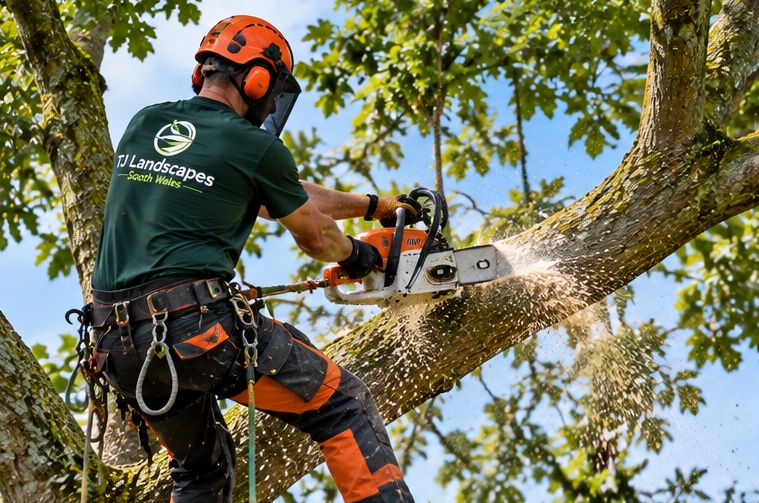
Trees on the coast live different lives from trees in a sheltered valley. The wind trims them, bends them and pushes their growth away from the sea, and salt scorches the side that faces it. In Port Talbot that shows in lopsided sycamores, conifer hedges browned on one face and garden trees that have grown far bigger than anyone planned when the house was new.
This guide covers the tree and hedge work we are most often asked about in Port Talbot, and what to think about before it starts. For the full list of work, see our tree surgery and hedge care page or the local page for tree surgery in Port Talbot.
What the wind does to a garden tree
A tree that grows in a steady prevailing wind usually adapts well. It builds stronger wood on the side that takes the strain and puts down roots to match. The problems come when that balance changes: a neighbouring tree is removed and suddenly this one takes the full force, a heavy limb grows out on the sheltered side, or the roots are disturbed by building work, a new patio or a trench.
Signs worth a closer look include a canopy that is much heavier on one side, a lean that has got worse, cracks or splits where big limbs join the trunk, dead branches high up and fungus growing at the base. None of these always means a tree is unsafe, but they are all reasons to have it looked at.
Reducing the sail, not stripping the tree
The aim of most pruning on an exposed Port Talbot plot is to reduce how much wind the crown catches, and to keep it balanced. That is usually done by a light crown thinning or a modest reduction, taking out crossing, rubbing and weak branches and shortening the longest limbs back to good side growth.
What we avoid is over-thinning. Stripping out all the inner branches and leaving tufts of leaves at the tips, sometimes called lion-tailing, puts all the weight at the ends of the limbs and can make a tree more likely to fail in a gale, not less. Our guide to crown lifting, thinning and reduction explains the differences.
Salt-burnt conifers and shelter hedges
Tall conifer hedges are common across the town's post-war estates. On the seaward side they often go brown after a stormy winter, and that brown patch is where most of the questions come from. Leylandii and most similar conifers will not grow back from old brown wood, so cutting a browned face back hard usually leaves it bare for good.
The practical choices are to trim lightly and regularly so the hedge never needs a hard cut, to reduce the height so it catches less wind, or, where it has gone too far, to take it out and replace it with a salt-tolerant broadleaf hedge. Our guide to planting for wind and salt in Port Talbot suggests replacements, and hedge trimming: how often and when covers upkeep.
Checking trees after a storm
After a big blow off the bay it is worth walking round the garden once the weather has settled. Look up as well as down.
- Broken branches still hanging in the crown, which can drop later without warning.
- New splits where limbs join the trunk.
- Soil lifted or cracked on one side of the base, which can mean the roots have moved.
- A lean that was not there before.
- Branches resting on roofs, fences, power lines or phone lines.
Keep people away from anything that looks unstable, and never try to free a branch caught near a power line yourself; report it to the network operator. For the rest, take a few photos and send them over, and we will tell you what we think needs doing.
Pruning or felling?
Most garden trees in Port Talbot can be kept with the right pruning, and a well-shaped tree gives shelter, shade and privacy that takes years to replace. Felling makes sense when a tree is dead or dying, badly damaged, planted far too close to the house or growing somewhere it will always cause trouble. Where a tree is removed, we often suggest planting something smaller and tougher in its place. Our article on tree felling or pruning sets out how we weigh it up.
Size is often the real issue rather than health. A tree that looked modest when it went in can end up shading the whole of a small terraced garden, dropping leaves into gutters and lifting the edge of a path. In that case a staged reduction over a couple of seasons, or crown lifting to let light in underneath, may solve the problem without losing the tree altogether. We will always talk you through the options before anything is cut.
Timing, wildlife and permission
Many trees can be pruned at almost any time of year, but late autumn to late winter is often the best window for bigger work, once the leaves are off. Birds nest in trees and hedges mainly from spring into summer, and it is against the law to disturb an active nest, so we check before cutting. See when trees should be pruned for more.
Some trees are protected by a tree preservation order, and trees in conservation areas have their own rules. If there is any chance yours is covered, check with Neath Port Talbot Council before work is booked. Our guide on whether you need permission to cut down a tree in Wales explains the basics, though for anything uncertain the council has the final word.
Access and taking the waste away
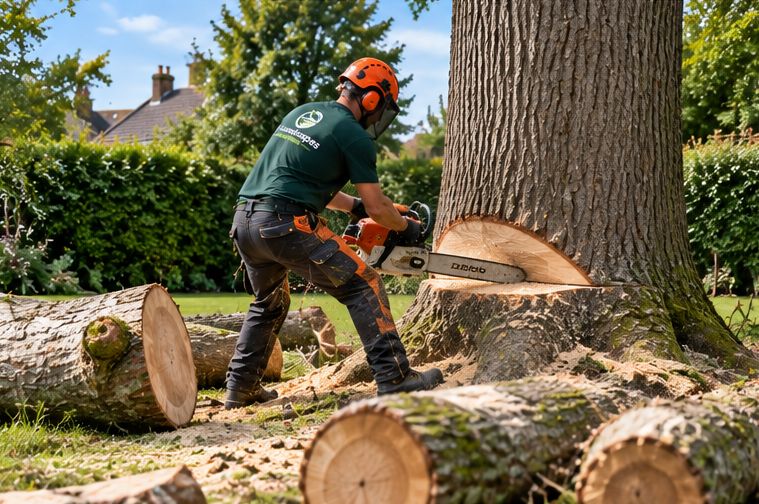
Plenty of terraced gardens in Port Talbot have no side access, so every branch has to come out through the house or down a rear lane. We plan for that on the first visit, cutting timber into manageable pieces, protecting floors where we have to pass through and loading as we go. All the green waste is taken away, and if the work is part of a bigger tidy-up, our guide to garden clearance in Port Talbot covers the rest.
You can see how tree work fits with everything else we do on our landscaping in Port Talbot page.
Talk to T J Landscapes about your garden
Free quotes and honest advice across South Wales.
Questions People Ask
Can you make my tree safer in the wind without cutting it right back?
Usually, yes. A light crown thinning or reduction cuts down how much wind the tree catches and takes out weak or crossing branches, while keeping its natural shape.
My conifer hedge is brown on the sea side. Will it recover?
If there is still some green growth on the brown face, light trimming may help it thicken again. Bare brown wood on leylandii and similar conifers rarely regrows, so a replacement hedge is sometimes the better answer.
Can I cut branches that overhang from next door?
In general you can cut back overhanging branches to the boundary, but it is courteous to talk to your neighbour first, and you should check the tree is not protected. If in doubt, ask Neath Port Talbot Council.
Do you take all the wood and branches away?
Yes. Branches, logs and hedge cuttings are cleared and taken away as part of the job, unless you would like to keep some logs.
How do I get a quote for tree work?
Send us photos and a short description through the contact form. Tony and the team will come and look, and the quote is free.