
It is one of the questions we hear most often from people in Pontypool, usually while standing on a patch of worn, mossy grass halfway up a terraced garden. The old lawn has gone thin, the mower lives in the front room because there is nowhere else to keep it, and a neighbour has just had a plastic lawn put down that looks green all year.
Both options can work well here, and both can go wrong. This guide goes through the things that tip the balance on Pontypool’s valley-side plots, so you can make the choice with your eyes open. For the lawn work itself, see our turf laying page.
Start with the light on your side of the valley
Real grass needs sun. Houses in Pontypool are built along both sides of a narrow valley, and a garden on the side that faces away from the sun can spend much of the winter in shadow from the hillside, the terrace behind and its own back wall. Add a mature tree or a high fence and some lawns get only a few hours of direct light even in summer.
Turf laid in deep shade tends to thin out, go soft and let moss in within a couple of seasons. If your garden is like that, artificial grass is a genuine answer rather than a shortcut, because it does not care about light at all. A lawn that gets sun for most of the day is a different matter: good turf will thrive there and give you something living, cool underfoot and easy to repair.
Our guide on why lawns go patchy, mossy or bare is worth reading if you are not sure whether shade or something else is behind the problem.
Rain, clay and what sits under the surface
The valleys get a lot of rain, and plenty of Pontypool gardens sit on heavy, clay-rich ground or on old fill left from when the terraces were built. Water that cannot soak away is bad news for either kind of lawn, just in different ways.
- Real turf on wet, compacted ground goes muddy, gets moss and loses its roots. It needs decent topsoil and somewhere for the water to go.
- Artificial grass is laid on a free-draining stone base, and the backing lets water through. If the ground below that base holds water, puddles still form and the surface can stay damp and grow algae at the edges.
- Both benefit from sorting drainage first, whether that is a better fall, a gravel trench or a proper soakaway.
We look at the ground carefully before recommending either. Our article on stopping a garden waterlogging explains the usual fixes.
Slopes and small terraces
A lot of Pontypool back gardens climb or fall steeply from the house. Neither kind of lawn is happy on a steep bank. Turf can slip while it roots, and a sloping lawn is awkward and tiring to mow. Artificial grass can be fixed to a gentle slope, but on anything steep the base tends to creep and rainwater races across the surface.
The usual answer is to level the ground first. Once a garden has been cut into terraces, a small flat level of fifteen or twenty square yards makes an ideal spot for either option. On those compact terraces, artificial grass often makes the most sense: there is no mower to carry up the steps, and no clippings to bring back down. On a larger, sunny level, real turf is usually better value over time. Our guide to terracing a steep Pontypool back garden shows how the levels are worked out.
Who is going to use it?
Think honestly about the people and animals that will be on the lawn most days.
- Children. Real grass is softer to fall on and stays cooler in hot weather. Artificial grass gives a clean, mud-free play space in a wet winter, which counts for a lot in the valleys.
- Dogs. Dog urine scorches real turf in patches. Artificial grass copes, but it needs rinsing regularly and a base that drains well, or it will start to smell.
- Sitting out. Synthetic surfaces can get surprisingly warm on a sunny day, especially against a south-facing wall. Real grass stays comfortable to sit on barefoot.
- Wildlife. A living lawn feeds birds and insects; a plastic one does not. If that matters to you, keep some real planting around the edges whatever you choose.
The upkeep nobody mentions
Real turf needs mowing from spring to autumn, some feeding, and an occasional rake to keep moss down. On a Pontypool terrace that often means carrying the mower through the house or up a flight of garden steps, which is the part people tire of first.
Artificial grass is lower maintenance, not no maintenance. Leaves and needles need blowing or brushing off, the pile benefits from a stiff brush now and then so it stands up, and weeds and moss can creep in along the edges and seams if the base or edging is poor. It also has a working life: after a number of years the fibres flatten and fade and it has to be replaced, whereas a looked-after lawn simply carries on.
If low upkeep is the main goal, our low-maintenance garden ideas for Pontypool homes covers other ways of cutting the work down too.
What goes into each option
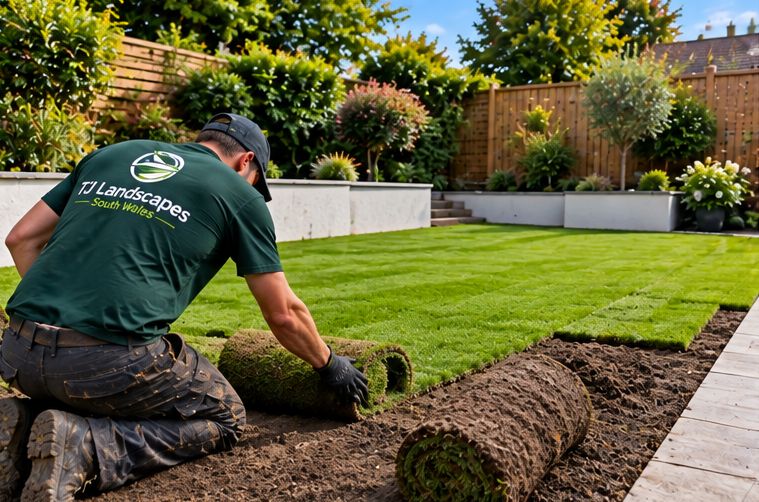
For real turf, we clear the old lawn and weeds, improve or replace tired soil, level and firm the ground and lay fresh rolls with tight, staggered joints. Timing matters, and spring and autumn are easiest; the best time to lay turf in South Wales explains why. If you are wondering about sowing instead, see turf or seed.
For artificial grass, the old surface is dug out to a set depth, a weed membrane goes down, then a compacted stone base and a finer levelling layer. The grass is rolled out, joined, trimmed and fixed along firm edges, usually timber, sleepers or a paving border, then brushed and topped with sand if the product calls for it. The quality of that base decides how long it will look good.
In both cases the ground work is where the effort goes, and on a terraced street much of it depends on access. Everything comes in and goes out through the house or along a rear lane, and we plan that before we start.
A mix often suits Pontypool gardens best
It does not have to be one or the other. A common layout on a stepped Pontypool plot is artificial grass on a small shady top terrace where the children play, a patio by the house, and a patch of real turf on the sunniest level. Mixing them lets each surface go where it works.
If you are unsure, Tony can look at the light, the ground and the slope and give you an honest view on your own garden. You can see more of the work we do locally on our landscaping in Pontypool page, or ask for a free quote with no obligation.
Talk to T J Landscapes about your garden
Free quotes and honest advice across South Wales.
Questions People Ask
Will artificial grass cope with Pontypool rain?
Yes, if it is laid on a properly compacted, free-draining base and the ground underneath is not holding water. Where the soil is heavy clay, we look at drainage before the base goes in.
Is real turf worth it in a shady garden?
In light shade, with a shade-tolerant turf and good soil, it can be. In deep shade for most of the year, it usually thins and fills with moss, and artificial grass or planting is often the better choice.
Can artificial grass go on a slope?
On a gentle slope, yes, with a well-fixed edge at the bottom. On steep ground we would level the area first, both for artificial grass and for turf.
How do I keep artificial grass clean if I have a dog?
Pick up solids promptly, rinse the area regularly with a hose, and brush the pile now and then. A good base that drains freely makes the biggest difference.
Can you remove my old lawn and lay the new one?
Yes. Tony and the team clear the old surface, take the waste away, prepare the ground and lay whichever lawn you choose.