
Ask most people in Pontypool what they dislike about their garden and the answer is rarely the garden itself. It is the jobs: dragging a mower up steps to a lawn on a tilt, scraping moss off a path every spring, weeding a bank that is hard to stand on, and patching a fence that leans a little further each winter.
A low-maintenance garden takes those jobs away, or makes them quick. This guide sets out the ideas that work best on Pontypool’s sloping, rain-soaked plots, in roughly the order we would think about them. The general principles are in our guide on how to plan a low-maintenance garden; this one is about applying them here. The work itself comes under our landscaping and garden design service.
Where the work really comes from
Before choosing any materials, it helps to list what currently takes your time. In the Pontypool gardens we visit, it tends to be the same few culprits:
- Sloping grass that is slow and awkward to mow, and scalps on every bump.
- Banks and borders too steep to kneel on comfortably, so weeds win.
- Shady, damp surfaces that grow moss and algae and turn slippery.
- Tired timber, such as fences, sheds and old decking, needing treatment or repair.
- Hedges that have grown taller than a stepladder can comfortably reach.
Fix the causes on that list and the garden looks after itself far better, whatever the finish.
Flatten the ground you use
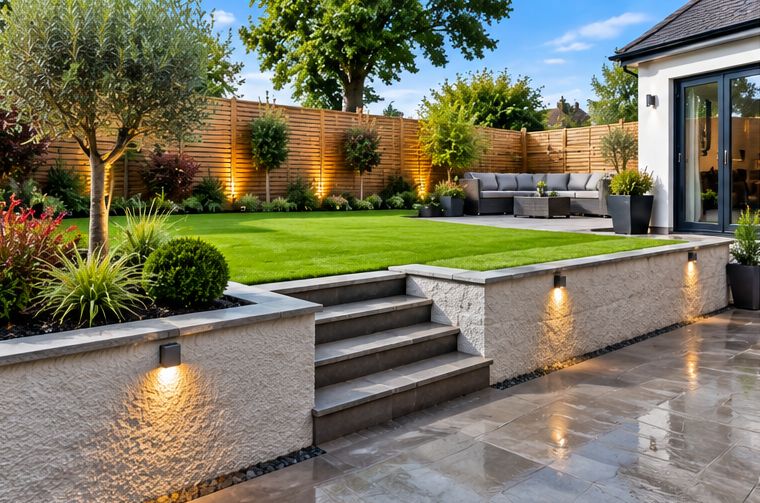
The single biggest saving on a steep Pontypool plot is to turn slopes into level terraces. A flat patio or lawn is quicker to sweep or mow, beds on level ground are easier to weed, and water stops running across everything.
The levels do not have to be large. Two or three well-built terraces, held by walls in brick, block, stone or sleepers, can change how a narrow valley garden works. Our guides to terracing a steep Pontypool back garden and retaining walls for sloping Pontypool gardens explain how it is done.
Hard surfaces that shed the rain
Paving is the backbone of most easy-care gardens, but in a wet valley it only stays low-maintenance if it is laid to drain. A patio with a proper fall away from the house, a firm sub-base and well-filled joints dries quickly after rain, gives weeds fewer places to root and resists moss.
- Porcelain is dense and easy to wipe clean, which suits shady gardens where algae is a problem.
- Textured sandstone looks at home against stone terraces and grips well, though it benefits from an occasional clean.
- Gravel over a membrane is quick to lay and drains freely, but keep it to level areas: on a slope it wanders downhill.
- Good edging between paving, gravel and planting stops materials mixing and saves hours of tidying.
Our patio and paving page has more on materials, and patio slabbing for Pontypool terraced houses looks at the space next to the house in detail.
Raised beds instead of banks
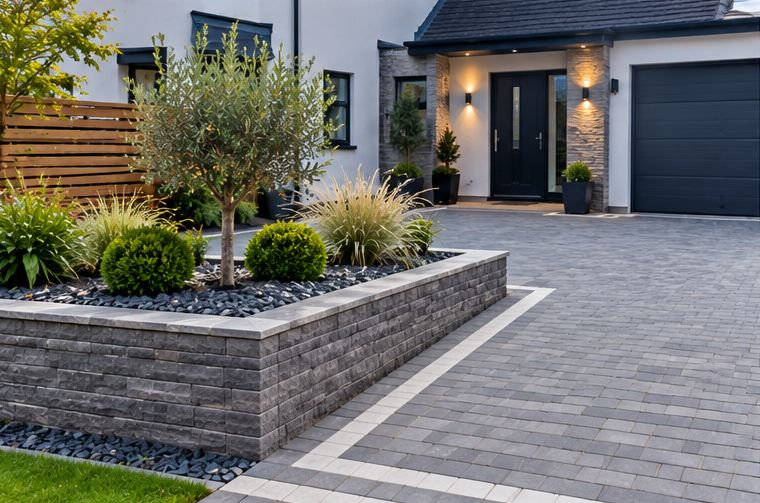
If you enjoy growing things but not the kneeling, raised beds are the answer. Built from sleepers or brick at a comfortable height, they bring the soil up to you, drain well even when the ground below is heavy, and keep plants in their place. On a terraced plot, a retaining wall can double as the side of a raised bed.
Fill them with good topsoil, mulch the surface with bark or compost, and the weeding drops to a few minutes a week. Herbs, compact fruit bushes and hardy perennials all do well in them. For brick versions, see building brick raised beds and planters.
Planting that suits the valley
The easiest plants are the ones that are happy where they are put. In Pontypool that means choosing for rain, shade on part of the day, and wind on the more exposed upper plots. Tough evergreen shrubs, ferns in shady corners, ground cover to knit over a bank and hardy grasses all need little more than a trim once a year.
Plant closely, so the soil is covered and weeds cannot get going, and put down a thick layer of bark around the plants. Avoid bedding plants that need replacing every season, and thirsty pots that need watering daily in summer. A few well-chosen shrubs will do more for the garden than a lot of fussy planting.
The lawn question
A lawn is not automatically high maintenance, but a sloping, shady one usually is. You have three choices: keep a smaller lawn on the sunniest, flattest level; replace it with artificial grass on a compact or shaded terrace; or do without and use paving and planting instead. Each has trade-offs, which we set out in artificial grass or real turf for a Pontypool garden.
If you keep real grass, a mowing strip of paving or brick along the edges means no more edging by hand, and a lawn shaped with gentle curves rather than tight corners is quicker to cut.
Boundaries, steps and the finishing touches
Fences with concrete posts and gravel boards stand up to wet ground far longer than timber posts sunk straight into soil, and a well-built fence needs little more than an occasional treatment. See our fencing page for the options. If a tall hedge has become a burden, reducing it to a height you can reach, or replacing a section with a fence, can save hours every year.
Safe, even steps make the whole garden easier to use and keep clean; garden steps and paths for Pontypool hillside homes covers them. Finally, a little garden lighting and a place to sit are what make an easy-care garden one you actually go out into.
If your garden is already overgrown, a clearance is the natural first step, and garden clearance in Pontypool explains what gets taken away. Tony can look at your plot and suggest which of these ideas would make the most difference; see our landscaping in Pontypool page, or ask for a free quote.
Talk to T J Landscapes about your garden
Free quotes and honest advice across South Wales.
Questions People Ask
What is the lowest-maintenance surface for a Pontypool garden?
Well-laid paving with a good fall and filled joints is hard to beat. In shady spots, porcelain is easier to keep clean than most natural stone.
Is gravel a good idea on a sloping garden?
Only on the level parts. On a slope, gravel drifts downhill and ends up on the lawn or the path, so we use it on flat terraces with firm edging.
Will a low-maintenance garden look bare?
Not if it is planned well. Good paving, raised beds and a few strong shrubs can look full and green all year with very little work.
Can you do the whole thing, from clearing to planting?
Yes. Tony and the team clear the garden, build any walls, terraces and raised beds, lay the paving and finish the planting and bark.
How much will it cost to make my garden low maintenance?
It depends on the size of the garden, how steep it is, access, the materials you choose, how much needs clearing and whether drainage needs work. We give free quotes once we have seen the garden.