
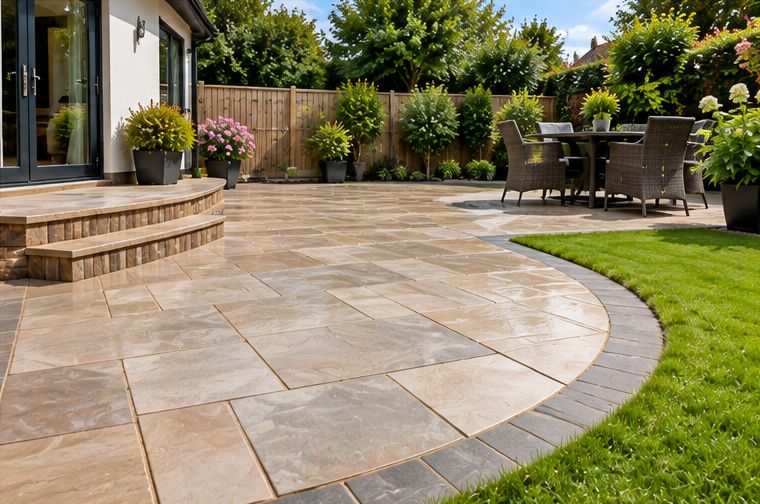
Walk along almost any terraced street in Pontypool and look over the back walls: flights of steps climbing away from the kitchen door, often cast in concrete decades ago, with uneven risers, cracked treads and a lean to one side. People put up with them for years, then stop using the top of the garden altogether because the climb feels risky in the wet.
This guide is about replacing or improving those routes: how a comfortable step is proportioned, which surfaces grip in valley rain, how to keep water off them and how to fit them into a garden you may later terrace. Steps and paths are part of our patio and paving work, alongside the patios they usually lead from.
Why the old steps feel so awkward
Many of the tired flights we see in Pontypool were built simply to reach an outhouse or a washing line, not to be walked comfortably with a basket or a toddler. The usual faults are easy to spot once you know them:
- Risers of different heights. Your legs set their rhythm on the first few steps, so one taller or shorter step is where people trip.
- Treads that are too shallow. If your whole foot does not fit on the step, you end up climbing on your toes.
- Treads that tip too far forward. A slight fall sheds rain, but a steep one sends your feet towards the edge when it is icy.
- No landing. A long, straight run with nowhere to pause is tiring and makes a fall more serious.
- Crumbling edges and moss. Old concrete and smooth slabs go slippery under a coat of algae in a shady valley garden.
Getting the proportions right
Outdoor steps feel easiest when they are shallower and deeper than indoor stairs. As a rough guide, a rise of around six inches with a tread of twelve inches or more is comfortable for most people, and every step in a flight should match. On a steep Pontypool plot that can mean more steps than you expect, or a route that turns once or twice across the slope rather than going straight up.
A landing every so often, big enough to stand on with a bag of shopping, makes a long climb much kinder. Landings are also natural places to join a terrace, a path or a seating spot. Our guide to garden steps in brick and stone explains rise and going in more detail.
Materials that cope with valley weather
Pontypool gets plenty of rain, and many gardens sit in the shadow of the hillside for part of the year, so grip matters more than looks. The options we use most:
- Textured sandstone or riven slabs. Good grip and a natural look that suits stone terraces. Treads can be cut from the same slabs as a patio so the whole garden ties together.
- Porcelain with an outdoor finish. Hard wearing and easy to clean, but choose a textured, slip-resistant grade for steps, never a smooth one.
- Brick or block. Neat risers that suit red-brick houses, with a paving tread on top.
- Sleeper steps. Quick to form on a bank and good for informal paths, though timber gets slippery in shade unless it has a grooved or gritted face.
- Gravel paths between steps. Fine on gentle stretches, but loose stone drifts downhill on steep ground, so we keep gravel to flatter runs and hold it with firm edges.
For a fuller comparison, see which patio paving copes best with Welsh rain.
Keeping water off the route
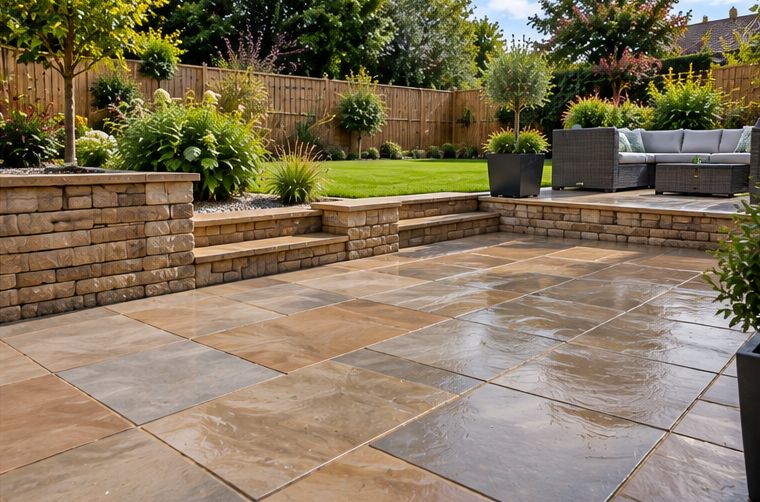
A path on a hillside is also a channel. Rain runs down it, and on some Pontypool gardens it arrives from the bank above as well as from the sky. Left alone, that water washes out bedding, lifts slabs and feeds the moss that makes steps treacherous.
We give treads a slight fall so they shed water rather than hold it, and we set paths with a gentle cross-fall towards a planted edge or a channel. Where a lot of water comes down, a gravel-filled trench or drain along the uphill side catches it before it reaches the path. Each step and slab is laid on a proper base, in the same way as a patio; how a patio should be laid covers the sub-base and bedding.
Handrails, lighting and the everyday climb
A handrail on at least one side turns a flight you avoid into one you use. It is worth adding on any long or steep run, and essential if older relatives visit. Simple timber or metal rails fixed into the side wall or to posts set in concrete work well.
Low-level lighting on the steps, or in the side walls, makes the route safe after dark in winter, when it is dark by teatime and the bins still need to go out. Think about the jobs you really do on the route: bins to a rear lane, a mower to the lawn, logs to the house. A path wide enough for a wheelie bin, with a ramp or low steps at the end, can save a lot of lifting.
Fitting steps into a wider plan
In a lot of Pontypool gardens, new steps are the first part of a larger change. If you might terrace the garden later, it pays to plan the levels now so the steps land in the right places. Our guides to terracing a steep Pontypool back garden and retaining walls for sloping Pontypool gardens explain how levels, walls and steps work together.
Where the side walls of a flight are old and bulging, they may need rebuilding at the same time; our brickwork and garden walls service covers that. Old steps are usually broken out and the rubble taken away as part of the job.
The things that shape a quote are the length of the route, how steep the ground is, the material, how much old concrete has to come out, drainage and access for materials. Tony will walk the route with you and give you a free quote; see our landscaping in Pontypool page, or get in touch.
Talk to T J Landscapes about your garden
Free quotes and honest advice across South Wales.
Questions People Ask
Can you replace old concrete steps without digging up the whole garden?
Usually, yes. We break out the old flight, rebuild the base and lay new steps in the same line or a better one, leaving the rest of the garden as it is.
What is the least slippery surface for garden steps?
A textured natural stone or a slip-resistant outdoor porcelain, laid with a slight fall so water runs off. Keeping moss down with an occasional scrub helps whatever you choose.
My garden is very steep. Will I need lots of steps?
Often more than you expect, if they are to be comfortable. Turning the route across the slope with a landing or two can make it easier than one straight flight.
Can you make it easier to get the bins down to the lane?
In many gardens, yes. A wider path with shallow steps or a short ramp at the lane end makes wheeling bins much easier.
Do I need permission to build garden steps?
Ordinary garden steps and paths usually do not need planning permission, but raised platforms, work near a boundary or changes to shared walls can be different. If in doubt, check with Torfaen council.