
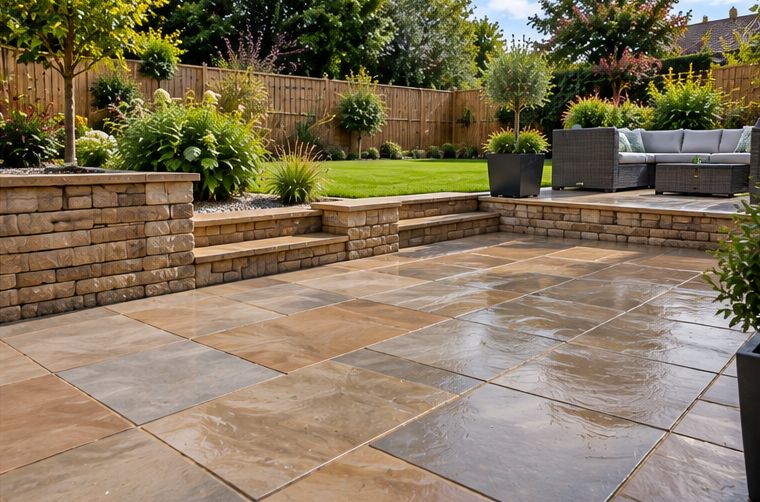
A garden wall outlives almost everything else in a garden. Fences get replaced, patios get relaid and lawns come and go, but a well built wall can stand for generations. That makes the choice of material worth a bit of thought, especially in a city like Newport where one road of Victorian red brick can sit next to an estate of buff facing brick and a lane of old stone cottages.
This guide weighs up brick, block and stone for Newport homes, then looks at the ground, the height rules and retaining walls. Our brickwork and garden walls page covers the work we do, and our landscaping in Newport page has more on the city's gardens.
Start by looking at the house
Before thinking about cost or upkeep, stand in the road and look at your home and the ones either side. A new wall that picks up the colour and texture of the house looks as if it was always there. One that clashes stands out for decades.
- Victorian and Edwardian terraces nearer the centre are mostly red or brown brick, sometimes with decorative courses. A matching reclaimed or reproduction brick suits them best.
- Interwar and post-war semis are often rendered or pebble-dashed with brick details. A brick wall that matches the plinth or a neatly rendered block wall both work.
- Newer estate houses in areas such as Rogerstone, Bettws and Langstone usually have a standard facing brick, which is often still made and easy to match.
- Older stone homes, more common in Caerleon and on the rural edges of the city, look right with a stone wall or at least stone-faced work.
Think too about what the wall has to do besides look good. A front wall may need piers for a gate, a gap wide enough for bins, or a lower section so you can still see out of a driveway. If you are also turning a front garden into parking, it makes sense to plan the wall and the drive together; our guide to block paving or slabs for a Newport driveway covers the surface, and our paving work can be done in the same project.
Brick: the Newport default
For most front and side walls in Newport, brick is the natural choice. It is hard wearing, needs very little maintenance and comes in a huge range of colours and textures. A low front wall with piers and a coping looks smart on a terrace or semi, and brick can be built into curves, steps and planters as well as straight runs.
The details make the difference: a proper coping to shed rain, a damp-proof course near the base, frost-resistant bricks in exposed spots and the right mortar joint. Our guide to choosing bricks and coping goes into these.
Block: practical, and better than it sounds
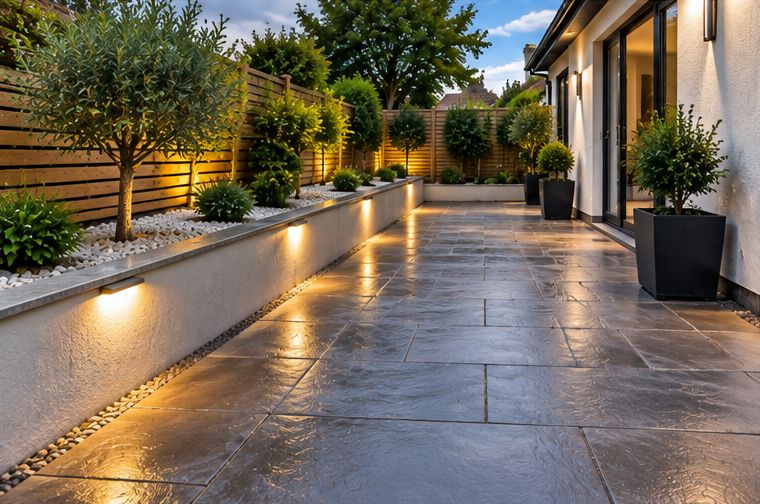
Concrete block is quicker to build and good value for long runs, back boundaries and retaining walls. Bare block looks utilitarian, but finished with render and a coping it gives a clean, modern wall that suits many semis and newer homes. It also works as the hidden structure behind a brick or stone face.
Rendered walls do need occasional attention. A coloured through-render keeps its looks well, while a painted finish will need redoing from time to time, particularly on walls that catch the rain coming up the Usk estuary.
Stone: for older houses and character
Natural stone suits period homes, cottages and gardens where the boundary walls are already stone. It is slower to build and relies on the skill of the person laying it, so it usually costs more than brick for the same length. The result, though, is a wall that weathers beautifully and fits in with older parts of the city.
Where you already have an old stone wall that is bulging or losing its top, repairing it with matching stone and a suitable mortar is often better than replacing it. In Caerleon in particular, check with the council before disturbing the ground for new foundations near the Roman remains. Our article on garden decking for a Caerleon or Langstone home explains why digging there needs extra care.
Clay ground, roots and footings
Much of Newport sits on clay, particularly on the lower ground near the river. Clay swells when wet and shrinks when dry, and that movement cracks walls that sit on shallow foundations. Nearby trees and big hedges make it worse by drying the ground in summer.
For a garden wall that means a proper concrete footing, taken down to firm ground and sized for the height of the wall, and sometimes a movement joint in longer runs. It is the part you never see and the part that decides whether the wall stays straight. Our guide to garden wall foundations explains how we size them.
Height, boundaries and what to check
As a general rule, garden walls up to about one metre next to a road and about two metres elsewhere often do not need planning permission, but that can change for listed buildings, conservation areas and some newer estates with their own restrictions. Check with Newport City Council if you are unsure.
If the wall is on or right beside the boundary line, talk to your neighbour before work starts. Walls on a shared boundary can bring in party wall rules, and it is worth getting proper advice on those. We are builders of walls, not solicitors, but we are always happy to talk through the plan with both neighbours on site.
Retaining walls on sloping plots
Not every Newport garden is flat. On the higher, sloping parts of the city, a wall often has to hold back soil as well as mark a boundary. A retaining wall is a different job from a free-standing one: it needs drainage behind it, a stronger construction and, above a modest height, a design from an engineer. See when a retaining wall needs engineering advice.
Retaining walls can also create useful level space for a patio or lawn, as described in our guide to landscaping a sloping garden.
Talk to T J Landscapes about your garden
Free quotes and honest advice across South Wales.
Questions People Ask
Which is cheaper, brick or block?
A rendered block wall is usually quicker to build than a brick one of the same size, and stone usually takes longest. The real cost depends on height, length, foundations, access and finish, so we price each wall after a free visit.
Can you match the brick on my Newport house?
Often, yes. Many estate bricks are still made, and reclaimed bricks can match older terraces. We bring samples to compare against the house before ordering.
Do I need permission to build a garden wall?
Low walls often do not, but it depends on the height, where the wall is and whether the property is listed or in a conservation area. Check with Newport City Council before building anything tall or on a road frontage.
My old front wall is leaning. Can it be saved?
Sometimes. If the lean comes from a failed footing or tree roots, rebuilding is usually the lasting fix. A wall that has only lost its coping or has loose top courses can often be repaired. We will tell you which after a look.
How do I get a quote for a wall?
Send details and photos through our contact form. Tony will come out, measure up and give you a free quote.