
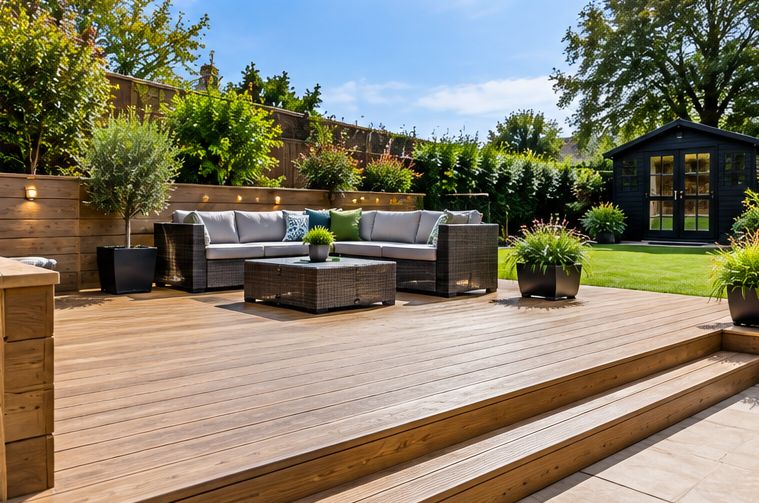
Plenty of gardens have a cracked concrete yard or a dated patio that nobody loves any more. Breaking it out is noisy, messy and means skips of rubble, so a common question is whether a deck can simply go on top.
In many cases the answer is yes. A solid slab can make a very good base for a low deck. But there are a few checks to make first, and the way the frame is built on hard ground is quite different from a deck on soil. Here is what we look at. You can also read more about our garden decking service.
Is the old surface sound enough?
The first job is to look hard at what is already there. A deck spreads its weight through bearers onto the base below, so that base needs to stay put.
- Hairline cracks in a concrete slab are rarely a problem, but wide cracks, sunken sections or a slab that rocks underfoot suggest the ground beneath has moved.
- Patio slabs that are loose, hollow or lifting will carry on moving and take the deck with them unless they are re-bedded or removed.
- Tree roots pushing up the surface will keep pushing, so the tree and roots need to be dealt with first.
- Areas that already pond badly after rain need a drainage plan before anything goes on top.
How the frame sits on a hard base
On a solid slab we do not need posts dug into the ground. Instead, the frame usually sits on bearers laid across the surface, lifted slightly on packers, rubber pads or adjustable supports so the timber never sits in standing water. These supports also let us level the frame on a patio that falls or undulates.
The bearers run in the same direction as the fall of the slab wherever possible, so rainwater can flow between them and off the edge rather than being dammed behind a length of timber. The joists then sit on the bearers, and the boards on the joists, as with any deck.
Where the height available is very limited, low-profile frames and some composite systems are designed for exactly this situation, with slim joists and clip fixings that keep the build-up to a minimum.
The damp-proof course and door heights
This is the check most often missed. Building a deck over an existing patio raises the finished level, and it is easy to end up too close to the damp-proof course of the house or right up against the bottom of a back door.
As a rule of thumb, the top of a deck should sit a good way below the damp-proof course, usually quoted as at least 150mm, so rain splashing off the boards does not soak the wall above it. Air bricks and vents must stay clear, and there should be a small gap between the deck and the wall so water can run away. If the patio is already close to those levels, it may be better to break out the section near the house or choose paving instead.
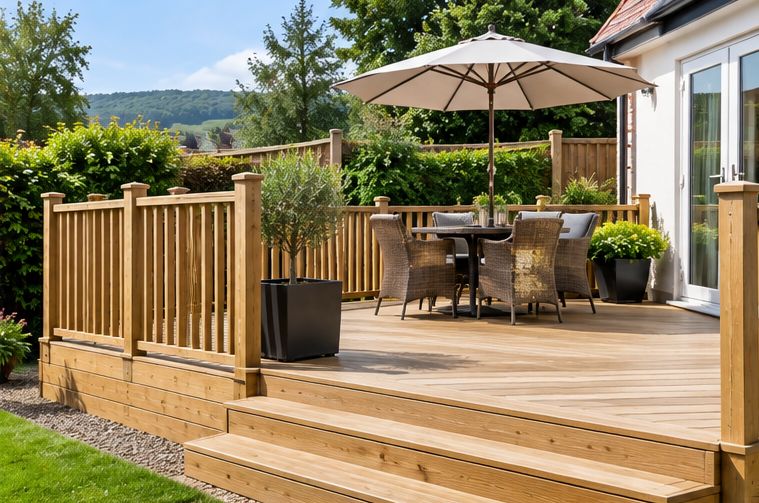
The step out of the back door matters too. A deck that finishes just below the threshold is comfortable and keeps water out. One that finishes level with it, or too far below, can cause problems.
Letting water out and air in
A slab under a deck acts like a tray. If the water it collects cannot get away, the underside of the frame sits in damp air for months, and even treated timber will struggle.
We make sure the fall of the old surface leads to a drain, a soakaway or open ground at the edge, and we leave gaps in any fascia or skirting so air can move through. It is also worth clearing moss, soil and weeds off the old surface before building, since anything left there will rot quietly under the deck. If the garden as a whole holds water, our guide on stopping a garden waterlogging explains the wider options.
Advantages and trade-offs
Building over an existing base has real benefits. There is less digging and less waste to take away, weeds cannot grow up through a sound slab, and a flat concrete base makes a very stable platform. On a tight terraced plot with no side access, avoiding a big break-out can make the whole job simpler.
The trade-offs are height, hidden problems and access. The deck will sit higher than the patio did, any movement in the old base will show in the new deck, and once the boards are down it is harder to get underneath. Leaving a removable board or a hatch over a drain or manhole is sensible.
It is also worth thinking about the edges. Where the old patio is larger than the new deck, the exposed strip can be tidied, re-pointed or planted, and where it is smaller the frame may need a few posts or pads beyond the slab to carry the extra width.
When breaking out is the better choice
Sometimes starting again is the right answer. If the old patio is badly broken, sits too high against the house, or is part of a larger redesign, removing it gives a clean slate. We can lift the old surface, take the waste away and either lay a new patio or build the deck on a properly prepared base.
For the rubble and any other clutter, our garden clearance service takes waste away as part of the job.
Getting a view on your patio
Every old slab is different, and a short visit usually tells us whether it will make a good base. Tony and the team work across South Wales, from terraces in Pontypool, where we are based, to newer estates in Cwmbran and Caerphilly.
If you are deciding between boards, our comparison of composite and timber decking is a good place to start. When you are ready, ask us for free advice and a free quote.
Talk to T J Landscapes about your garden
Free quotes and honest advice across South Wales.
Questions People Ask
Can decking go straight onto concrete without a frame?
Boards should not be laid flat on concrete. They need a frame underneath so water can drain and air can circulate, even if that frame is very shallow.
Do I need to fix the frame to the concrete?
Not always. A low deck on a slab is often heavy enough to stay put, but in exposed spots or where it meets steps we may fix it down at a few points.
Will a deck over a patio be very high?
It depends on the frame. A standard frame adds a noticeable step, while low-profile systems keep it much slimmer. Checking the levels at the back door is the first thing we do.
What happens to a drain cover under the deck?
It must stay accessible. We usually build a lift-out section of boards over manholes and gullies so they can be reached without taking the deck apart.
Is it cheaper to deck over a patio than to remove it?
It often saves on labour and waste removal, but the condition of the base, the levels and the materials all affect the outcome. A free quote will show both options side by side.