
Plenty of gardens in and around Monmouth come with trees that were planted long before the current owners arrived. In the older part of town that might be a single sycamore or ash filling a walled back garden. On the rural edge it could be a line of oaks along a boundary, a beech beside the drive or old fruit trees in what used to be an orchard.
These trees give shade, privacy, wildlife and a sense of age that no new planting can match. They also need looking after. This guide is about how to live well with a big tree in a Monmouth garden: what to watch for, what sort of work helps, and the checks to make before anyone picks up a saw. For the services we offer, see our tree surgery and hedge care page.
Start by getting to know the tree
Before deciding on any work, spend a little time looking at the tree through the year. Most problems give some warning, and noticing them early usually means smaller, cheaper and less damaging work later.
- Deadwood: bare, brittle branches in the crown that do not come into leaf in spring.
- Fungus: brackets or toadstools at the base or on the trunk, which can point to decay inside.
- Cracks and splits: especially where two main stems meet in a tight V.
- Lean: a tree that has started to lean more than before, or soil lifting on one side after a storm.
- Thin or early-browning leaves compared with previous years.
None of these automatically means a tree has to come down. They are reasons to have it looked at properly before deciding.
Wet ground and old roots
Parts of Monmouth sit low beside the Wye and the Monnow, and gardens there can stay sodden for long spells in winter. Trees on permanently wet ground may root shallowly, and a saturated soil gives roots less grip in a gale. If you have a big tree on low ground, keep an eye on it after heavy rain and high winds, and look for fresh cracks in the soil around the base.
Roots are also easily harmed by building work. Digging trenches, raising the soil level, or driving machinery across the root area can damage a tree in ways that only show years later. If you are planning a patio, extension or new drainage near a large tree, talk to us about it first. Our guide to planning for wet ground near the Wye and Monnow covers drainage in more detail.
The work that usually helps
Most mature trees need only modest, occasional work. Taking off too much at once stresses a tree and can cause a mass of weak regrowth, so we aim to do what is needed and no more.
Crown lifting removes the lowest branches to raise the canopy, letting light onto a lawn or clearing a path, drive or roof. Crown thinning takes out selected inner branches so wind and light pass through more easily. Crown reduction shortens the outer branches to bring the size down a little while keeping a natural shape. Deadwood removal does exactly what it says, and is often the most useful single job on an old tree. Our guide to crown lifting, thinning and reduction explains each in more depth.
Topping, where the whole top of the tree is cut off, is something we generally advise against. It rarely solves the problem and often leaves a weaker, uglier tree.
Check before you cut
Monmouth is an old town, and some of its streets and surroundings are covered by conservation rules, while individual trees anywhere can be protected by a tree preservation order. In either case you normally need to notify or get consent from Monmouthshire County Council before carrying out work. The rules have exceptions and details that change, so please check with the council first rather than relying on us or on neighbours.
Nesting birds are protected by law too. Work on trees and hedges between spring and late summer needs a careful look for active nests first. If there is a nest, the work waits. Our general guide, Do You Need Permission to Cut Down a Tree in Wales?, is a good place to start.
When to have the work done
Many broadleaved trees are best pruned in late autumn and winter when they are dormant and the leaves are off, so the shape is easy to see. There are exceptions. Some trees, such as birch and walnut, bleed sap if cut in late winter, and plums and cherries are usually pruned in summer to reduce the risk of disease. Our guide on when trees should be pruned goes through the timings.
Dead or dangerous branches are a different matter and should be dealt with whenever they are found.
If a tree has to come down
Sometimes a tree is too far gone, too close to the house or simply the wrong tree for the space. In a walled garden in the centre of Monmouth there is rarely room to drop a tree in one piece, so we take it down in sections, lowering the branches and trunk in manageable pieces. On bigger rural plots there may be more room, but we still plan the fall around fences, outbuildings and anything else in the way.
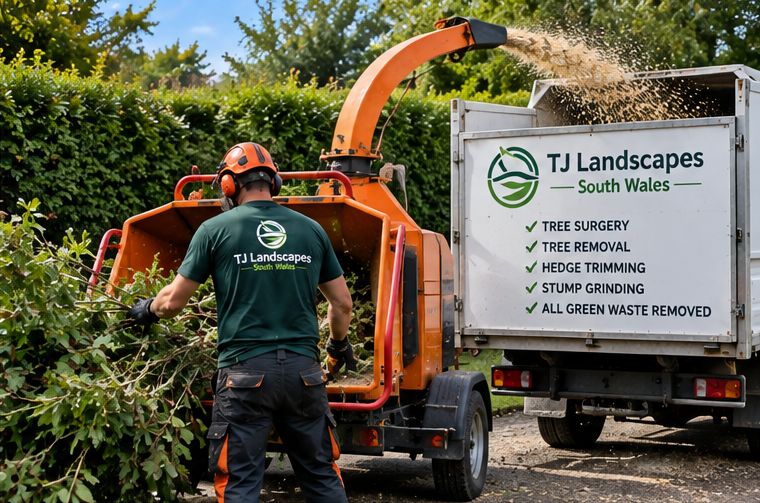
We clear away the brash and timber, and we can grind the stump or leave a section of trunk as a habitat pile if you prefer. It is always worth thinking about replanting. A new tree in the right place keeps the character of the garden going for the next generation. See tree felling or pruning: how to decide for more on weighing it up.
Trees as part of the wider garden
Big trees shape everything around them: where the lawn will grow, where a patio stays dry and how much light reaches the house. If you are planning a makeover, think about the trees first. Lifting a crown or thinning a canopy can make far more difference to a shady lawn than any amount of seed. Our article on large rural garden makeovers around Monmouth explains how we plan bigger jobs in stages.
Tony and the team will look at your trees, talk through the options and give you free advice and a free quote. You can read more about our work across the town on our Monmouth landscaping page, or send us a message to arrange a visit.
Talk to T J Landscapes about your garden
Free quotes and honest advice across South Wales.
Questions People Ask
My neighbour's tree overhangs my Monmouth garden. Can I cut it back?
Generally you can cut overhanging branches back to the boundary, but not beyond it, and you should offer the cuttings back. Protected trees still need council consent first. It is always better to talk to your neighbour before any work starts.
How often does a mature tree need attention?
It depends on the species, its size and what is around it. Many big trees only need a look every few years and occasional deadwood removal. Trees near houses, roads or paths are worth checking more often, especially after storms.
Will crown lifting help my lawn grow under a big tree?
Often, yes. Raising the canopy lets more light and rain reach the ground. Grass under a large tree will never be as thick as in the open, but lifting the crown can make a real difference. Shade-tolerant planting or bark is an option where grass struggles.
What affects the cost of tree work?
The size and type of tree, how much work is needed, access, what lies underneath, and how much timber and brash has to be taken away. Sectional felling in a tight town garden takes longer than open-ground work. We explain it all in a free quote.
Do you take away the wood?
Yes, we clear the brash and timber as part of the job. If you would like some logs left for a wood burner or a habitat pile, just tell us beforehand.