
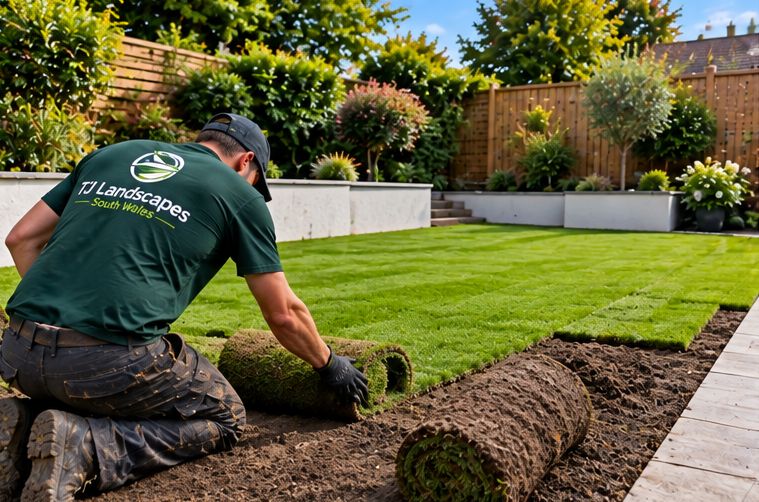
Outside the centre of Monmouth, gardens can be generous. It is common to find a sweep of grass running down from a farmhouse or a newer home on the edge of town, sometimes with an old paddock or orchard beyond. When that grass has gone tired, lumpy or mossy, people often ask whether it is worth starting again with new turf.
Often it is. But laying a large lawn is not simply a small lawn made bigger. The volumes of soil and turf, the time the rolls can sit before laying, the watering, and the way water moves across a big area all change the job. This guide covers what to think about on a larger Monmouth garden. For our lawn work in general, see our turf laying page.
Walk the whole area first
On a big plot, the ground is rarely the same from one end to the other. The top of the garden near the house might be firm and free-draining, while the far end, lower down, holds water for days. Before we plan anything, we walk the area with you, ideally after a spell of rain, and note where the water sits, where the ground dips and where old tree roots, stones or buried rubble might be.
Around Monmouth, the Wye and the Monnow mean that some land is naturally low and damp. That is not a reason to give up on grass, but it may mean draining part of the area, raising it with extra topsoil, or letting the wettest corner become a wildflower patch or damp-loving planting instead of lawn. Our guide to gardens near the Wye and Monnow goes into this in more detail.
Decide how much should be lawn
A lawn that is too big to look after soon becomes a chore. Before laying turf, it is worth deciding how much of the garden really needs to be close-mown grass and how much could be something else.
- Keep fine lawn close to the house, where you sit, play and look out.
- Leave areas further away as longer grass with mown paths through it, which takes far less time and helps wildlife.
- Use gravel, bark or paving under big trees where grass struggles for light.
- Think about where the mower goes. A route that avoids steps and tight corners makes weekly mowing much easier.
Our article on large rural garden makeovers around Monmouth explains how we plan these bigger layouts in stages.
Preparing a large area
Preparation is where a big lawn succeeds or fails. The old grass and weeds are stripped or treated, the ground is cultivated, stones and debris are raked out, and the soil is firmed and levelled. On heavy or compacted ground we may bring in topsoil to give the new roots a decent depth to grow into.
Levels matter more over a large area. A gentle, even fall helps surface water run off rather than sitting in hollows, and small bumps that would barely show in a town garden become obvious lines and scalped patches when you mow a big lawn. Our guide on preparing the ground before laying turf covers the steps in full.
Turf deliveries and timing
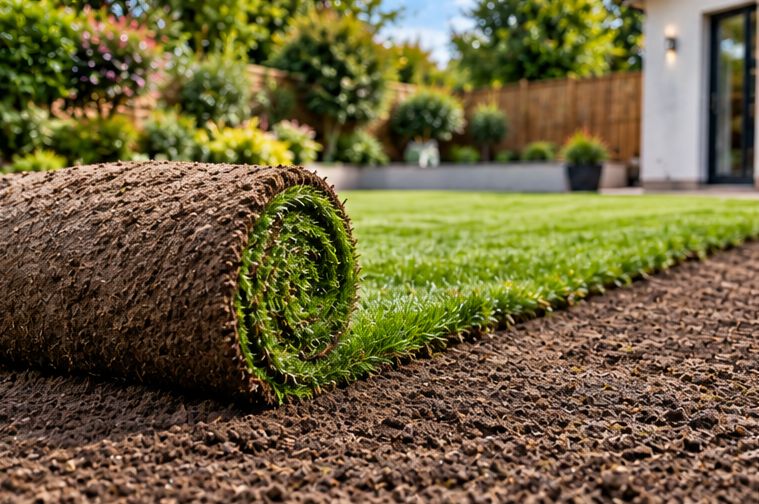
Turf is a living product and should be laid soon after it is cut, ideally within a day or so, before the rolls start to yellow and heat up in the stack. For a big lawn that means planning the delivery carefully. We usually match the order to what can be laid in a day, lay the rolls in batches and keep any waiting turf shaded and damp.
Access matters too. On a rural plot outside Monmouth, a lorry may be able to drop pallets close to the work. In other cases the turf has to be barrowed a long way across the garden, which takes time and is best planned around firm, dry routes. Autumn and spring are usually the best times to lay, when the soil is warm and moist but not waterlogged. Our guide on the best time to lay turf in South Wales explains why.
Watering a big new lawn
Small lawns can be watered with a hose. A large one needs a plan. New turf must not dry out in its first few weeks, and in a dry spell that means a lot of water. A sprinkler moved around the lawn in sections, early in the morning or in the evening, is usually the most practical approach. Pay particular attention to edges and the sunniest parts, which dry first.
In a wet Monmouth autumn you may hardly need to water at all, but keep checking. Lift a corner of a roll now and then to see whether the soil beneath is moist. Our guide on caring for new turf in the first six weeks sets out a simple routine.
Turf or seed for a big area?
For very large areas, seed is sometimes the more practical choice, especially for the rougher parts of a garden where a perfect finish is not needed. Turf gives an instant, usable lawn and copes better with weeds and wet weather while it establishes. Many larger gardens end up with a mix: turf near the house and seed further out. Our comparison of turf and seed goes into the pros and cons.
Keeping it looking good
Once the new lawn has rooted, regular mowing, a feed in spring and autumn, and attention to drainage and moss will keep it in good heart. Big lawns under mature trees often need crown lifting or thinning to let in light; see caring for mature trees in Monmouth gardens. For a year-round routine, read how to look after a lawn through the year.
Tony and the team lay lawns of all sizes, from small town gardens to large plots outside Monmouth, and can combine turfing with drainage, topsoil, edging and fencing. Read more on our Monmouth landscaping page, or ask us for free advice and a free quote.
Talk to T J Landscapes about your garden
Free quotes and honest advice across South Wales.
Questions People Ask
How long does it take to lay a large lawn?
It depends on the size, how much preparation the ground needs, the access and the weather. The preparation often takes longer than the laying. We give you a realistic timescale when we quote.
Part of my garden is always wet. Can it still be turfed?
Often, yes, once the reason for the wet is understood. A land drain, extra topsoil or regrading can help. On land that floods from the river, there are limits, and damp-loving planting may be a better choice for the lowest parts.
Can I walk on the new lawn straight away?
Keep off it as much as possible for the first few weeks while the roots grow into the soil below. Light foot traffic to move a sprinkler is fine, but avoid heavy use until the turf is firmly rooted.
What affects the cost of laying a large lawn?
The area, how much clearing and preparation is needed, whether topsoil or drainage is required, access for deliveries and barrows, and how much waste has to go. We explain it all in a free quote.
Should I use a ride-on mower on new turf?
Not until it is firmly rooted. When you do start, set the blades high for the first few cuts and avoid turning sharply on the new grass.