
Plenty of homes in Chepstow start with a climb before you even reach the front door. There might be a flight up from the pavement, a narrow side path to the back and more steps again down to the garden. When these are uneven, slippery or crumbling, the whole house feels harder to live in.
This guide is about getting those routes right: where they go, how the steps are sized, which paving grips and how to keep water off them. We build paths and steps as part of our patio and paving work, often alongside walls and terraces.
Map the routes you actually walk
Before choosing any materials, think about the journeys made every week. Front door to pavement. Back door to the washing line. Side gate to the bins and back. The shed or the vegetable beds at the bottom of the garden. Each route has its own needs; the bin run has to take wheels, the washing line route is walked with a full basket, and the front steps are used in the dark in winter.
Chepstow gardens often have routes that grew up over time, with a few steps added here and a path there. Laying them out afresh can remove awkward corners and let one flight of steps do the work of two. If you are also reworking the levels of the garden, our guide to landscaping a steep Chepstow garden explains how the routes fit into the bigger plan.
Slope, ramp or steps?
A gentle fall can be handled by a sloping path with no steps at all, which is easier with bins, barrows and pushchairs. As the gradient steepens, a path becomes tiring and slippery, and steps are the safer choice. Where there is room, a mix works well: a sloping path with a few steps at the steepest point, or a longer zig-zag route that eases the climb.
If anyone in the house uses a wheelchair or walks with a frame, tell us early. A proper ramp needs far more length than most people expect, and on a steep Chepstow plot it may need a very different layout.
Steps that feel right underfoot
Comfortable garden steps have a lower rise and a deeper tread than the stairs inside a house. As a rough guide, a rise of around 150mm with a tread of at least 300mm feels easy outdoors, and every step in a flight should match. An odd step, a little taller or shorter than the rest, is the one people trip on.
- Keep risers even through each flight, adjusting the landings rather than the steps.
- Add a landing on long flights, so there is somewhere to pause, turn or put a bag down.
- Give each tread a slight fall to the front or side so rain runs off rather than pooling.
- Make the nosing visible, with a contrasting edge or a light, so the step edge is clear at dusk.
Materials that grip in the wet
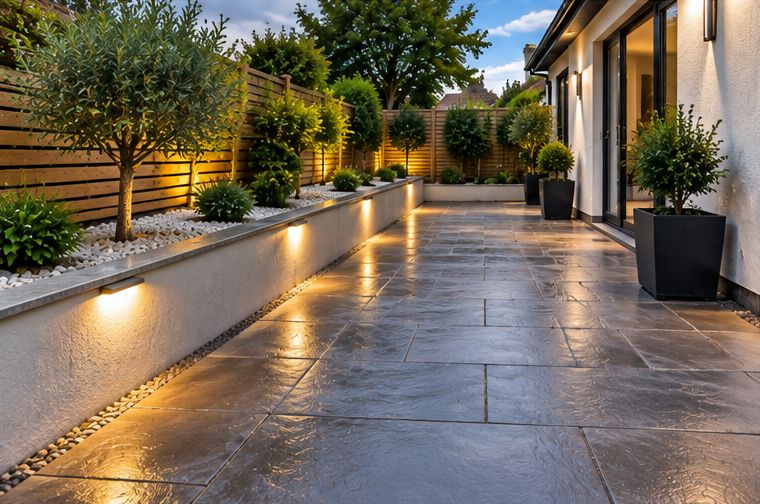
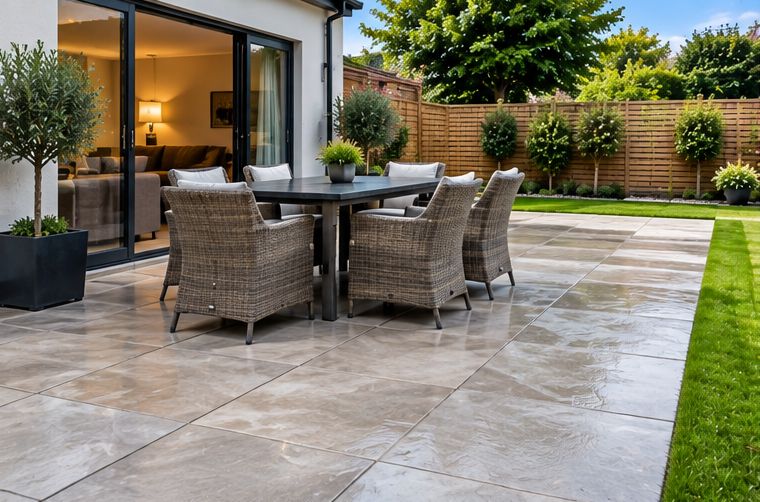
Chepstow gets its share of rain, and steps under trees collect leaves and moss through autumn and winter. That makes grip the first test for any material. Riven natural stone and textured sandstone have a rough face that stays grippy. Many porcelain ranges come in outdoor grades with a textured finish, but smooth tiles meant for indoors should be avoided outside. Block paving and brick work well for paths and give a good foothold.
On period homes, reclaimed or natural stone steps usually sit better against old walls. On newer houses, sawn sandstone or porcelain with a matching patio can tie everything together. Our natural stone patios for period homes in Chepstow guide and the natural stone paving page look at the options. Gravel is cheap to lay but tends to wash downhill on steep paths, so we keep it to gentle slopes with firm edging.
Building steps that stay put
Steps on a slope are always being pushed downhill by the soil behind them and loosened by water running over them. Good steps sit on a proper concrete base, with each riser bedded firmly and the treads fixed in mortar rather than laid loose. Paths need a compacted sub-base and solid edging, especially on the downhill side, where an unrestrained edge slowly creeps away.
Water needs a planned route too. A path that runs down the slope can turn into a stream in heavy rain, so we build in a cross fall, a channel or a gravel strip to take water to the side. Our guide to garden steps in brick and stone covers the construction in more depth.
Old stone steps: repair or replace?
Many older Chepstow gardens have stone steps that have been there a very long time. Worn, dished treads have character, but a rocking or tilting step is a hazard. Often the stone itself is fine and just needs lifting and rebedding on a sound base, perhaps with one or two broken pieces replaced to match.
Where a flight has sunk, or the steps are so uneven that no amount of patching will make them safe, rebuilding is the better route. We can often reuse the original stone for the new treads so the garden keeps its look.
Handrails, lighting and the finishing details
A simple handrail on a steep flight makes a huge difference, especially in winter. Timber, galvanised steel and black metal rails can all be fixed to posts or to a sound wall beside the steps. Low-level lighting along the route, set into the risers or on short posts, helps you see each edge on dark evenings.
Planting softens the sides of a path, but keep it back from the walking line so wet leaves do not spread across the treads. If the route leads through a side gate, see our guide to gates and fencing for a Chepstow home so the two are planned together.
For a look at the kind of work we do in the town, visit our landscaping in Chepstow page. When you are ready, ask for a free quote and Tony and the team will walk your routes with you.
Talk to T J Landscapes about your garden
Free quotes and honest advice across South Wales.
Questions People Ask
What is a comfortable height for garden steps?
Around 150mm per step, with a tread of at least 300mm, feels easy for most people outdoors. The most important thing is that every step in the flight is the same.
Which paving is least slippery for steps in Chepstow?
Riven natural stone, textured sandstone and outdoor-grade porcelain with a textured finish all grip well. Keeping the steps clear of moss and leaves matters as much as the material.
Can you repair our old stone steps rather than replace them?
Often, yes. Loose or rocking steps can usually be lifted and rebedded on a firm base, with damaged stones replaced to match. If the flight has sunk badly, rebuilding may be the safer choice.
Can you add a handrail to existing steps?
Yes, as long as there is sound ground for posts or a solid wall to fix to. We can add one as a small job or as part of a larger path and steps project.
Will you take away the old paving and soil?
Yes. Old slabs, broken steps and spoil are cleared and taken away as part of the job.