
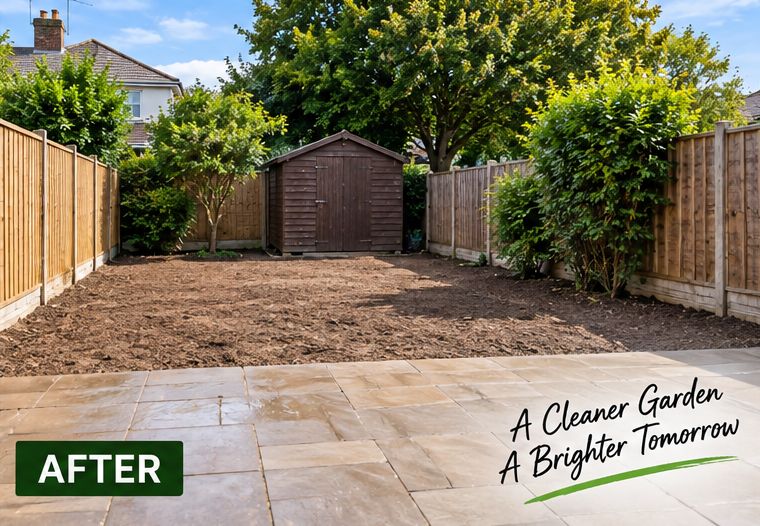
Leave an Aberbeeg garden for a couple of seasons and it disappears. The moisture and shelter that make the valley green also suit bramble, ivy, nettles and self-sown trees, which spread from the banks behind the houses into any ground left unattended. Steps vanish, walls are swallowed and the shed becomes hard to reach.
This guide explains how we tackle overgrowth in the village, with the slopes, narrow access and wet soil in mind. Our garden clearance page covers the service generally, and landscaping in Aberbeeg shows what often comes next.
What usually takes hold
Most overgrown gardens in Aberbeeg have a similar cast:
- Bramble, arching in from the bank and rooting wherever a stem touches the soil
- Ivy, climbing walls, fences and trees and hiding the state of whatever is underneath
- Self-sown saplings, often sycamore or ash, which can be sizeable trees within a few years
- Nettles, docks and long grass in the flatter, richer patches
- Moss and algae on old paths and steps, making them slippery
- Buried rubbish: old pots, broken slabs, rotten timber and garden furniture
Japanese knotweed and some other invasive plants are a different matter, controlled by law and not something to cut and carry away with ordinary green waste. If we suspect one, we will stop and tell you, so you can get the right treatment arranged.
Agreeing what stays
Before anything is cut, we walk the garden with you and agree what to keep. A good shrub, an old rose or a stone edge can be buried under years of growth, and it is easier to save them if we know about them at the start. We mark those and work round them.
It also helps to know what the garden will become. If a new patio or lawn is planned, we can clear right down to bare soil; if you simply want the garden tidy and usable, we may leave established planting and cut back only what has got out of hand. Planning a garden makeover in Aberbeeg can help you decide.
Working on the bank without making it slip
Many Aberbeeg gardens run up into a steep bank, and that bank is often held together partly by what grows on it. Stripping every root off a slope and leaving bare soil through a wet winter can let it wash down into the garden below.
So on steep ground we usually cut growth back to the base rather than dig it out, clear the lower part of the slope thoroughly and leave the upper part stable. Where you want the bank tamed for good, it is worth thinking about planting it up, terracing it or building a wall. Our guide on retaining walls on steep ground in Aberbeeg explains the options, and larger trees on the slope are covered in tree work on steep banks near Aberbeeg.
Getting the waste out
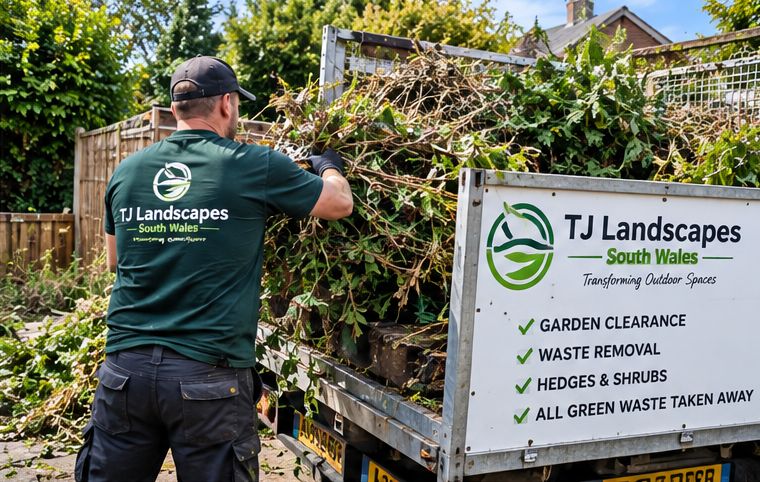
Many cottages and terraces in the village have no vehicle access to the back garden. Waste leaves by steps, a side path or occasionally through the house. We bag and carry material to the van, cut bulky growth into manageable pieces and protect any route through your home. Where it helps, we chip woody material on site so there is less to carry.
Green waste is taken away for composting, and general rubbish is sorted and disposed of properly. You do not need to hire a skip or fill your own bins. For what we can and cannot remove, see what can and cannot go in a garden clearance, and for where it ends up, garden waste: where it goes.
Birds, hedgehogs and timing
Overgrown gardens are good for wildlife, and a cleared Aberbeeg garden next to a wooded bank will have visitors. Nesting birds are protected, so from early spring to late summer we check hedges and thickets before cutting and hold off where there is an active nest. Autumn and winter are usually the easiest time for a heavy clearance, and we work carefully round piles where hedgehogs or frogs may be sheltering.
What the cleared ground tells us
Once the growth is gone, the real garden shows itself. That is the moment to look at where water sits, whether old walls are leaning, how the paths and steps have fared and where the light falls. It is common in the village to uncover wet patches that the brambles were quietly thriving on.
Ivy deserves a special mention. On old stone and brick walls it can be the only thing hiding loose pointing or a bulge, and pulling off decades of growth can bring mortar with it. We cut ivy at the base first and let it die back where a wall looks fragile, then remove it once it has loosened its grip. The same caution applies to ivy on a fence that is already leaning, since the weight of growth may be what is holding it in place, or pulling it over.
We will point out what we see and what might be worth doing, with no obligation. If damp is the issue, dealing with damp ground in an Aberbeeg garden is a sensible next read.
Stopping it coming back
A cleared garden left bare will fill again within a season or two, especially next to a bank full of bramble. The simplest defences are covering ground you are not using with membrane and gravel or bark, keeping a clear strip along the foot of the slope, and cutting back new bramble shoots each spring before they root. Planting the ground with something you do want is often the best cover of all.
If you would like us to clear your garden, send a few photos and a note of the access through our enquiry form.
Talk to T J Landscapes about your garden
Free quotes and honest advice across South Wales.
Questions People Ask
How long does it take to clear an overgrown Aberbeeg garden?
It depends on the size, how dense the growth is, the slope and how far waste has to be carried. Many small gardens take a day or two, and we give you a clear idea when we quote.
Do you take all the waste away?
Yes. Green waste is taken for composting and other rubbish is sorted and disposed of properly, so nothing is left piled in the garden or the lane.
Can you clear a garden I cannot get into at the moment?
Usually. We cut our way in from the nearest access point and work back. Photos taken from the door or an upstairs window help us plan.
Should I clear the garden before selling or letting the house?
A tidy, usable garden helps a property show well. See clearing a garden before selling or letting a house for what to prioritise.
Do I need to be at home while you clear the garden?
Not necessarily, as long as we can reach the garden and know what is staying. We agree everything on the first visit and send photos or a call if something unexpected turns up, such as a buried wall or a plant we are unsure about.
What affects the cost of a clearance in Aberbeeg?
The amount and type of growth, any trees or stumps, the volume of rubbish, how steep the garden is and how far waste has to be carried to the van. Tony gives a free quote after seeing it.