
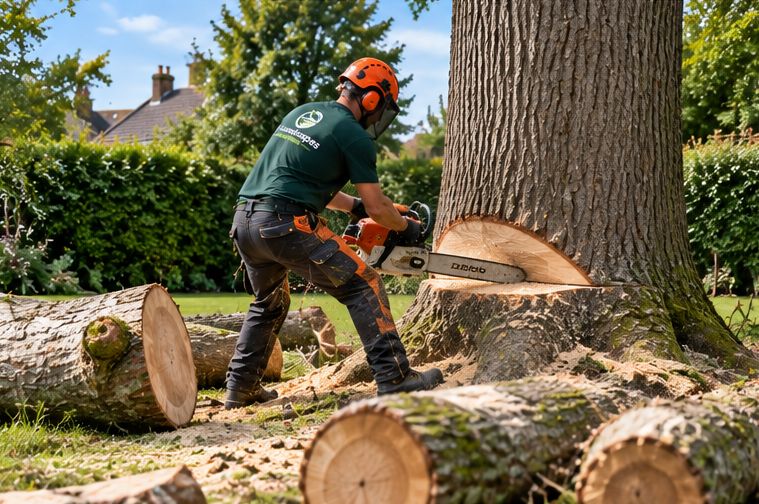
Aberbeeg sits low where two valleys join, and the hillsides come down close behind many of its terraces and cottages. Plenty of those slopes carry trees, from self-sown ash and sycamore to old hedgerow oaks and hollies. Some grow inside the back garden; others lean in from land beyond the fence.
Most owners do not want the trees gone. They want more light, fewer leaves in the gutters and branches kept off the roof. This guide looks at how tree work is planned on a steep Aberbeeg bank, what to check before anything is cut, and the choices between pruning and felling. Our tree surgery and hedge care page describes the service, and landscaping in Aberbeeg shows how it fits into the rest of the garden.
First question: whose tree is it?
On a hillside the boundary is not always obvious. A fence may stop halfway up the slope, or there may be no fence at all, just a line of old stones in the bracken. Before planning any work, find out whether the tree is on your land, a neighbour's, or ground owned by someone else such as the council or a private landowner. Your deeds or the Land Registry plan are the place to start.
Generally, you can cut back branches that overhang your boundary, but not work on the rest of someone else's tree without their agreement, and the cuttings belong to the tree's owner. If in doubt, talk to them first. We are landscapers, not solicitors, so for a genuine dispute we would suggest proper legal advice.
Rules to check before cutting
Some trees are protected by a tree preservation order, and trees in a conservation area usually need notice given to the council before work. Wild birds' active nests are protected by law, which is why spring and early summer need extra care. Larger-scale felling outside a garden can also need a felling licence from Natural Resources Wales.
For trees around Aberbeeg, the local planning authority is Blaenau Gwent County Borough Council, and it is worth asking them before any significant pruning or felling. Our home guide, do you need permission to cut down a tree in Wales, sets out the general position.
Why banks change the approach
Tree roots help bind the soil on a slope. Take a large tree out of a steep bank and grind or dig out its roots, and you remove some of what holds that ground together. That does not mean trees on banks can never be felled, but it is one reason we often suggest reducing or lifting a tree rather than removing it, and leaving stumps in the ground where they sit on a slope.
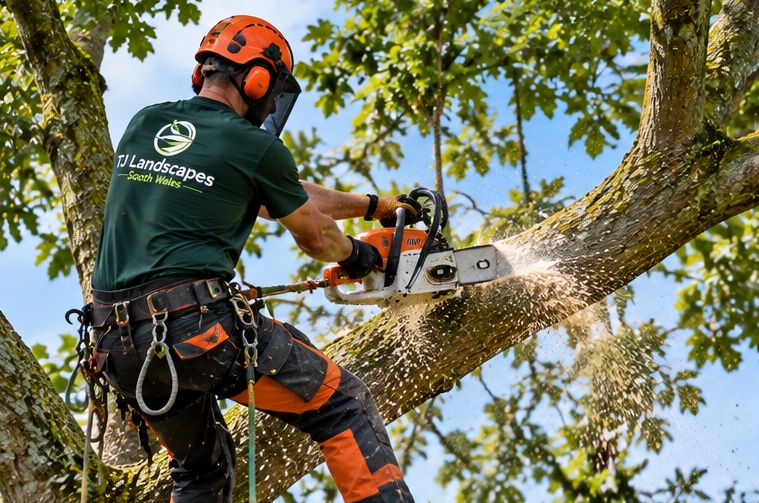
The bank also dictates how branches come down. On level ground, cut wood can often be dropped into open space. Behind an Aberbeeg cottage there may be a roof, a wall and a greenhouse below, and a slope that sends anything dropped rolling downhill. So more of the work is done by lowering sections on ropes, piece by piece, and the working area below is kept clear throughout.
Options that keep the tree but let in light
In a village hemmed in by hills, a tree on the southern side of a garden can take away what little winter sun there is. Before choosing felling, look at the lighter options:
- Crown lifting: removing lower branches so light passes underneath and the space below becomes usable
- Crown thinning: taking out selected inner branches so the canopy lets more light and wind through
- Crown reduction: shortening the outer branches to bring down the overall size
- Deadwood removal: taking out dead or broken limbs that could fall onto a garden or path
Each has limits, and not every tree responds well to heavy cutting. Our guide to crown lifting, thinning and reduction explains the differences, and tree felling or pruning helps with the bigger decision.
When removal is the right call
Sometimes a tree has outgrown its place: it is dead or dying, badly split, leaning towards a house, or pushing against an old retaining wall. On a bank we may take it down in sections from the top and leave the stump to hold the ground. If a wall has been damaged, the repair is planned alongside the felling; see retaining walls on steep ground in Aberbeeg.
Felling on a slope can also open up a surprising amount of garden. Once the light comes in, a strip of lawn or a seating area may become possible where only moss grew before.
Hedges along the foot of the slope
Many Aberbeeg gardens have a hedge where the garden meets the bank, often holly, hawthorn or privet mixed with bramble. Left alone these grow tall and wide in the damp, and cutting them back from a sloping side is awkward. We trim, reduce and reshape them, and can lay an old hawthorn hedge where the stems suit it. The guide to hedge trimming covers timing.
Clearing up on awkward ground
Branches and logs have to leave the site, often by the same steps or narrow path the owner uses. We cut wood to manageable sizes, chip what we can and take the green waste away. If you would like logs left for a stove, say so beforehand. Where the bank has become overgrown as well, the tree work can be combined with a clearance; see clearing overgrowth from an Aberbeeg garden.
To arrange a free look at the trees above your garden, use the enquiry form and tell us roughly where they stand.
Talk to T J Landscapes about your garden
Free quotes and honest advice across South Wales.
Questions People Ask
Can I cut back branches from a tree on the bank behind my Aberbeeg house?
Usually you can cut overhanging branches back to your boundary, as long as the tree is not protected and you do not harm the tree as a whole. Offer the cuttings to the owner. Check with the council first if a preservation order or conservation area might apply.
Will removing a tree make the bank unstable?
It can affect it, which is why we often leave the stump and roots in place on a slope and prefer pruning where it achieves what you want. Where a bank is already moving or a wall is failing, we will say so and suggest the next step.
When is the best time for tree work around Aberbeeg?
Many trees are pruned in late autumn or winter, when they are dormant and birds are not nesting. Some species are better cut at other times. When should trees be pruned explains this.
How do you work on trees above a roof or greenhouse?
By taking the tree down in smaller pieces and lowering them on ropes rather than letting them fall, with the area underneath kept clear. The guide what happens on the day a tree surgeon visits walks through a typical day.
What affects the price of tree work on a slope?
The size of the tree, how steep and tight the site is, what sits underneath, how much of the work needs lowering on ropes, and how much wood and green waste there is to remove. We quote for free after seeing it.