
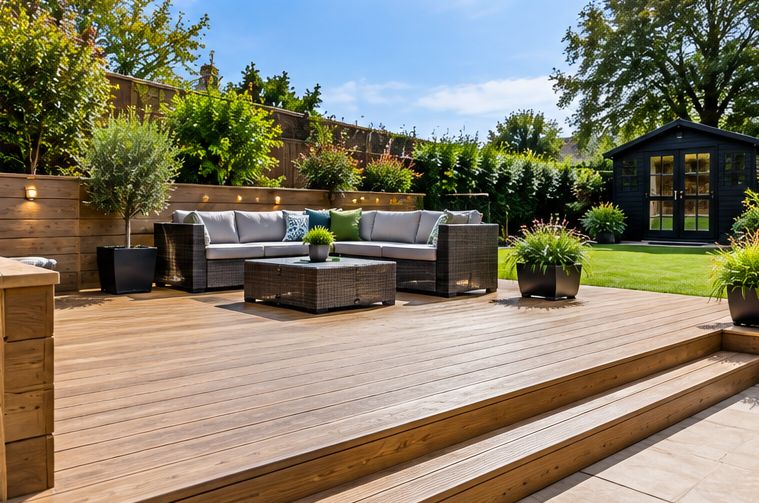
A lot of the people who ask us about decking in Caerphilly have young children, a dog or both, and not much spare time. They like the idea of a deck: warm underfoot, a step down from the patio doors, somewhere for toys and a paddling pool. What puts them off is the thought of splinters in small feet and a weekend every spring spent scrubbing and staining.
Composite decking answers most of those worries. This guide explains what it is, why it suits many family gardens in and around Caerphilly, and what to think about before you choose. For all our local work, see the landscaping in Caerphilly page.
What composite boards are made of
Composite decking boards are made from a blend of wood fibre and plastic, formed into boards that look like timber but behave differently. Many are capped with a tougher outer layer that resists staining and fading. They are cut and fixed in much the same way as timber boards, onto a frame of joists, but they do not need oiling or staining and they do not split.
Quality varies a great deal between brands, so it is worth looking at samples in person. Some cheaper boards feel hollow underfoot and fade quickly; better ones feel solid and hold their colour. We are happy to bring samples when we visit.
Why families in Caerphilly choose it
For busy households, including the many Caerphilly parents who spend their weekdays commuting to Cardiff, these are the points that usually tip the balance:
- No splinters. Composite does not crack and splinter the way ageing softwood can, which matters when children run about barefoot.
- Better grip in the wet. Most composite boards have a textured surface that stays grippier than smooth timber once algae starts to build up.
- Little upkeep. A wash with warm soapy water a couple of times a year is usually enough. There is no staining or sealing.
- Stain resistance. Spilt juice, felt-tip and muddy paw prints wipe off capped boards far more easily than bare wood.
- Long life. Good composite lasts much longer than untreated softwood, so the deck should see the children through to their teens and beyond.
It is not perfect. Composite is heavier and costs more to buy than softwood, and dark boards can get hot in strong sun. We cover the wider comparison in composite or timber decking for a South Wales garden.
The frame matters as much as the boards
A composite deck is only as good as the structure under it. The joists need to be closer together than for timber boards, because composite is more flexible, and the frame needs to be set on firm footings, level and with enough air moving underneath to stop damp building up.
This is especially important in the newer parts of Caerphilly, where garden ground is often compacted clay that holds water. We lay a membrane and gravel under the deck to keep weeds down and let water drain, and we set the posts on solid footings rather than straight into soft soil. Our guide to what lies under a new-build garden in Caerphilly explains why that ground can be tricky.
Decks on sloping new-build plots
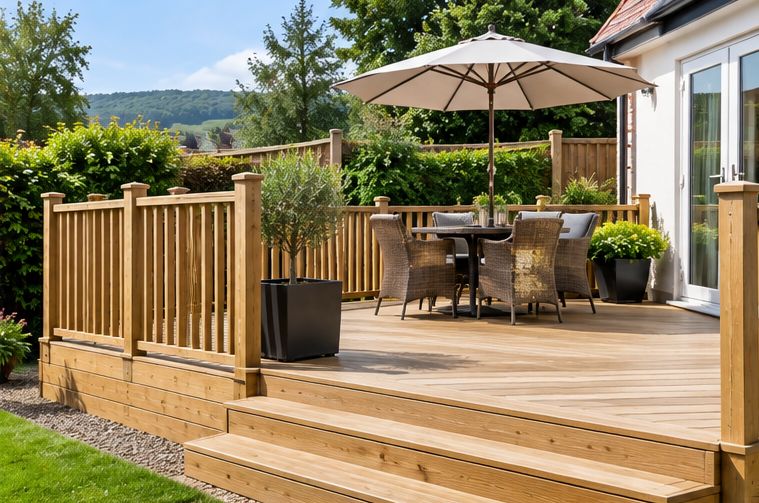
Plenty of family homes on Caerphilly's newer estates have a back garden that falls away from the house, sometimes steeply, with a small level strip by the doors and a bank beyond. A deck is often the neatest way to create a flat, usable area level with the kitchen, standing on posts over the slope without the retaining walls a patio would need.
If the deck will be raised, it needs a sturdy balustrade, especially with toddlers around, and steps with a handrail down to the lawn. Raised decks can need planning permission, so check with Caerphilly County Borough Council first. Our guide to raised decking covers the general points.
Sizing a deck for family life
It is easy to build a deck too small. Lay out the furniture you have, or plan to buy, on the lawn and walk around it. Allow room to pull chairs out, to get past with a tray and, if the children will play on it, to spread out a game. On the other hand, a deck that takes over the whole garden leaves no grass to run on.
A few ideas that work well in family gardens:
- A wide, shallow step along the edge that doubles as extra seating.
- Built-in storage under a bench for cushions and outdoor toys.
- Low lights set into the steps so they are safe after dark.
- Planters along the edge to soften the look and screen the neighbours.
Looking after it through the year
Composite is low maintenance rather than no maintenance. In a Caerphilly garden, the jobs are simple: sweep leaves off in autumn so they do not sit and stain the boards, keep the gaps between boards clear so rain can drain through, and give the surface a wash with a soft brush and soapy water in spring. Avoid metal shovels and rock salt in icy weather, as they can mark the capping.
Check the ground under the edges now and then too. If soil or bark from a nearby border builds up against the frame, it holds moisture and cuts off the airflow the deck needs. A clear gap around the edge helps the whole structure stay dry and sound for longer.
Patio or deck?
If you are still deciding between boards and slabs, our local guide Patio or Decking for a Caerphilly Garden? looks at how slope, shade and upkeep point one way or the other. You can see our decking service across the region on the garden decking page, and more about decks around the town on garden decking in Caerphilly.
Tony and the team will measure up, look at the levels and suggest a layout that suits your family. Send us a message to arrange a free visit and quote.
Talk to T J Landscapes about your garden
Free quotes and honest advice across South Wales.
Questions People Ask
Does composite decking get slippery?
Much less than smooth timber, but any surface in shade will pick up some algae in a damp South Wales winter. A wash in spring and autumn keeps it grippy. Our guide on how to stop decking going slippery has more tips.
Is composite decking safe for dogs?
Yes. It does not splinter, and most capped boards resist scratching from claws better than soft timber. Wash off any accidents promptly.
What affects the cost of a composite deck?
The size, the height above the ground, the board you choose, the frame and footings needed, any steps and balustrades, and access to the back garden. We explain all of it in a free quote.
Can composite decking be laid in a shady garden?
Yes, and it copes better than timber in shade because it does not rot. Choosing a textured board and leaving good airflow under the deck helps.
How long does it take to build?
A straightforward ground-level deck usually takes a few days. Raised decks with steps and balustrades take longer. We will give you a realistic timescale when we quote.