
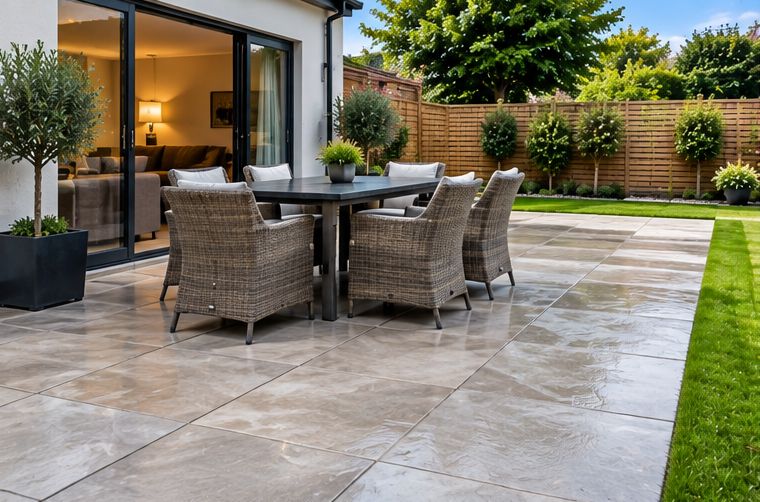
It is one of the first questions people ask when we visit a garden in Caerphilly. They want a proper place to sit outside, they have seen neighbours with both, and they are not sure which will suit their own plot. There is no single right answer for the town, because the gardens here vary so much, from the long, fairly level plots behind older semis to the sloping, freshly graded gardens on the newer estates.
This guide sets out how we think the choice through for Caerphilly homes. For the general comparison of timber and composite boards, see composite or timber decking for a South Wales garden, and for the rest of our local work, the landscaping in Caerphilly page.
Look at the ground before the brochure
The shape of the land matters more than anything else. On a flat garden, or one with only a gentle fall, a patio is straightforward: we dig out, lay a compacted sub-base and set the slabs with a slight fall for rain to run off.
Where the garden drops away from the back door, the sums change. To build a patio level with the house on falling ground, the low side has to be built up with a retaining wall and a lot of compacted fill. A deck simply stands on posts, and the posts get longer where the ground drops. Some Caerphilly streets climb the hillsides that ring the town, and on those plots a raised deck is often the quicker and neater way to get a flat seating area.
New-build gardens bring a different problem. The ground is often uneven, compacted and full of clay, which a patio base has to be dug through and a deck can sit above. Our guide to what lies under a new-build garden in Caerphilly explains what we usually find.
Sun, shade and a damp climate
South Wales is wet, and Caerphilly sits in a basin surrounded by hills that catch plenty of rain. Any outdoor surface that stays in shade will grow algae over the winter. On a patio, that shows as a green film you can pressure wash off. On timber decking, it makes the boards slippery and, over the years, speeds up rot if water sits in the grooves.
So if the only spot for your seating area is on the north side of the house or under a tree, paving usually copes better. A riven or textured slab gives grip when it is damp. If the chosen spot is open and sunny, both will do well. Our article on which patio paving copes best with Welsh rain compares the materials.
Where each one usually wins
After seeing a lot of gardens around the town, these are the patterns we notice:
- Patio: level plots behind older semis, shady corners, areas where heavy furniture or a hot tub will sit, and anywhere you want a surface that will outlast the house's next few owners.
- Deck: gardens that fall away from the back door, lumpy new-build ground, seating raised to meet a patio door, and plots where digging out and carting away soil would be difficult.
- Both: paving by the house for the everyday traffic, with a deck lower down the garden where the ground drops or where the evening sun lands.
What each asks of you afterwards
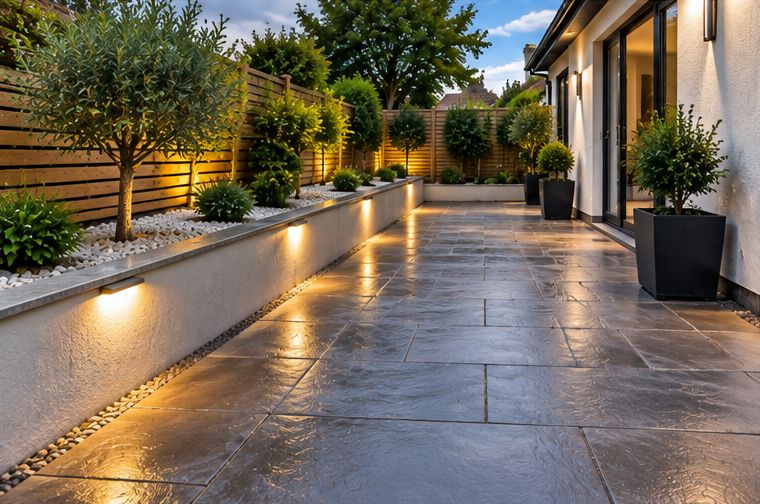
A well-laid patio needs very little: a sweep, a wash once or twice a year and an occasional look at the joints. Timber decking needs cleaning each year and treating every so often to keep it looking good. Composite boards sit in the middle, needing a wash but no staining. For households where both adults are out at work in Cardiff or elsewhere all week, that difference in weekend jobs can decide the matter.
We have written separately about composite decking for Caerphilly family gardens if you like the idea of boards but not the upkeep.
Living with the house next door
On a semi or a closely packed estate, raising the seating area also raises you into your neighbour's view, and them into yours. A deck built high on a sloping plot can look straight over a fence. A patio at ground level avoids that. If a raised area is the only practical option, we plan screening or planting along the edge from the start. Raised decks and platforms can also need planning permission, so check with Caerphilly County Borough Council before committing to one.
Where the rain goes afterwards
Both options change how water leaves the garden, and on the heavy ground found under many Caerphilly lawns that matters. A patio sheds every drop of rain that lands on it, so it needs a fall towards a border, a gully or a soakaway, and on clay a channel drain along the low edge is sometimes worth adding. A deck lets rain fall through the gaps onto the soil beneath, which is kinder to drainage, but the ground under it should be covered with a weed membrane and gravel so it does not turn into a damp, weedy hollow.
If your garden already holds puddles after a wet week, tell us when we visit. Sorting the drainage first will help whichever surface you choose, and our guide on how to stop a garden waterlogging explains the usual fixes.
Making the decision on site
The best way to settle it is to stand in the garden, look at the levels and the light, and talk through how you would use the space. Tony and the team lay patios, block paving and paths on our patio and paving service, and build timber and composite decks through our garden decking service, so we have no reason to push you one way.
You can read more about each in the town on our patio paving in Caerphilly and garden decking in Caerphilly pages. When you are ready, send us a message with a photo of the garden and we will arrange a free visit.
Talk to T J Landscapes about your garden
Free quotes and honest advice across South Wales.
Questions People Ask
Is a patio or decking cheaper in Caerphilly?
It depends on the garden. On level ground a patio is often simpler; on a slope, a deck can avoid the walls and fill a patio would need. Size, access, materials, levels and waste all drive the cost, and we explain them in a free quote.
Which lasts longer?
A properly laid patio on a sound base will usually outlast a timber deck by many years. Composite decking lasts longer than softwood, but paving is still the most durable surface for most gardens.
Can you build decking over an old concrete patio?
Often, if the concrete is sound and drains, a low deck can go over it on a frame. See our guide to building decking over an old patio.
Is decking a problem in the wet?
Timber can get slippery in shade and damp. Choosing a grooved or anti-slip board, allowing air to move underneath and cleaning it each year helps a great deal.
Can we have a patio now and add a deck later?
Yes. If we know a deck may follow, we can plan the patio's edge and levels so the two join neatly when the time comes.