
When the new town estates of Cwmbran were laid out, small trees were planted in back gardens, along boundaries and on the green strips between houses. Decades later, many of them are far bigger than anyone expected. They shade lawns, drop leaves into gutters, push against fences and hang over the neighbour's patio.
This guide looks at boundary trees in Cwmbran gardens from the practical side: working out whose tree it is, talking to neighbours, what to check before cutting, and the kinds of tree surgery and hedge care that deal with the problem without spoiling the tree.
First, whose tree is it?
It sounds obvious, but it is the question that causes most of the trouble. A tree belongs to whoever owns the land its trunk grows from. On a Cwmbran estate that may be you, your neighbour, or neither of you: some trees stand on land kept by the council or a housing association, particularly along paths, verges and the edges of open spaces.
Your deeds and the title plan can help, and so can asking neighbours who have lived there longer. If a tree seems to be on public land, contact Torfaen council or the landlord rather than cutting it yourself. We are landscapers, not solicitors, so where ownership is genuinely unclear it is worth getting proper advice before anything is cut.
Branches over the fence
In general, you can cut back branches that overhang your garden, as far as the boundary line, without the owner's permission. There are limits, though. You should not go onto their land or reach over to cut beyond the boundary, you should not do anything that kills or badly damages the tree, and the branches you remove belong to the owner, so the usual courtesy is to offer them back.
In practice, cutting a tree back hard along one side can leave it lopsided and unhealthy, and nobody enjoys a row over the fence. Most Cwmbran neighbours would rather agree a plan. If you both want the tree reduced, it is often better to do the work together, shaped from both sides, and share the job.
Checks to make before any cutting
Some trees are protected, and it is your responsibility to check before work starts. Our guide to whether you need permission to cut down a tree in Wales covers the rules in more detail, but the main points are these:
- Tree preservation orders. A tree covered by a TPO usually needs the council's consent before pruning or felling. Torfaen council can tell you whether one applies.
- Conservation areas. Some of the older village parts of Cwmbran may fall within one, where notice is normally needed before tree work. Check with the council if you are unsure.
- Nesting birds. It is an offence to disturb an active nest, so heavy cutting in spring and early summer needs a careful look first.
- Tenancy and covenants. Tenants should ask their landlord, and some estate deeds say something about trees and boundaries.
We will mention anything we notice when we visit, but the checks themselves are for the owner to make.
Choosing the right kind of work
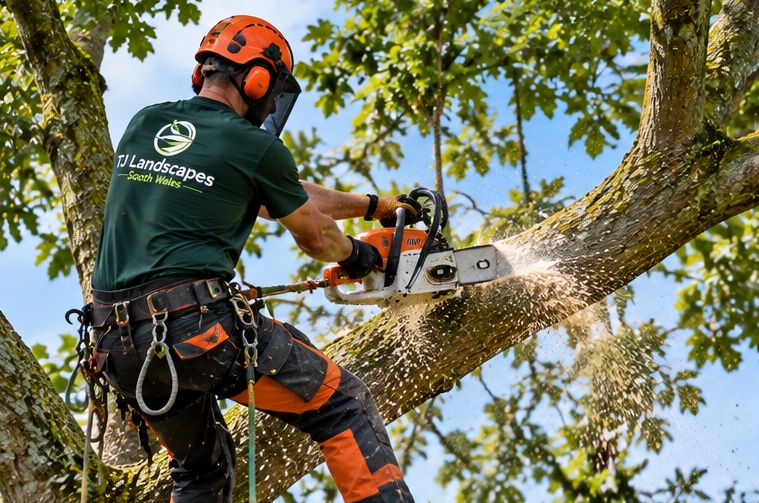
Most boundary problems in Cwmbran gardens do not need a tree taken down. A few targeted jobs usually fix what is bothering people:
- Crown lifting removes the lowest branches, letting light under the tree and clearing a fence, shed roof or washing line.
- Crown thinning takes out a proportion of inner branches so more light and wind pass through, without changing the tree's outline much.
- Crown reduction brings the overall height and spread in, which helps where a tree has simply got too big for a small plot.
- Cutting back from a building clears gutters, roofs and windows by a sensible margin.
Our guide to crown lifting, thinning and reduction explains each one, and tree felling or pruning helps where you are unsure whether the tree should stay at all. We avoid topping, where a tree is simply cut off at a height, because it tends to regrow as a mass of weak shoots.
When felling is the honest answer
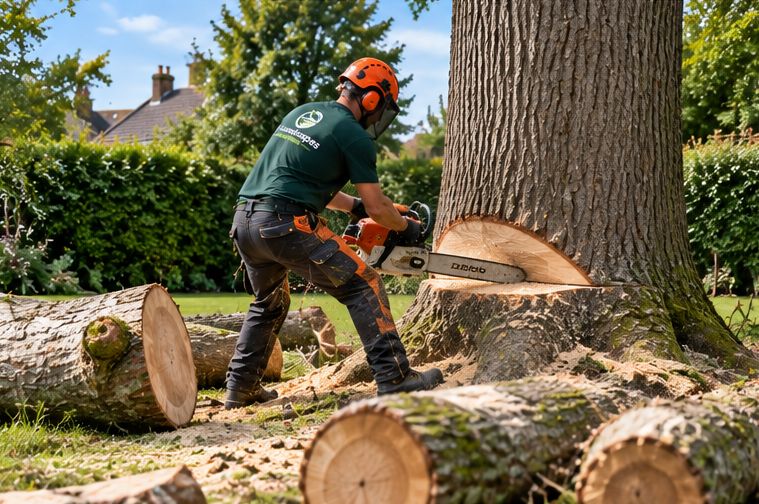
Sometimes a tree is in the wrong place for good. It may be a fast-growing conifer that was planted as a small screen and now blocks the whole garden, a tree that is dying or split, or one growing so close to a house or wall that it will keep causing problems. In those cases, felling and replanting with something smaller can be the kinder option for everyone.
On a tight estate plot, a tree is usually taken down in sections rather than felled in one piece, lowering branches carefully so fences, sheds and greenhouses are not hit. The stump can be left low, ground out, or dealt with to suit what comes next. What happens on the day a tree surgeon visits explains how the work runs.
Hedges along the boundary
Many Cwmbran back gardens are divided by hedges rather than fences, and a hedge left for a few years can double in width and height. Regular trimming keeps it under control, and a hard cut can bring an overgrown one back, though some conifers do not regrow from old wood. Hedge trimming: how often and when sets out the timing.
Where a neighbour's very tall evergreen hedge blocks light and talking has not worked, councils in Wales have a formal process for high hedge complaints. It is meant as a last resort, and a friendly conversation nearly always gets further.
Planning the space the tree leaves
Reducing or removing a big tree changes a garden more than people expect. A lawn that was always mossy may suddenly get sun, a border that was dry and shaded may become useful, and the fence the tree was pushing against may need replacing. It is worth thinking about the next step before the work starts.
If the lawn under the old tree needs rescuing, our guide to refreshing a worn-out lawn in Cwmbran will help, and replacing tired fences on a Cwmbran estate covers the boundary itself. You can see our wider approach on our landscaping in Cwmbran page, or ask for a free quote and Tony will come and look at the tree with you.
Talk to T J Landscapes about your garden
Free quotes and honest advice across South Wales.
Questions People Ask
Can I cut my neighbour's tree where it hangs over my Cwmbran garden?
Generally you can cut overhanging branches back to the boundary, as long as the tree is not protected and you do not harm it or go onto their land. It is always better to talk to your neighbour first, and to offer the cuttings back.
How do I find out whether a tree has a preservation order?
Ask Torfaen council, who keep the records for trees in Cwmbran. If a tree is protected, you will usually need their consent before any work.
Will you take the branches and logs away?
Yes. We clear up after the work and take the green waste away, unless you would like to keep some logs or chippings for the garden.
What time of year is best for boundary tree work?
Many trees can be pruned in late autumn and winter, when they are dormant and birds are not nesting, though some species prefer other times. Our guide on when trees should be pruned has more detail.
What affects the cost of tree work?
The size of the tree, how close it is to buildings and fences, how easily we can get into the garden and how much waste there is to remove. We give a free quote after seeing it.