
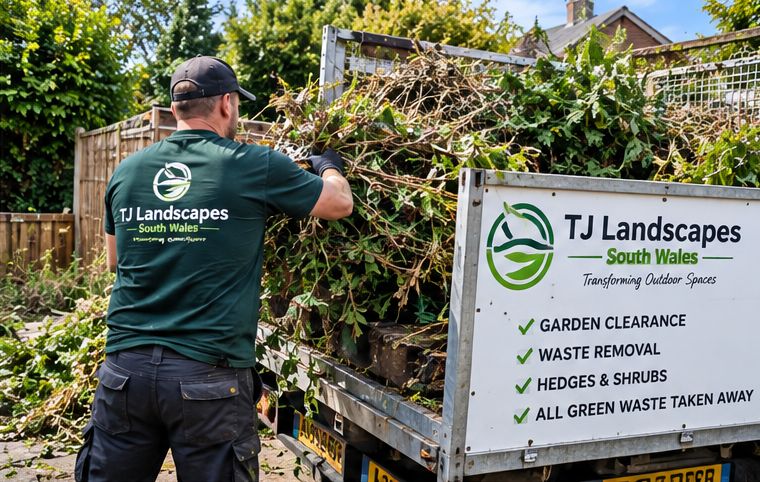
When people in Pontypool ask us to clear a garden, the first question is nearly always the same: will you take all of it? The honest answer is that we take almost everything a garden produces, plus most of what tends to pile up in one, and we agree the list with you before we start so nothing is a surprise on the day.
This guide walks through what typically comes out of a garden in Pontypool, a few things that need to go another way, and how the waste physically gets from a steep back garden to our van. For the service itself, see our garden clearance page.
What a Pontypool garden tends to hide
Gardens on the valley sides fill up in a particular way. Growth spreads down from the bank above, rubbish gathers at the bottom of the slope, and each terrace level becomes a place to put things that did not fit anywhere else. On older houses there are often several generations of garden in the same plot, one buried under the next.
Once the brambles are cut back, it is common to find old paths and steps, broken concrete from a demolished outhouse, a sunken pond, heaps of soil left from an extension, and runs of fencing that fell over years ago and were simply grown through. None of that is unusual here, and it all shapes how long a clearance takes.
Green waste: brambles, ivy and self-seeded trees
Most loads are made up of plant material. In Pontypool that usually means:
- Brambles and nettles spreading from a neglected bank, often with roots that need digging out, not just cutting.
- Ivy climbing old walls and sheds. We pull it carefully where the wall behind is fragile, because ivy can be holding loose stone in place.
- Self-seeded saplings of sycamore, ash and buddleia, which root into walls and steps. Small ones can come out with the clearance; bigger trees are handled as tree work.
- Overgrown hedges and shrubs cut back to a manageable size, working around any active nests.
- Rough grass and weeds across terraces that have not been mown for a season or more.
All of this is taken away with us, not burned or left in a heap in the corner. Getting an overgrown garden back under control covers what to do once it is cut back.
Hard waste: rubble, soil and old structures
Heavy material is where Pontypool clearances differ most from a quick tidy-up on a flat plot, because steep gardens collect it and it all has to be carried. Items we commonly take, once agreed at the quote:
- Broken slabs, bricks and concrete from old paths, crumbling steps or a knocked-down outhouse.
- Surplus soil and turf dug off when a level is being cut in for a patio or lawn.
- Old sheds, greenhouses and timber stores, dismantled on site. Our guide to shed and outbuilding clearance explains how that works.
- Rotten fencing and trellis, especially where a new fence is going in.
- Garden furniture, pots and general garden rubbish left behind by previous owners or tenants.
Rubble and soil are heavy and bulky, so it helps if you can tell us roughly how much there is. It is kept separate from green waste because the two go to different places.
Things that go another way
A few things cannot go in with general garden waste. The most important one for older valley properties is sheeting on garages, lean-tos and sheds that may contain asbestos. We do not break or remove it; it needs checking and handling by someone set up to do so safely, and we will point it out if we see it. Old garden chemicals, paint, fuel and gas bottles also need their own route, usually through a council recycling centre.
Invasive plants such as Japanese knotweed are treated differently in law from ordinary weeds and should not be cut and mixed in with green waste. If you think you have it, tell us before any work starts. Our guide to what can and cannot go in a garden clearance has the full list.
Getting it out of a terraced garden
This is the part people often underestimate. On a mid-terrace house in Pontypool with no side passage, every bag and every barrow load has to come through the house or out to a rear lane, and on a stepped plot it may have to be carried down several flights first.
We plan the route before we start. Where there is a usable rear lane we load from there; where there is not, we bag everything into manageable loads, lay down floor protection and carry it through. Heavy material is moved in smaller loads so steps and old walls are not overloaded, and we start at the far end of the garden so the cleared ground is not trampled over again and again.
The factors that shape a quote are the amount and type of waste, how far it has to be carried, the number of steps, how the van can get close, and whether anything needs dismantling. Tony will look at all of that on a free visit.
What stays behind
Clearing is not the same as stripping. We leave anything you want to keep, so it is worth marking plants, ornaments or paving you are fond of before we arrive. Old stone walls and steps are kept wherever they are sound, because in a sloping Pontypool garden they are usually doing a job. Nests, hedgehogs and frogs are left undisturbed or moved somewhere safe.
Protected trees and anything over the boundary are left alone too. If a wall or fence is shared with next door, we will not remove it without you having agreed it with your neighbour.
After the clearance
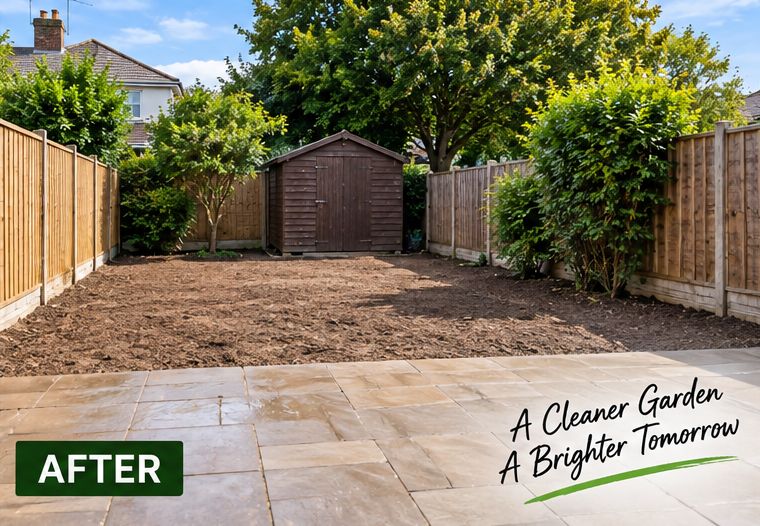
A cleared garden is the best time to plan what comes next, because you can finally see the slope, the levels and the state of the walls. Many clearances in Pontypool lead straight into terracing, a patio or a simpler layout. Our guides to terracing a steep Pontypool back garden and low-maintenance garden ideas for Pontypool homes are good next reads.
We are based on Conway Road, so a visit to look at your garden is a short trip. See our landscaping in Pontypool page for more, or ask for a free quote.
Talk to T J Landscapes about your garden
Free quotes and honest advice across South Wales.
Questions People Ask
Do I need to be in when you clear the garden?
Not always. If waste has to come through the house, someone needs to let us in. If we can work from a rear lane, you may only need to be there at the start and finish.
Can you clear the garden and take down the old shed at the same time?
Yes, as long as it is included in the quote. We dismantle it on site and take the pieces away. If the roof may contain asbestos, that part has to be dealt with separately.
Will you take soil and rubble as well as plants?
Yes. Tell us roughly how much there is, because it is heavy and has to be carried out separately from the green waste.
Do you burn garden waste on site?
No. Green waste is taken away with us rather than burned in the garden.
Can you clear a garden that is due to be landscaped?
Yes. Clearing it ourselves means we can leave the ground ready for the next stage, and it often saves time on the landscaping itself.