
Trees grow well on the valley sides around Pontypool. That is lovely when you are looking across at the hills, and less lovely when a sycamore on the bank above your garden has doubled in size and the lawn has turned to moss beneath it.
This guide looks at the tree jobs that come up most often in Pontypool, how we decide between pruning and felling, what makes the work harder on a terraced street, and what you should check before anyone picks up a saw. For the service itself, see our tree surgery and hedge care page.
The tree problems we see most around Pontypool
The same handful of situations come up again and again in the town’s older streets and on the newer estates alike.
- Shade from above. On a stepped garden, a tree on the top terrace or on the bank behind throws its shadow over everything below it, including the patio by the house.
- Self-seeded trees. Sycamore, ash and birch seed freely into neglected corners and along the backs of terraces. Left alone for ten or fifteen years, a seedling becomes a proper tree in the wrong place.
- Roots and walls. Trees growing close to old retaining walls, outbuildings or steps can push stone and brick out of line as their roots and trunks thicken.
- Overhanging branches. Limbs reaching over a neighbour’s garden, a rear lane or a roof, dropping leaves into gutters and blocking light from windows.
- Hedges and conifers that got away. A boundary hedge that was once waist height and now towers over the garden.
Pruning first, felling if it is the right answer
A tree that is simply too big for the space is not always a tree that has to go. Crown lifting takes off the lowest branches so light gets under the canopy and you can walk beneath it. Crown thinning removes a proportion of the inner growth so more light filters through. A careful reduction brings the overall size down while keeping a natural shape. Our guide to crown lifting, thinning and reduction explains each one.
Felling makes more sense where a tree is dead, dying or unstable, where it is damaging a wall or building, where it has seeded itself somewhere it can never be managed, or where pruning would leave it misshapen. We will always tell you if we think pruning will do the job instead. Tree felling or pruning: how to decide goes into the reasoning in more detail.
Ash dieback has affected ash trees right across Wales, and ash is common in valley gardens and on the banks behind them. A badly affected ash can become brittle, so if you have one that is thinning at the top or losing whole branches, it is worth having it looked at sooner rather than later.
Checks before any work starts
We are landscapers, not planners or solicitors, so treat this as a starting point rather than legal advice. Before felling or heavy pruning in Pontypool:
- Tree preservation orders. Some trees are protected by an order. Torfaen County Borough Council can tell you whether a tree is covered, and consent is usually needed before work on a protected tree.
- Conservation areas. Parts of Pontypool may fall within a conservation area, where notice is normally required before work on many trees. Check with the council if you are not sure.
- Nesting birds. It is an offence to damage or destroy an active nest. We check trees and hedges before cutting and hold off where birds are nesting, which usually means taking particular care in spring and early summer.
- Neighbours. If a tree is on the boundary or belongs next door, talk to your neighbour before anything is cut. Overhanging branches can generally be trimmed back to the boundary line, but it is courteous, and wise, to agree it first.
Our guide on whether you need permission to cut down a tree in Wales covers these points in more depth.
Working on a terraced street
Access is what makes tree work in Pontypool different from work on a big suburban plot. Many terraced houses have no side passage, so every branch and log has to come through the house or be carried to a rear lane. On a steep garden that can mean carrying it up or down several flights of steps.
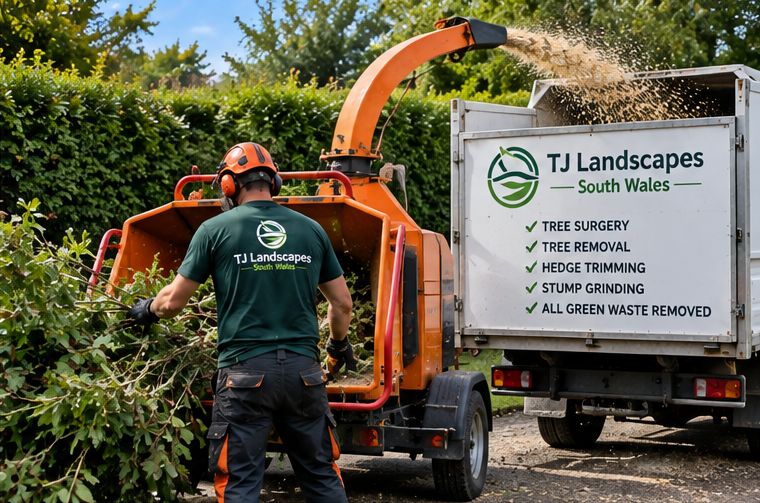
Rather than dropping a tree in one piece, which is rarely possible in a narrow garden anyway, we usually take it down in sections from the top, lowering pieces under control so they miss walls, sheds, greenhouses and the neighbour’s fence. Timber is cut into sizes that can be carried, and brash is bagged or bundled so it can be moved without dragging it through the house.
Where we can get to a rear lane, it often makes sense to take the waste out that way. We plan the route before the day, and we protect floors and doorways where material has to come through the home. What to expect on the day itself is covered in what happens when a tree surgeon visits.
Stumps, walls and what comes after
Once a tree has gone, the next question is what to do with the stump. It can be cut low and left, or dug out if you want to plant, pave or build over the spot. Be careful with stumps close to old retaining walls: the roots may be part of what is holding the soil in place, and pulling them out can destabilise the wall. In that case we would look at the wall at the same time.
Felling or reducing a big tree often transforms a Pontypool garden, suddenly letting light onto a lawn or patio that has been in shade for years. It is a good moment to rethink the space. Our guide to retaining walls for sloping Pontypool gardens helps if a wall needs attention, and artificial grass or real turf is worth a look if the lawn below needs replacing.
Timing the work
Many deciduous trees are easiest to prune in late autumn and winter, when the leaves are off and the shape is easy to see, and it is outside the main nesting season. Some species, such as cherries and birches, are better pruned at other times of year to reduce the risk of disease or bleeding sap. Our article when should trees be pruned? gives a fuller picture.
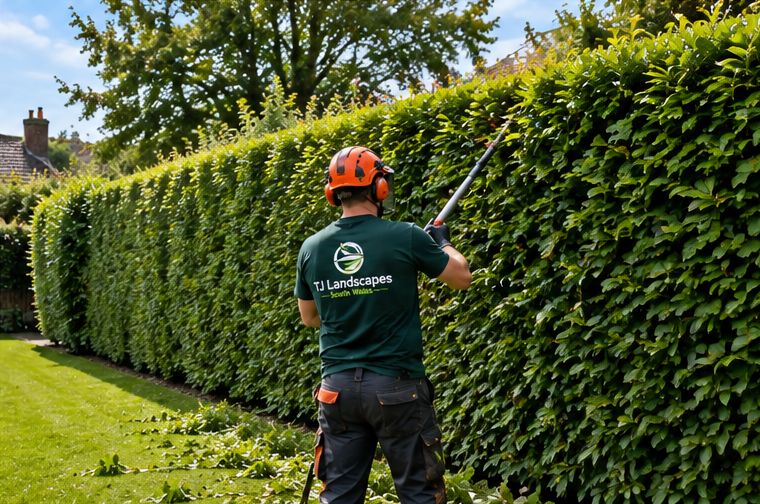
Hedges are a little different. Most need a trim once or twice a year, timed around nesting birds; see hedge trimming: how often and when.
If you have a tree that worries you, Tony can come and look at it with you. We are based on Conway Road, so most Pontypool gardens are a short trip away. Read more on our landscaping in Pontypool page, or ask for a free quote.
Talk to T J Landscapes about your garden
Free quotes and honest advice across South Wales.
Questions People Ask
Can I cut back branches from my neighbour's tree?
Generally you can trim branches that overhang your side back to the boundary, but not beyond it, and not if the tree is protected without consent. Talk to your neighbour first, and check with Torfaen council if there is any chance the tree has a preservation order.
Is a tree next to my garden wall a problem?
It can be. As trunks and roots thicken they can push an old wall out of line. Sometimes careful pruning or removing the tree is enough; sometimes the wall needs rebuilding too. We look at both together.
How do you remove a tree from a garden with no side access?
We take it down in sections, cut the timber into manageable pieces and carry it out through the house or to a rear lane, protecting floors and doorways as we go.
Do you take the branches and logs away?
Yes, the green waste is taken away as part of the job. If you would like to keep some logs for a stove, just say so beforehand.
Will pruning stop my garden being so dark?
Crown lifting or thinning often makes a big difference to light without losing the tree. If the tree is simply too large for the plot, felling may be the better long-term answer.