
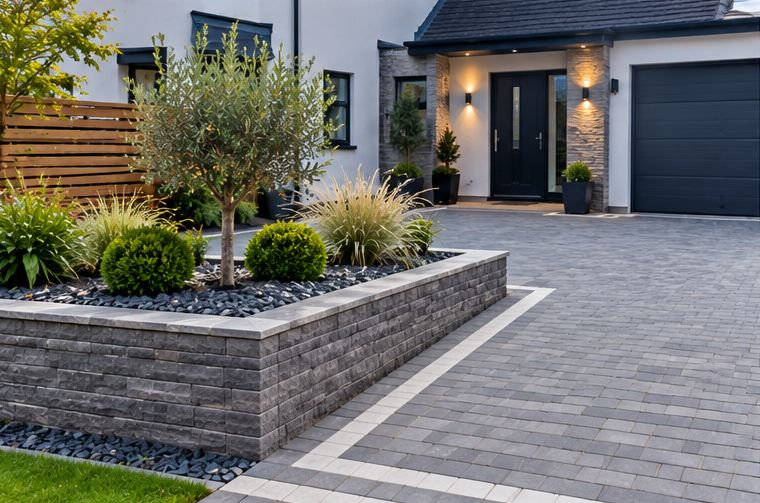
Summer evenings in Abergavenny can be long and lovely, with the last light catching the top of the Sugar Loaf while the valley below goes blue. The rest of the year, darkness comes early and the garden can disappear by teatime. A few well-placed lights change that, making steps safe, drawing you out onto the patio and giving you something to look at from the kitchen window in winter.
This guide looks at lighting ideas that suit gardens here, from hillside plots with steps to cottage gardens with stone walls. It also covers the practical side: power, cables, and planning lighting in at the same time as the rest of the landscaping.
Start with safety: steps, paths and changes of level
Many Abergavenny gardens climb or drop away from the house, and uneven stone steps are easy to misjudge in the dark. Lighting them is the most useful thing any garden scheme can do.
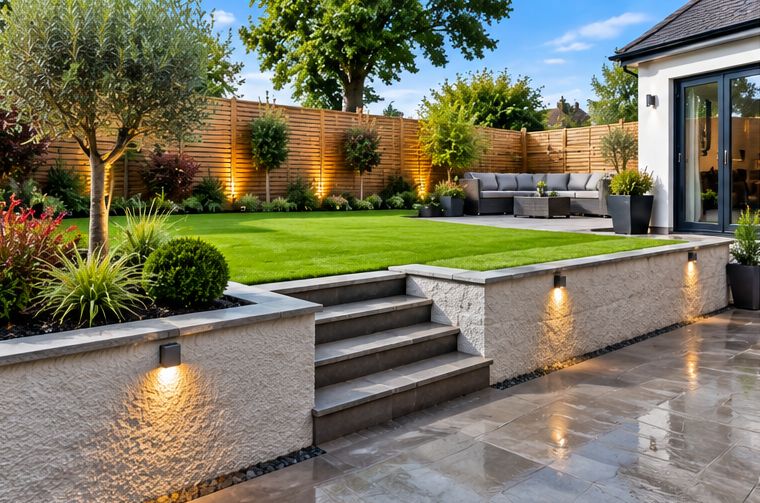
- Step lights set into the riser or the wall beside each step throw light down onto the tread without glare.
- Low bollard or post lights along a path mark the route without lighting the whole garden.
- Wall lights by the back door and gate make coming and going easier on dark winter evenings.
- Downlights under copings on a raised bed or retaining wall pick out the edge of a drop.
The aim is to see where your feet go, not to floodlight the slope. A string of soft pools of light is safer and easier on the eye than one bright lamp on the house wall. Where a set of steps is being rebuilt anyway, fittings can be built into the new risers or side walls, which looks far neater than lights added afterwards. Our guide to garden steps in brick and stone covers the building side.
Keeping the night sky dark
Abergavenny sits right beside Bannau Brycheiniog, the national park that has been recognised as an International Dark Sky Reserve. On clear nights, gardens on the edge of town can see a surprising number of stars, and that is worth protecting.
Garden lighting does not have to spoil it. Choose fittings that point downwards and are shielded at the top, keep the colour warm rather than cold white, and avoid uplighting trees into the sky. Timers or motion sensors mean lights are only on when someone is actually out there. Your neighbours, the local wildlife and your own view of the hills will all be better for it.
Lighting the patio and the deck
A seating area needs enough light to eat and talk by, but not so much that you cannot see past it. Low wall lights, a few recessed lights in the edge of a deck or a string of festoon lights along a pergola usually do the job. Candle lanterns and a fire pit add the rest on a cool evening.
Recessed deck lights and lit steps are much easier to fit while the deck is being built, as the cables can be run inside the frame. Our guide to decking for entertaining in Abergavenny and Decking Lighting, Planters and Finishing Touches look at that in more detail.
Picking out walls, trees and planting
Stone walls look wonderful lit from low down at a shallow angle, which brings out the texture of every face. A single light at the base of a small tree, aimed into the canopy rather than the sky, turns it into a feature from indoors. Grasses and ferns can look striking with light behind them.
Keep feature lighting to two or three points rather than spotting everything. On a garden with a mountain view, the best effect is often a softly lit foreground with the dark outline of the hills beyond. If your garden has old stone walls, our article on dry stone and mortared walls for Abergavenny gardens has ideas for building or restoring them.
Solar, low voltage or mains?
Solar lights are simple to place and need no cables, but in an Abergavenny winter they get little daylight to charge from, and many only glow faintly or for a short while. They are fine for decoration but less reliable for steps.
Low-voltage systems run from a transformer, usually plugged in or wired near the house. They are safer to work with in the garden, easy to extend and suit most path, step and deck lighting. Mains-voltage lighting is brighter and suits larger gardens and long runs, but it must be installed and connected by a registered electrician, with the cable buried at a safe depth or run in protective ducting.
Whichever you choose, check that fittings are rated for outdoor use, since rain here arrives sideways as often as it falls straight down.
Planning it in with the build
The easiest time to add lighting is during a landscaping project, while the ground is open. Cable routes and ducting can go in under a new patio, along a wall or through a deck frame before anything is finished, so there are no trenches through a new lawn later.
We plan lighting as part of the layout, marking where each light goes and making sure ducting is laid in the right places for your electrician to connect up. It works well alongside new patios and paths, walls and decking. To see how it fits a whole Abergavenny garden, visit our landscaping in Abergavenny page, and when you are ready, ask Tony for a free quote.
Talk to T J Landscapes about your garden
Free quotes and honest advice across South Wales.
Questions People Ask
Do I need an electrician for garden lighting?
For anything wired into the mains, yes: it should be installed and connected by a registered electrician. Plug-in low-voltage kits and solar lights do not need one, though cables still need running tidily and safely.
How many lights does a garden need?
Fewer than most people think. Light the steps, the path to the door and the seating area first, then add one or two features. Too many lights flatten the garden and wash out the view of the hills at night.
Can lighting be added to an existing patio?
Yes. Wall lights and freestanding fittings are straightforward. Recessed lights in the paving itself are harder once it is laid, so if you are planning a new patio, it is worth thinking about lighting before it goes down.
What colour of light looks best?
Warm white suits stone, timber and planting and feels calm. Cold white can look harsh against Abergavenny's reddish stone and draws more insects. Coloured lights are best kept for occasional use.
Will garden lights disturb bats and other wildlife?
Bright, cold light left on all night can. Bats, moths and birds all use the dark, and gardens on the edge of Abergavenny that back onto fields, woods or the river are busy with them after dusk. Keep lights low, warm and pointing down, leave hedges, trees and the far end of the garden unlit, and put everything on a timer or sensor. That way the garden works for you in the evening and stays dark for wildlife the rest of the night.