
Abergavenny has a good share of stone cottages, in the older streets of the town and in the hamlets and lanes on the lower slopes of the hills around it. Their gardens are often small, sometimes oddly shaped, and usually bounded by stone walls that have stood for well over a century.
A patio can make one of these gardens far more usable, but it is easy to get the look or the detail wrong. Below are the ideas and practical points we talk through with cottage owners, from choosing a stone to protecting the house. For more on the gardens we work on in the town, see landscaping in Abergavenny, and for the service itself, our patio slabbing and paving page.
Take your cue from the cottage walls
Stand back and look at the house before choosing any paving. Much of the older building stone around Abergavenny is a warm sandstone in reds, browns and greys, often laid in rough courses with lighter dressed stone around doors and windows. A patio that picks up one of those tones will look settled from the first day.
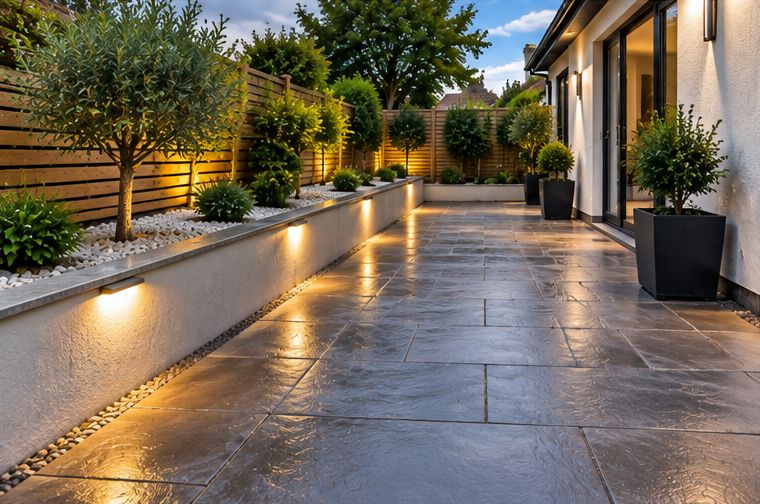
That usually rules out very bright, uniform or glossy slabs right next to the house. They can look fine in a modern garden, but against rubble stone walls they tend to shout. Go for texture and gentle colour variation instead, and let the house be the main feature.
Stone choices that sit well with old buildings
These are the materials we most often suggest for cottage gardens in the town.
- Natural stone flags. Riven surfaces and irregular edges suit a cottage perfectly. See our page on natural stone paving.
- Indian sandstone. Widely available in buff, grey and autumn-brown mixes that echo local stone. Our Indian sandstone paving page covers the colours and finishes.
- Limestone. Calmer and more even in tone, good for a slightly smarter look beside a cottage that has been extended or rendered. See limestone paving.
- Setts and cobbles. Small granite or sandstone setts make a lovely edging, path or threshold, and cope well with curves and awkward corners.
- Gravel with stone stepping pads. A soft, forgiving option for side paths and informal corners that needs little upkeep.
Porcelain can work in a cottage garden if you choose a stone-effect range with a matt, textured finish, especially where you want easy cleaning under a table. Our guide porcelain, sandstone or concrete compares them fairly.
Making a small cottage yard feel bigger
Many cottage gardens are narrow yards with high walls on two sides. The instinct is to use small slabs to match the small space, but larger slabs laid in a simple pattern often make a yard feel wider, because there are fewer joints to catch the eye. Laying the longer side of the slabs across the yard rather than along it helps too.
Other tricks work well in tight spaces: a single step up or down to create two distinct areas, raised beds built against a sunny wall to free up the floor, and climbers on the walls instead of shrubs taking ground space. A small built-in bench along one wall can replace a bulky set of chairs.
Laying patterns with a traditional feel
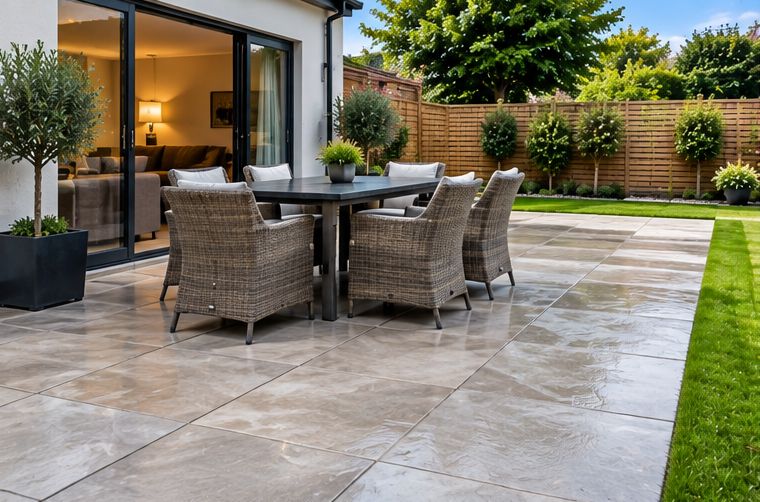
For a cottage, a random or mixed-size pattern using three or four slab sizes looks the most natural, as if the stone had been gathered over time. A coursed pattern, where slabs run in rows of the same width, is a touch more formal and suits a straight-sided yard.
Details lift a simple patio. A border of setts around the edge, a curved edge where the patio meets planting, or a gap left for thyme and other low plants between stones in a quiet corner all add character. Keep any joints you want to walk on properly filled, though, so the surface stays firm and weeds stay out.
Protecting old walls from damp
This is the part that matters most. Many old stone cottages have no damp-proof course at all, and their solid walls rely on being able to dry out. If a patio is laid high against the wall, or slopes towards it, rain soaks straight in and damp can appear inside.
- Keep the level down. The finished patio should sit well below the internal floor level and, where there is a damp course, at least two brick courses below it.
- Fall away from the house. The surface should slope gently so water runs off towards the garden or a drain, never back to the wall.
- Leave a gap. A narrow gravel strip or a channel drain between the patio and the wall lets the base of the wall breathe and catches splash-back.
- Do not bury air bricks. Any vents at the foot of the wall must stay clear.
Our guide on how a patio should be laid explains sub-bases, bedding and falls in full, and applies just as much to a small cottage patio as a large one.
Access, rubble and what lies underneath
Cottage gardens can be tricky to reach. Some have no side access at all, so every slab comes through the house or down a narrow lane, and every barrow of spoil goes back the same way. It takes longer, and it is worth knowing about when you plan the job.
Old gardens also hide things. Buried rubble, old paths, the footings of long-gone outbuildings and made-up ground are all common under cottage lawns. Sometimes the old stone can be cleaned and reused as edging or walling, which suits the house and cuts down on waste. If the boundary walls themselves need attention, our guide to dry stone and mortared walls for Abergavenny gardens explains the choices.
Listed cottages and conservation areas
Parts of Abergavenny are within a conservation area, and some cottages are listed. Laying a back garden patio does not usually need consent, but changes to front gardens, boundary walls, and anything attached to a listed building might. Check with Monmouthshire County Council before you start if you think your home could be affected. We are landscapers, not planners, so the council is the right place for a firm answer.
Once the patio is down, looking after it is simple. Our guide to cleaning and looking after a new patio covers the first few months.
Talk to T J Landscapes about your garden
Free quotes and honest advice across South Wales.
Questions People Ask
Can you match the colour of my cottage walls?
We can get close. Natural stone varies from batch to batch, so we bring samples to the garden and look at them against the house in daylight before ordering.
Will a new patio cause damp in my cottage?
Not if it is laid properly. Keeping the surface low, sloping it away from the house and leaving a gravel strip at the foot of the wall all protect old stone walls from extra water.
Is a stone patio slippery in wet weather?
Riven natural stone has good grip, but any paving can grow algae in shade. Regular brushing and the occasional clean keep it safe. Choosing a textured finish over a smooth, sawn one helps in shady cottage yards.
Can you reuse old stone from my garden?
Often, yes. Old flags, setts and walling stone can be cleaned up and laid as edging, steps or part of the patio, which suits an Abergavenny cottage well.
How do I get a price?
Every garden is different, so we visit, measure up and look at access and ground conditions, then give you a free, written quote. Get in touch to arrange a visit.