
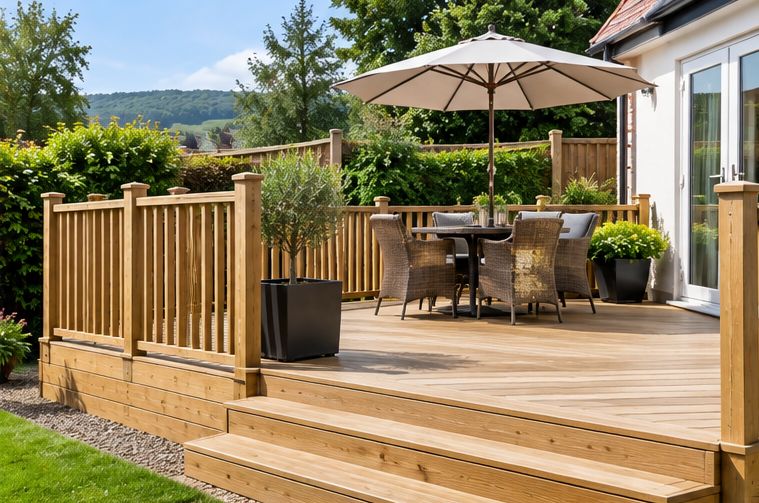
Food and company go together in Abergavenny, and plenty of people here want a garden that works for a summer lunch or a long evening with friends. A deck is often the neatest way to get there, particularly on the hillside plots where a flat patio would mean a lot of digging.
This guide looks at decking from the host's point of view: how big it needs to be, where it should go, which boards cope with a damp valley climate, and how to keep guests comfortable when the wind picks up. For more on the town's gardens, see landscaping in Abergavenny, and for how we build, our garden decking page.
Start with the guest list
Think about the gatherings you actually have. Is it the family of four most weekends and a dozen people a couple of times a summer? Or regular dinners for eight? Size the deck for the everyday, then make sure the bigger occasions can spill onto a lawn or patio next to it.
A table for six with chairs pulled out needs a surprisingly generous area, and you need room to walk behind the chairs. Add a barbecue or outdoor kitchen and a pair of lounge chairs, and the deck grows quickly. Marking out the shape on the ground with string, and setting your own furniture on it, is the easiest way to test a size before anything is built.
Zones: cooking, eating and lounging
The decks that work best for entertaining have clear zones. Cooking goes on the side nearest the kitchen door, but downwind of where people sit so smoke drifts away from the table. The dining area takes the middle, and a softer lounging corner with low seats can sit at the edge with the best outlook.
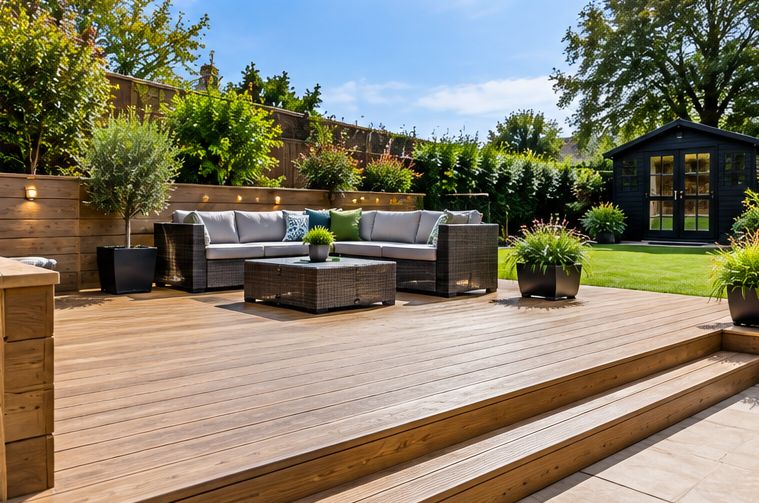
Changing the level between zones, even by a single step, or turning the boards to run in a different direction, marks each area without walls. A built-in bench along one side saves space and gives extra seats when more people turn up than expected.
Think about storage as well. Cushions, a barbecue cover and a few spare chairs need a dry home, and a bench with a lifting lid or a small store tucked under a raised section keeps them close at hand without cluttering the deck.
Using the slope to your advantage
Many Abergavenny gardens fall away from the house or climb behind it. A raised deck on posts turns that into a level platform, often at the same height as the kitchen floor, so food and drinks go straight out without steps. On a plot facing the hills, lifting the deck can also lift you over a boundary and open up the view.
A raised deck needs a solid frame, proper footings, balustrades wherever there is a drop and steps with an even rise. Our guide to raised decking: frames, steps and balustrades explains what is involved. Glass or slim metal balustrade panels keep the view open where a chunky timber rail would block it.
Boards for a wet valley climate
The Usk valley gets its share of rain, and decks in shade or under trees stay damp for long spells. Board choice and ventilation both matter. Timber decking should be pressure treated, laid with small gaps for drainage and built with air moving underneath. Composite boards resist rot and need less upkeep, although they still benefit from a regular clean.
Our comparison of composite or timber decking goes through the pros and cons in detail. Whichever you choose, a deck used for parties needs grip, so read how to stop decking going slippery before you settle on a board.
Shelter and shade for your guests
A deck on open ground can be glorious on a still evening and bracing in a breeze. Plan shelter on the windward side: a slatted screen, a run of planters with tall grasses, or a hedge along the edge. It is worth knowing where the weather usually comes from before deciding which side to screen. Our guide to windproof fencing for exposed Abergavenny plots covers the principles.
Overhead, a pergola with climbers or a fixing point for a sail shade gives relief on hot afternoons and a sense of enclosure after dark. Keep any structure well clear of the barbecue.
Lights for long evenings
Parties rarely finish before dusk. Low-level lights set into steps and along edges make the deck safe, while softer lights in planters or strung along a pergola set the mood. Keep the glare down and the hills still show against the sky late into a summer evening.
Plan the cabling while the frame is open, even if you add the fittings later. Our articles on decking lighting and finishing touches and garden lighting ideas for Abergavenny evenings have more ideas.
Neighbours, privacy and permission
A raised deck can look straight into a neighbour's garden, and a busy one can be noisy. Screening on the side facing next door, and a quick word with the neighbours before you build, avoids bad feeling later.
Decks that stand more than about 30 centimetres above the ground often need planning permission, as can decks in the grounds of listed buildings or in conservation areas. Check with Monmouthshire County Council before work starts. We are happy to give you the details of the design to help with that conversation.
From idea to first party
Tony and the team will visit, look at the levels and access, and talk through how you like to entertain. We then set out a design and a free quote, with the board, balustrade and lighting options explained plainly. If the area needs clearing first, we can take care of that too.
Most decks are built in a matter of days once the materials arrive, although a large raised deck on a steep plot takes longer, because every post has to be set and checked by hand. We keep the garden tidy as we go and clear away offcuts and packaging at the end, so the first thing you do on the finished deck is put the furniture out. Send us a message with a few photos of the garden and we will book a time to call round.
Talk to T J Landscapes about your garden
Free quotes and honest advice across South Wales.
Questions People Ask
How big should a deck for entertaining be?
Big enough for your table with chairs pulled out, a walkway behind them and any barbecue or seating you want. Marking it out with string and your own furniture is the best test.
Is composite or timber better for an Abergavenny deck?
Both work. Composite needs less upkeep and resists rot in damp, shady spots. Timber is warmer underfoot and cheaper to buy, but needs regular treatment. We will talk through both on site.
Can you build a deck on a steep slope?
Yes. A raised deck on posts is often the simplest way to create a level space on a sloping Abergavenny plot, with balustrades and steps built in.
Where should the barbecue go?
Near the kitchen door for convenience, but downwind of the seating so smoke drifts away, and clear of any overhead structure or planting.
Do you fit lighting on decks?
We can plan and build in low-level lighting and the routes for cables, so fittings can be added neatly by an electrician where mains power is needed.