
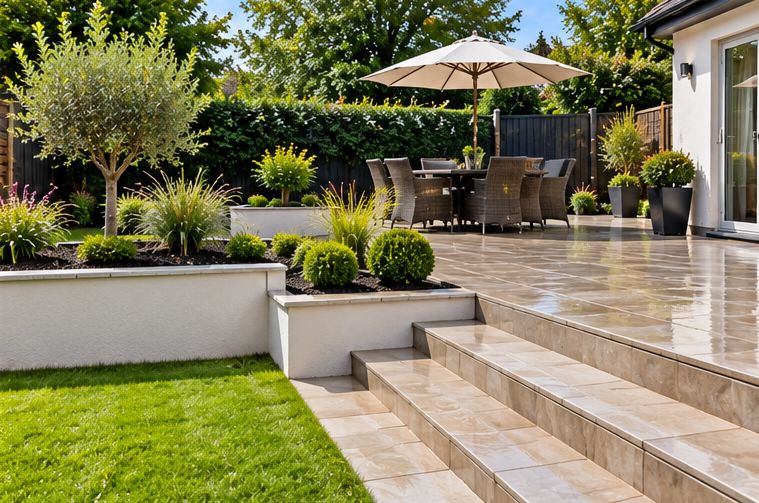
Sleepers have become a favourite for sloping gardens, and it is easy to see why. They are straight, heavy and simple to stack into low walls, they look at home in a planted garden, and they can be carried in by hand where a digger cannot go. For a lot of hillside plots in Chepstow, where access is tight and the changes in level are modest, they are a very practical choice.
They do have limits, though. This guide covers where sleeper terraces work well, where masonry is the better call, and the details that decide whether a sleeper wall stays straight for years or starts to lean after a couple of winters. Our Chepstow landscaping page shows the wider range of work we do in the town.
Where sleepers earn their place
Sleepers are at their best on low terraces: raised beds, the edge of a lawn, a step down to a seating area or a series of shallow levels up a gentle bank. They suit informal and family gardens, cottage-style planting and vegetable plots, and they soften quickly as plants grow over them.
They are less suited to tall retaining walls, to ground right next to a house or drive, or to any bank that already shows signs of slipping. In those places a block, brick or stone wall with a proper footing is the safer answer, and our brickwork and garden walls service covers that. We often mix the two, with masonry doing the heavy lifting lower down and sleepers forming the gentler levels above.
Why they suit awkward Chepstow access
Plenty of gardens on Chepstow's steeper streets can only be reached through the house, down a narrow side passage or up a flight of steps from the pavement. Bringing in ready-mixed concrete and pallets of block in those places is slow, heavy work. Sleepers can be carried in two at a time, cut on site and fixed with hand tools, and the soil dug out for one level is usually reused to build up the next.
That makes sleeper terracing a good fit for gardens where a digger simply cannot get in, and it keeps the amount of spoil leaving the site down, which matters when every barrow has to go back up the steps.
Choosing the timber
Not every sleeper sold is right for holding back soil. The main choices are:
- New softwood sleepers, pressure treated for use in contact with the ground. Affordable, straight and widely available.
- New hardwood sleepers, often oak, which are heavier, very durable and weather to a silver grey.
- Reclaimed railway sleepers, which have character but may contain creosote or tar. We do not recommend these for vegetable beds, seating or where children play.
Whichever you choose, check the treatment is rated for ground contact rather than general outdoor use. That one detail has a big effect on how long the wall lasts in damp Monmouthshire soil.
How high can a sleeper wall go?
As a general guide, we keep sleeper retaining walls low, usually no more than a few sleepers high, and step the garden in several shallow terraces rather than one tall one. The weight of wet soil behind a wall rises quickly with height, and timber on its own can only resist so much.
If a Chepstow slope needs more than a modest change of level in one go, we will talk to you about masonry, a combination of materials or breaking the height into two tiers with a planted strip between them. For taller structures near buildings or boundaries, read when a retaining wall needs engineering advice.
Fixing sleepers so they stay put
A sleeper wall that is simply stacked and backfilled will move. The ones that last are tied together and anchored into the ground. Our usual method includes:
- A firm, level first course set slightly below the finished ground, on compacted stone.
- Upright posts, often sleepers themselves or treated timber, set deep behind or in front of the wall.
- Long timber screws or coach bolts through each course into the next and into the posts.
- Staggered joints, like brickwork, so no vertical joint runs the full height.
- A slight lean back into the slope on taller runs.
Drainage behind the timber
Water is the main reason sleeper walls fail. Soil that stays saturated after rain pushes harder against the wall and keeps the timber wet, which speeds up rot. Behind every retaining run we line the back of the sleepers with a membrane and backfill with free-draining stone, with a way for water to escape at the base.
On some hillside gardens in Chepstow, water seeps out of the bank for days after heavy rain. Where that happens, a perforated drain along the foot of the wall, leading to a soakaway or suitable outlet, makes a real difference. Our guide on stopping a garden waterlogging explains the options.
Planning the terraces and the steps between them
Sleeper terraces work best when each level has a clear use and a comfortable way in. Sleepers make simple, attractive steps too, with gravel or bark treads behind each riser. Keep the rise even from step to step, and add grip strips or a textured tread where they get shade, because wet timber can be slippery.
For a wider look at how terraces fit into the whole garden, from patio to top boundary, see our guide to landscaping a steep Chepstow garden. If you would rather step down with timber over the whole slope, decking on uneven ground in Chepstow covers that alternative.
How long sleeper terraces last
Good-quality treated softwood, well drained and properly fixed, should give many years of service; hardwood usually lasts longer. Timber sitting in wet soil with no drainage will fail far sooner. Once built, keep soil and mulch from piling above the top course, clear leaves from the base and check fixings every so often.
If you would like to talk through a sleeper layout for your garden, our landscaping and garden design page explains how a project runs, and the enquiry form is the quickest way to book a free visit.
Talk to T J Landscapes about your garden
Free quotes and honest advice across South Wales.
Questions People Ask
Are sleepers cheaper than a stone or block retaining wall?
For low terraces they usually cost less to build, mainly because they need less excavation and no concrete footing, and they are quicker to put up. Over the long term, masonry lasts longer. The height, access, drainage and timber type all affect the comparison, which we set out in a free quote.
Can I grow vegetables in sleeper beds?
Yes, but use new timber that is treated for ground contact rather than old railway sleepers, and many growers line the inside with a membrane. Raised sleeper beds on a sunny Chepstow terrace make very productive vegetable plots.
Will sleepers rot?
All timber eventually breaks down in soil, but treatment, drainage and good fixing slow it down a great deal. Hardwood sleepers generally last longer than softwood.
Can sleepers be laid on a slope without digging?
Some excavation is always needed to set a level base and posts. On a sloping Chepstow garden we cut the first course into the bank and use the soil behind to form the terrace, which keeps waste to a minimum.