
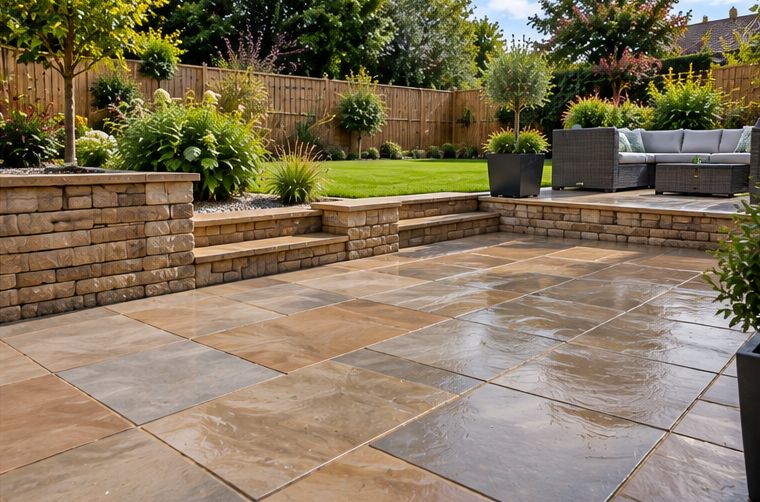
Chepstow has a good share of older homes: stone and rendered terraces, Victorian and Edwardian villas and cottages tucked into the slopes above the Wye. Their gardens often come with weathered stone walls, old steps and mature planting, and a bright, uniform patio can look out of place against all that.
Natural stone is the usual answer, but it covers a wide range of materials and finishes. This guide is about choosing a stone that suits a period property in Chepstow, laying it so it sits right against old walls and doorsteps, and avoiding the common mistakes. You can read more about our work in the town on our landscaping in Chepstow page.
Start with what is already there
Before looking at samples, stand in the garden and note the colours you already have: the stone of the house or its boundary walls, the brick of any outbuildings, the colour of the roof. A patio that picks up one of those tones will feel settled from the day it is laid.
Look at the textures too. Rough rubble walls and old sills tend to suit a riven or tumbled surface better than a sawn, sharp-edged one. That is not a rule, though. A crisp sawn stone laid close to the house, softening into a riven path further out, can look very good on a larger villa garden.
Stones that tend to suit older Chepstow homes
There is no single right choice, but a few materials come up again and again when we talk to owners of period properties.
- Indian sandstone: widely available in warm buffs, greys and mixed tones, usually with a riven face that gives good grip and an aged look.
- Limestone: calmer and more even in colour, often in blue-grey or black, and smart next to rendered or painted houses.
- Other natural stone: including reclaimed flags and British stones, which can be a close match for old walls where budget and supply allow.
- Granite: very hard-wearing, and useful for steps, edging and setts alongside a softer main patio.
If you are weighing stone against man-made options, our comparison of porcelain, sandstone and concrete sets out the trade-offs.
Laying patterns and joint widths
A random pattern of mixed sizes, often sold as a project pack, is the most traditional look and hides small colour variations well. Coursed laying, with rows of the same width, gives a more ordered feel that can suit a formal villa frontage or a terrace with a straight back wall.
Joint width matters more than people expect. Tight, neat joints feel modern. Slightly wider joints, pointed in a colour close to the stone, look more in keeping with an older house. We point with a mortar or a suitable jointing compound depending on the stone and how the patio will be used.
Edges finish the job. A border of setts, a row of bullnosed steps or a simple soldier course of stone laid on end frames the patio and stops the outer slabs creeping. On an older Chepstow garden, a slightly irregular edge that curves around an existing bed or tree often looks more natural than a straight line cut in without regard to what was there before.
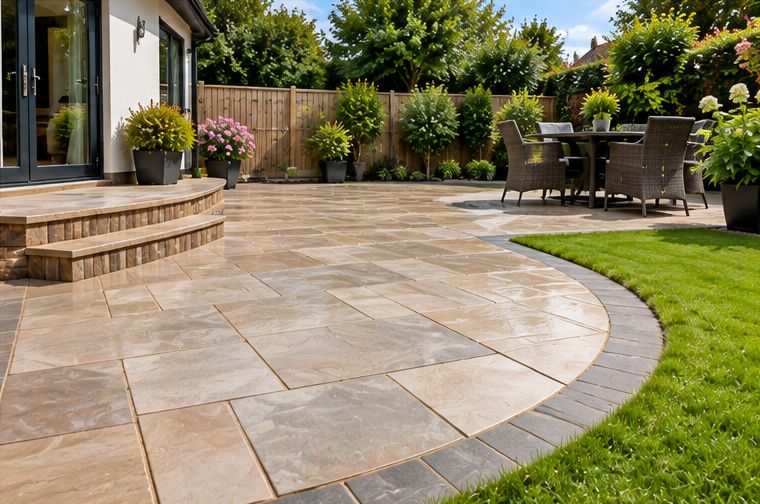
Meeting old walls, doorsteps and airbricks
Period houses bring a few details that need care. The patio must finish below the damp-proof course and leave any airbricks clear, so ventilation under a suspended timber floor is not blocked. On some older Chepstow houses that leaves less height to play with than you might think.
Where paving meets an old stone wall, we usually leave a small gap or a gravel margin rather than butting the slabs hard against it. That lets the wall breathe and stops water being channelled into its base. If the wall itself needs attention, it makes sense to deal with it first; our guide to repairing old stone garden walls in Chepstow explains the options.
Levels and falls on a sloping garden
Many period gardens in Chepstow slope away from the house or towards it. Every patio needs a gentle fall so rain runs off, and that fall has to lead away from the building, not towards it. Where the garden rises behind the house, we may need a low retaining wall or a channel drain along the back to keep water off the paving.
Getting the levels right is covered in our general guide on how a patio should be laid. On steeper plots, a patio is often one step in a wider layout, which our guide to landscaping a steep Chepstow garden looks at.
Mistakes we see on older properties
A few problems turn up often enough to be worth listing, so you can avoid them from the start.
- Paving laid too high against the house, bridging the damp-proof course.
- Slabs bedded on dabs of mortar rather than a full bed, which leaves hollow spots that crack.
- Very smooth stone used on a shady, north-facing patio that stays damp all winter.
- Cement pointing smeared across a pale stone and left to stain.
- No sealing or care plan for a stone that marks easily.
Looking after natural stone in a damp town
Being close to the river and the Severn estuary, Chepstow gets its share of wet, mild weather, and shaded stone can go green over the winter. A gentle clean in spring usually brings it back. Some stones benefit from a sealer; others are best left natural, and it depends on the product. Our guide on cleaning and looking after a new patio covers the basics.
If you would like to see samples against your own walls, ask us to bring some when we visit. See our patio slabbing and paving page for more, then use the enquiry form to book a free quote.
Talk to T J Landscapes about your garden
Free quotes and honest advice across South Wales.
Questions People Ask
Is natural stone too slippery for a shady garden?
Riven sandstone and textured limestone usually give reasonable grip, even when damp. Very smooth or polished finishes are better kept for sunnier spots. Regular cleaning to stop algae building up matters just as much as the choice of stone.
Can you use reclaimed stone?
Yes, where good-quality reclaimed flags are available and sound. They can look wonderful against an old Chepstow house. They vary in thickness, so laying them takes more time, and some pieces may not be usable.
Do I need permission for a patio at a listed or conservation area home?
An ordinary garden patio often does not need permission, but rules can differ for listed buildings, conservation areas and front gardens, especially where drainage is involved. Check with Monmouthshire County Council before you commit.
Will a natural stone patio fade?
Most natural stone mellows a little over time, which many people like on a period home. Some darker stones lighten slightly in sunlight. Ask to see a weathered sample if the exact colour matters to you.
What affects the cost of a stone patio?
The size, the stone chosen, how much the ground slopes, digging out and waste, drainage, steps or walls, and how easily materials can be brought in. We go through all of these in a free, itemised quote.