
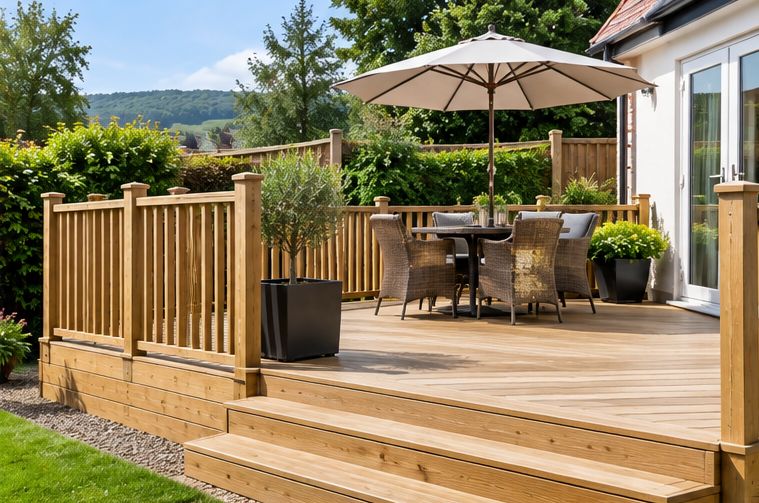
It is one of the questions we are asked most often when we visit Ebbw Vale: should the new seating area be a deck or a patio? Both can work well up here. Both can also go badly wrong if they are put in the wrong place, because the town’s altitude brings more rain, longer spells of damp and harder frosts than gardens nearer the coast.
Rather than list the pros and cons in general, this guide works through the conditions that matter in Ebbw Vale gardens and shows which way each one tips the decision. For the wider picture of our work in the town, see landscaping in Ebbw Vale.
Test one: how long does the spot stay wet?
Go out the morning after rain and look at the area you have in mind. If it is still damp at lunchtime, and especially if it sits in the shadow of the house or a hillside for much of the day, that tells you a lot. Timber in a spot like that stays wet, grows algae and becomes slippery. A textured patio will also go green in the shade, but it is simpler to clean and does not soften.
A sunny, breezy area that dries quickly suits either material. In that case, it comes down to what you prefer to look at and walk on.
- Dries within a few hours: decking or paving, your choice.
- Damp most of the day: paving is usually the safer bet.
- Standing water after rain: sort the drainage first, whatever goes on top.
Test two: is the ground flat or falling away?
Many Ebbw Vale gardens sit on the valley side, and this is where decking comes into its own. A deck on a timber frame and posts can give you a level platform over a drop without digging out and retaining lots of soil. Paving on the same slope needs the ground cut and filled, usually with a wall to hold it, which is more groundwork.
Once a deck is more than a little way off the ground, extra rules can apply to height and to overlooking your neighbours, so check with Blaenau Gwent council before planning anything tall. Our guide to raised decking explains how frames, steps and balustrades are put together. If you would rather terrace the slope, see making a sloping Ebbw Vale garden usable.
Test three: frost and winter use
Winters in Ebbw Vale are colder than in the lower valleys, and frost can sit on a garden for most of a short winter day. Paving that is well laid on a solid, free-draining sub-base copes with freeze and thaw without trouble. Poorly laid slabs with voids beneath them, or a porous stone that holds water, are the ones that crack and flake.
Timber decking handles frost itself, but a frosty deck is slippery, and a deck that stays wet all winter ages faster. If you want an area you will use all year, such as a route to the shed or the bins, paving is usually more practical. For which slabs stand up best to heavy rain, read which patio paving copes best with Welsh rain.
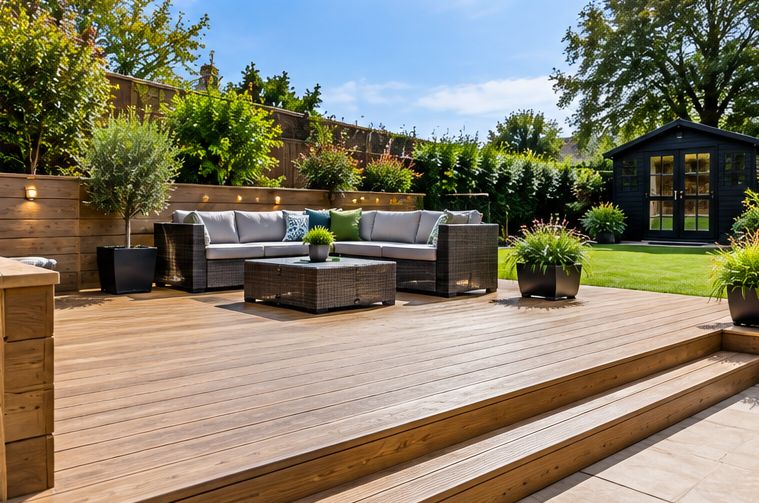
Test four: how exposed is it to the wind?
Some homes on the higher estates look straight out across open hillside, and the wind there has nothing to stop it. Paving is unaffected. A deck is fine too if it is fixed down properly, but anything built on top of it, like a pergola, screen or balustrade, needs solid fixings and posts. Lightweight furniture and planters on a raised deck can also move in a gale.
If your seating area is in a windy corner, a low wall or slatted screen will make it far more pleasant, whichever surface you choose.
Wind also dries things out. A deck in a breezy, open position sheds rain far faster than one boxed in by fences, which is one of the few times exposure works in your favour. We weigh shelter against drying when we suggest where a seating area should go.
If you choose decking in Ebbw Vale
A deck that lasts in the upland wet has three things going for it: the frame is kept clear of the soil and standing water, there is airflow underneath, and the boards have grip. We use treated timber for frames, leave gaps between boards, and lay weed membrane and gravel below so the space stays dry and clean.
Composite boards are worth a look in the damp, because they do not rot and need less upkeep, although they can still get slippery if algae builds up. Our guides on composite or timber decking and stopping decking going slippery go into more detail, and you can see how we build decks on our garden decking page.
If you choose paving in Ebbw Vale
A patio up here needs a proper sub-base, a fall away from the house and a surface with a textured finish. Porcelain is dense and does not soak up water, which suits a damp town, as long as a textured, outdoor-grade tile is chosen. Riven sandstone and good concrete slabs also work well when laid on a full bed of mortar.
For more on patios, see our patio and paving page and our ideas for patios behind Ebbw Vale terraced houses.
Using both
Often the best answer is a mix: a paved area by the back door for everyday use and bins, and a deck further up the slope where the sun and the view are. That way each material goes where it does its best job.
If you are still undecided, Tony and the team can look at the spot with you and explain what they would do and why. Ask for a free visit through our enquiry form.
Talk to T J Landscapes about your garden
Free quotes and honest advice across South Wales.
Questions People Ask
Which lasts longer in Ebbw Vale, decking or paving?
Well laid paving usually outlasts timber decking, especially in wet, shaded spots. A well built deck in a sunny, airy position can still give many years of use with regular care.
Is composite decking better than timber in a wet garden?
It does not rot and needs less maintenance, so it suits damp sites. It still needs cleaning to keep algae off, and the frame underneath is often timber, so good ventilation still matters.
Can a deck be built over an old patio?
Often, yes, as long as the old surface is sound and water can still drain away. Our guide on decking over an old patio or concrete explains the checks.
What affects the cost of each option?
Size, the slope, how much groundwork or framing is needed, access, the materials chosen, drainage and any waste to take away. We will quote for both in Ebbw Vale if you want to compare, free of charge.
How much looking after does each one need?
Paving wants a sweep and an occasional wash, with joints topped up if weeds appear. Timber decking needs a scrub each spring and a fresh coat of treatment or oil every so often, more often in a damp, shaded Ebbw Vale garden. Composite sits in between: no staining, but it still needs washing.