
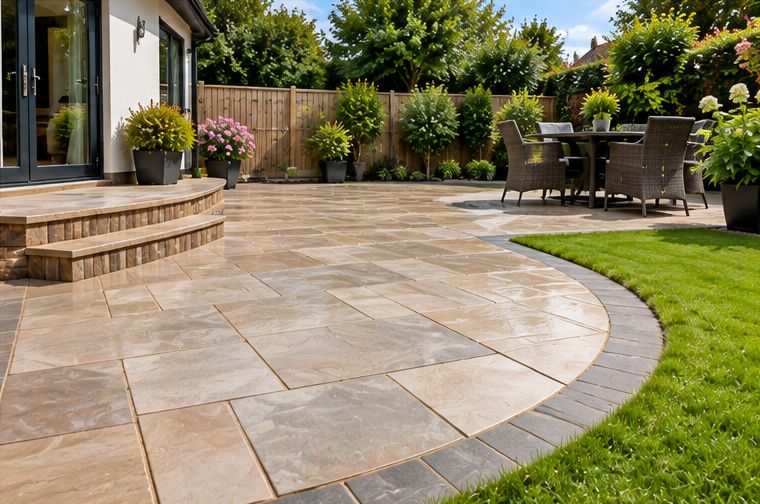
A Talgarth cottage built from local stone deserves paving that suits it. Bright concrete slabs can make an old house look tired, while the right natural stone makes a small yard or back terrace feel settled and part of the building. The catch is that cottages come with their own quirks: thick walls, low floors, uneven ground and corners that see little sun.
This guide covers what we think about when paving beside a Talgarth cottage. For the full range of materials and how we lay them, see our patio and paving page, and for our wider work in the area, the landscaping in Talgarth page.
Take the colour from the walls
The simplest way to choose stone is to stand back and look at the house. Many older buildings in this part of Powys are built of reddish-brown or grey sandstone, often with lime mortar and slate roofs. A paving stone in a related shade, slightly lighter or darker than the walls, will look deliberate. A contrasting colour draws attention to itself.
Samples always look different on a showroom floor than they do outside a cottage under a grey Talgarth sky, and they change again when wet. We are happy to bring a few pieces to the property so you can see them against the stonework, dry and after rain.
Riven, sawn or tumbled
Natural stone comes in several finishes, and the finish matters as much as the colour.
- Riven. Split along the natural layers, with an uneven, textured face. It has the most traditional look and gives good grip, which suits a cottage well.
- Sawn or honed. Cut flat and smooth, with crisp edges. It feels more contemporary and suits a modern extension or a garden room.
- Tumbled. Stones rolled to soften the edges and corners, so they look worn from the start. Good for paths and small courtyards.
Our pages on natural stone paving and Indian sandstone paving show the materials in more detail, and porcelain, sandstone or concrete compares stone with the alternatives.
Keep clear of the damp course
This is the point we are most careful about beside an old house. Paving laid too high against a wall can let rain splash above the damp-proof course, or bridge it altogether, and that can lead to damp inside. The usual guidance is to keep the finished paving level well below the damp course, and to slope it gently away from the house so water runs off rather than towards the wall.
Some older Talgarth cottages have no modern damp course at all, or have floors that sit close to the outside ground level. In those cases we may need to lower the ground by the wall, leave a gravel strip against the stonework, or add a channel drain across the doorway. We will talk you through the options before any digging starts.
A solid base on awkward ground
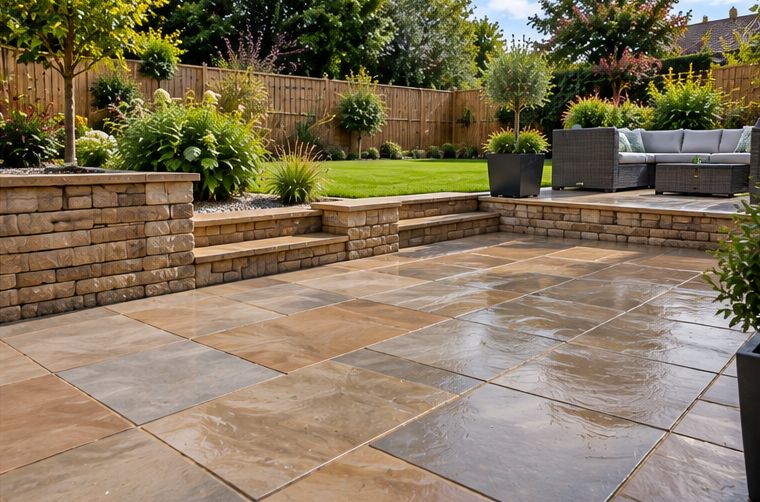
Cottage gardens are rarely flat or tidy under the surface. Old footings, buried rubble, soft patches where a drain once ran and roots from a nearby tree are all common. We dig out to firm ground, build a compacted sub-base and lay each stone on a full mortar bed so there are no hollows underneath to crack or rock.
Natural stone varies in thickness from piece to piece, especially riven stone, so it takes longer to lay well than uniform slabs. That extra care is what gives a flat, stable surface. Our article on how a patio should be laid explains sub-bases, bedding and falls.
Moss, shade and mountain rain
With more rain than most of South Wales and plenty of shady corners between thick walls and outbuildings, Talgarth patios can turn green quickly. A good fall so water does not sit, joints filled properly so weeds and moss have less to grip, and choosing a textured rather than polished stone all help keep it safe to walk on.
Regular brushing, clearing leaves before they rot on the surface and an occasional gentle clean keep stone in good order. Pressure washers should be used with care, as they can strip jointing and roughen soft stone. See how to clean and look after a new patio for more.
Joints that survive a hard frost
Frost is tough on paving joints. Water gets into cracks, freezes, expands and gradually pushes the pointing out. At the foot of the Black Mountains, where cold nights come often through the winter, the jointing needs to be dense and fully filled, not just skimmed across the top.
We use a strong mortar or a suitable jointing compound depending on the stone and the setting, and we avoid laying or pointing when a hard frost is forecast, because fresh mortar can be damaged before it sets.
Small spaces: yards, thresholds and paths
Many Talgarth cottages have a small front yard, a narrow side passage or a short path to the gate rather than a big terrace. These little areas are where stone really shows its worth, and where a few careful details lift the whole house: a larger stone at the doorstep, a neat edge where paving meets gravel, and a path that follows the natural line people walk.
Stone also mixes well with gravel, cobbles and planting. A paved strip with gravel either side, or a patio with low planting spilling over the edges, looks softer and suits a cottage better than a large expanse of slabs. For ideas beyond the patio, see country garden design ideas for Talgarth homes.
Talk to T J Landscapes about your garden
Free quotes and honest advice across South Wales.
Questions People Ask
Is natural stone slippery in wet weather?
Riven and textured stone gives good grip when laid with a proper fall and kept clear of moss. Smooth sawn stone can be slicker in shady, damp corners, so we suggest the finish to suit where the paving goes.
Can you reuse old flagstones from the garden?
Often, yes. Old flags can be lifted, cleaned and relaid on a new base, sometimes mixed with new stone of a similar colour. It depends on how many are sound once lifted.
What affects the cost of a stone patio at a cottage?
The size of the area, the stone and finish chosen, access to the back of the house, how much digging and levelling is needed, any drainage work near the walls and the waste to remove. We give a free quote after seeing the property.
Should the path and the patio be the same stone?
Not necessarily. Using one stone throughout ties a small cottage garden together, but a path in gravel, setts or tumbled stone leading to a riven sandstone terrace can look just as good and is often more practical on a slope. We usually suggest keeping to two or three materials at most, so the garden still looks calm, and choosing colours that sit well with the walls and the roof.
Can you lay paving in winter?
We can prepare bases in most weather, but laying and pointing is best avoided when hard frost is expected. We plan the work around the forecast.
How do we get a quote?
Send us a few photos of the area and the house walls through the enquiry form and we will arrange a visit.