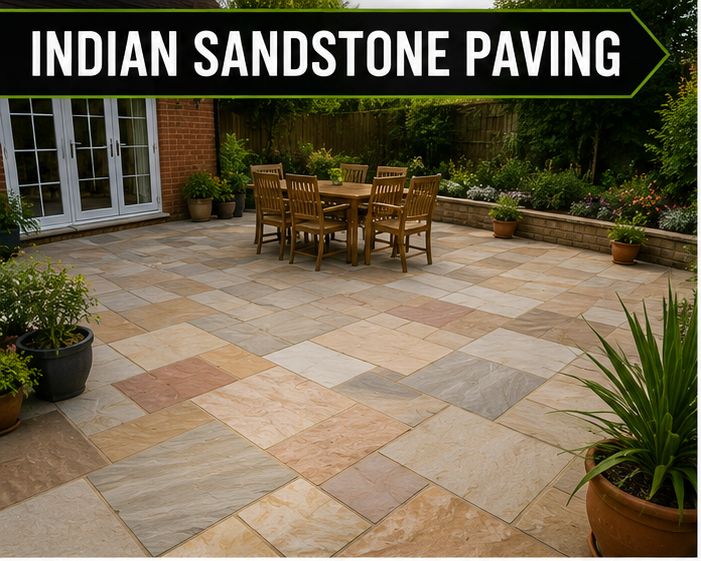
Indian sandstone is the paving most people picture when they think of a stone patio: slabs with a gently rippled face, soft shifts of colour from one piece to the next, and a mix of sizes laid in a loose random pattern. It has been one of the most widely used patio stones in Britain for years, and it earns its place because it looks natural without the cost of a locally quarried stone.
We lay it on patios, paths and garden terraces all over the region as part of our patio slabbing and paving work. Below we explain what it is, the colours and finishes you will come across, how we lay it so it stays put, and how to keep it looking good in a wet climate.
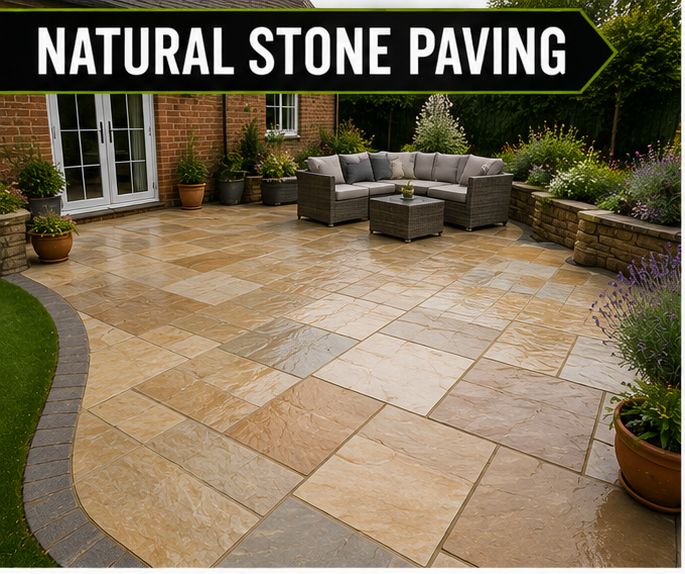
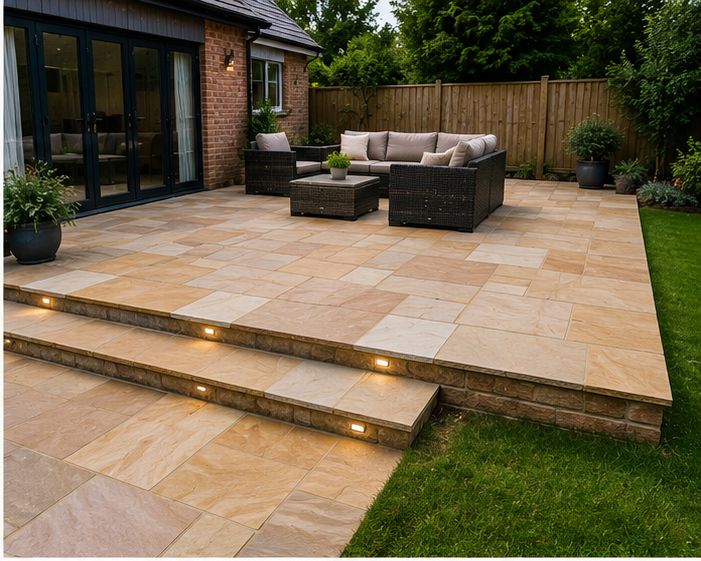
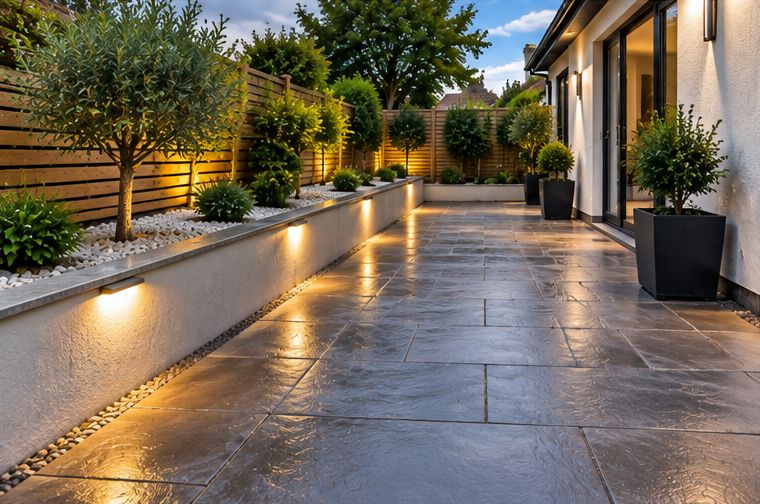
A few examples of riven and sawn sandstone, showing how the colour varies across a finished patio.
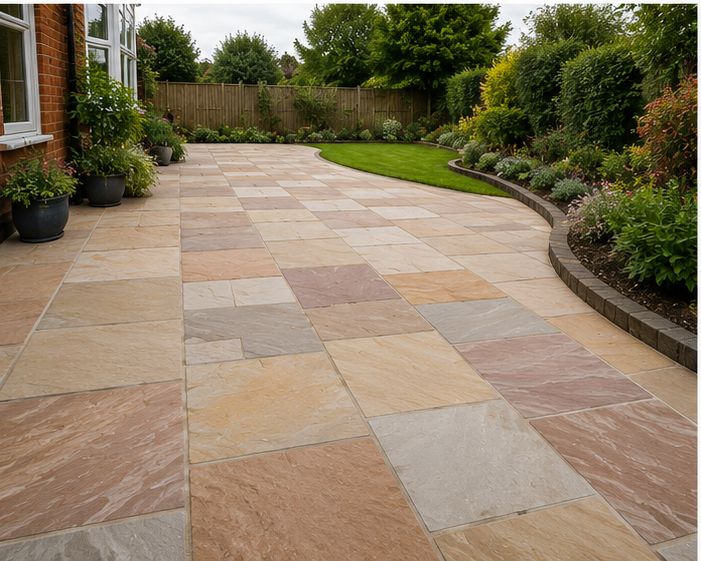
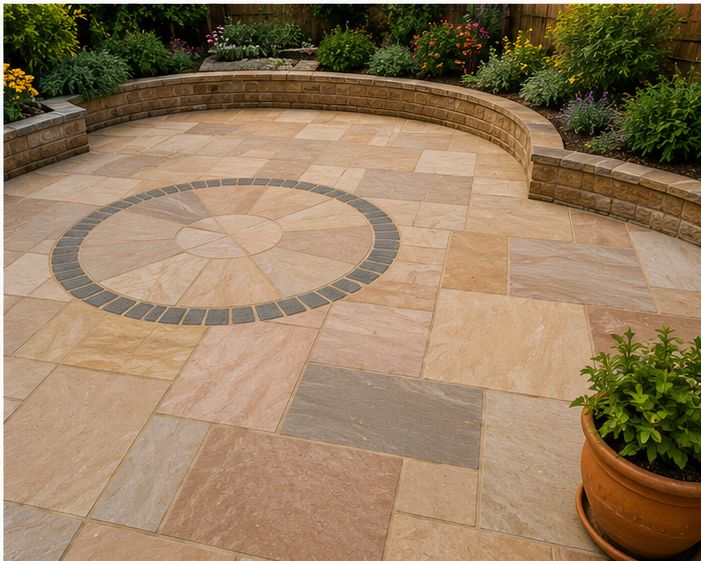
Sandstone is a sedimentary rock, made of grains of sand pressed and cemented together over a very long time. The stone sold here as Indian sandstone is quarried in India, much of it in Rajasthan, then split along its natural layers and cut into slabs before shipping.
Because it splits in layers, the classic finish is riven: the face is left as it came apart, with shallow ripples and ridges. Hand-cut riven slabs vary in thickness, so no two are quite alike. Calibrated slabs have been machined on the back to a more even depth, which makes them quicker and more predictable to lay. Most suppliers sell them in project packs, a mix of four or so sizes designed to be laid together in a random-looking pattern.
One point worth raising with any supplier is where the stone comes from. Concerns have been raised in the past about working conditions in some quarries, and many suppliers now publish how their stone is sourced. It is a fair question to ask, and we are happy to point you towards stone with clear sourcing.
Every colour is a natural blend, so expect variation between slabs, and sometimes within one slab. Names vary between suppliers, but these are the families you will usually see:
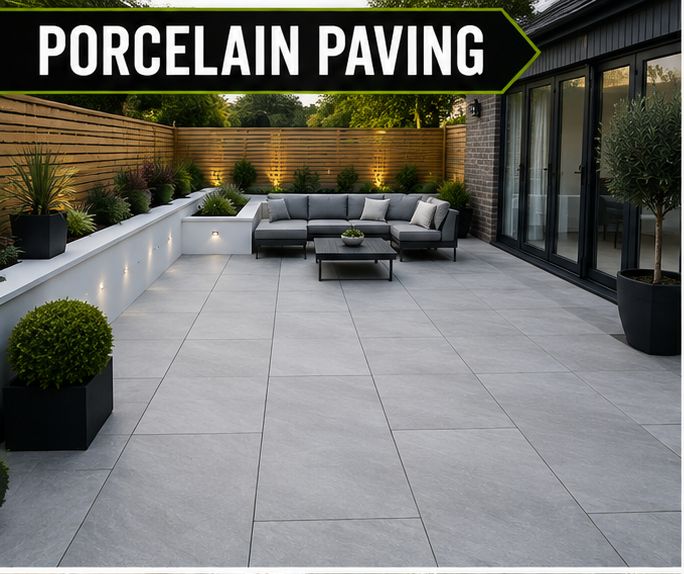
Alongside riven there are sawn finishes, cut smooth on the face with crisp edges for a cleaner, more contemporary look, and tumbled or brushed versions that soften the surface. Sawn sandstone looks sharp but has less texture underfoot than riven, which matters on a shady slope. Natural iron spots and ripples of darker mineral are part of the stone, not faults. If you would like to compare it with a completely uniform surface, look at our porcelain paving page.
Sandstone is forgiving to lay compared with porcelain, but uneven riven slabs need care. Our method follows the basics set out in our guide to how a patio should be laid:
With a project pack we lay out the pattern on the ground before fixing anything, to avoid long straight joints running across the patio and to spread the colour evenly.
Sandstone is porous, so in shade and under trees it will pick up green algae, lichen spots and marks from leaves. That is normal and does not harm the stone. A regular sweep, clearing leaf litter before it rots and letting light in by cutting back overhanging trees and hedges all slow it down.
For a deeper clean, use a cleaner made for natural stone and follow its instructions. A pressure washer on a gentle setting and held at a distance is fine; a narrow jet held close can etch the face and blast out pointing. Some people seal their sandstone to reduce staining. It can help, especially with lighter colours, but it may darken or add a slight sheen, so it is worth testing on a spare slab first. Our article on looking after a new patio covers this in more detail.
Riven sandstone suits the stone terraces and Victorian villas common across the region, cottage gardens, and anywhere with existing stone walls. Its texture makes it a sensible choice on sloping ground and for garden steps, and it pairs well with brick or stone walls and raised beds. It works well in the stepped valley gardens around Pontypool and on larger plots near Abergavenny.
It is less ideal if you want a spotless surface with almost no cleaning, or a perfectly flat, modern finish. Our guide to choosing between porcelain, sandstone or concrete sets out the trade-offs, and you can ask us to bring samples so you can see the colours in your own light.
Not sure which material suits your garden? Compare the options, or see our patio slabbing and paving page for the full picture.
Real reviews from homeowners across South Wales — rated 4.8 out of 5 on Google from 69 reviews and 10/10 on Checkatrade.
“Had my patio done by the company and could not be happier. Top quality work done and quickly too.”
“I was pleased to find Tony and his lads were absolutely great! Tony responded quickly & was very polite.”
“We were delighted with the work and materials, which were of very high quality. Tony and team helped us.”
Guides that help when you are choosing and planning paving.
We lay paving right across South Wales. Choose your town to see patio paving there.
Riven sandstone has a naturally textured face and usually gives good grip. Like any paving it can get slippery if algae or wet leaves are left to build up, so keeping it swept matters most in shaded corners and on steps.
Most sandstone mellows a little with sun and weather, and some of the brighter tones soften over the first year or two. Many people like that aged look. If you want colour that stays exactly the same, porcelain is the more stable option.
No, it does not have to be sealed. A sealer can reduce staining and make cleaning easier, but it can change the look of the stone. We are happy to talk through the pros and cons for your colour and your garden.
Hand-cut slabs keep a more varied thickness and a slightly rougher edge. Calibrated slabs are machined to a more even depth, which makes the finished surface more consistent and the job a little quicker. Both look good when laid properly.
Get in touch and Tony will come and look at the space, the levels and the access, and talk through colours with you. The quote is free, and it depends on the size, the ground, the stone you choose and how much digging out and waste is involved.
Tell us a little about your garden and the look you want. We will arrange a visit, bring samples if you like, and give you a free quote.