
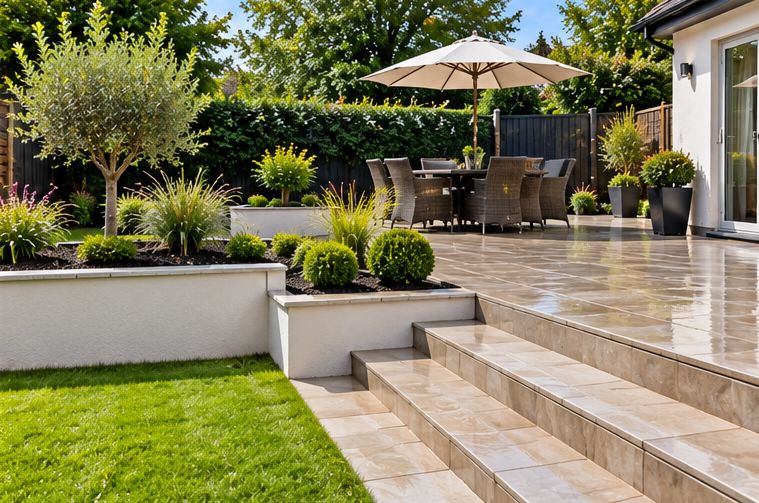
Merthyr Tydfil grew up the sides of the Taff valley, and it shows in the gardens. Behind many of the terraced rows, the back garden climbs steeply from the kitchen door, sometimes in a series of old crumbling steps, sometimes as a single bank of grass that nobody wants to mow. Other homes look out over a garden that drops away below them. Either way, a slope like that is hard to use and harder to enjoy.
Terracing is the usual answer: cutting the slope into a few level platforms, each held by a wall or sleepers and linked by steps. This guide explains how we plan a terraced garden in Merthyr Tydfil, from deciding how many levels to have through to getting materials in and keeping water under control. For the wider principles, see our home guide on how to landscape a sloping valleys garden.
Decide what each level is for
The best terraced gardens start with a list of uses rather than a drawing of walls. Do you want somewhere to eat outside? A patch of lawn for children? Raised beds for vegetables? A shed or bin store? Once you know the uses, you can work out how big each level needs to be and where it should sit.
As a rule of thumb, put the level you will use most closest to the house, so it is easy to reach with a tray of drinks. Sun matters too: in a valley town the sun can disappear behind the opposite hillside early in the day, so a seating terrace higher up the garden may get light and warmth that the lower levels miss. A quiet bench on the top level, looking out across the valley, is often the favourite spot once the work is finished.
Fewer, wider levels or more, narrower ones
There is always a trade-off. Fewer levels mean each one is wider and more useful, but the walls between them are taller. More levels mean lower walls, but each platform is narrower. On the steepest Merthyr Tydfil plots, two or three generous levels usually work better than five or six thin strips that are too narrow for a table and chairs.
Taller walls also bring more responsibility. The soil behind a retaining wall pushes hard, especially when it is saturated after heavy rain, so a tall wall needs a proper foundation, reinforcement and drainage. For a higher retaining wall, or one close to a house, a path or a neighbour’s boundary, engineering advice is sensible, and it is wise to check with the council before starting. Our guide when does a retaining wall need engineering advice explains why.
Holding each level in place
The walls are the backbone of a terraced garden, and the right material depends on height, looks and budget:
- Timber sleepers. Quick to build and warm to look at, good for lower levels and raised beds. In a wet climate, choose sleepers treated for ground contact and expect them to need replacing eventually.
- Block walls with a render or stone facing. Strong and adaptable, suited to taller retaining walls.
- Brick walls. A tidy, lasting finish that can match the house, with coping to shed rain.
- Natural stone. Fits the look of the valleys and can often reuse stone already on site from old walls.
We look at this in more detail in retaining and boundary walls in Merthyr Tydfil, and our brickwork in Merthyr Tydfil page shows the walls we build locally.
Water on a hillside
In a town as wet as Merthyr Tydfil, drainage is not an extra. Every terrace changes how rain moves down the slope. Without planning, water collects at the base of each wall, soaks the soil behind it and adds pressure, or pours off the lowest level towards the house.
We build a free-draining stone backfill and a perforated pipe behind retaining walls, with weep holes or an outlet so water can escape. Each level gets a slight fall towards a drain or planted edge. At the bottom, a channel or gravel trench catches what is left before it reaches the back door. Our guide to garden drainage solutions in Merthyr Tydfil goes further into where that water can go.
Steps that feel safe in the rain
Steps are what make a terraced garden work day to day. They need even risers, treads deep enough to stand on comfortably and a surface that grips when wet. On long flights, a landing halfway gives a place to pause. A handrail is worth considering on steep runs, and low lighting helps on dark winter evenings.
We build steps in brick, stone, sleepers or slabs to match the rest of the garden. See garden steps in brick and stone, and for grippy surfaces, our local guide to paving that stays safe in wet Merthyr Tydfil winters.
Getting soil and materials up and down
The practical side of terracing is often underestimated. Cutting a slope into levels creates a lot of spoil, and some of it may need to leave the site. Blocks, sleepers, stone, sand and cement all have to come in. On many of the older Merthyr Tydfil streets there is no rear access for machinery, so everything is moved by wheelbarrow, tracked barrow or by hand, sometimes up or down steep steps.
Where possible we balance cut and fill, using soil dug from the high side of a level to build up the low side, which reduces what has to be carried away. Where waste does need removing, we arrange it as part of the job. If the garden is overgrown before work starts, a garden clearance is usually the first step.
Planning your terracing project
Terracing is one of the bigger jobs in garden landscaping, but it is also one of the most rewarding. A slope that was a no-go area becomes somewhere to sit, grow, play and look out over the town. The key is to plan the levels, walls, steps and drainage together.
Tony and the team plan and build terraced gardens as part of our landscaping and garden design work, and there is more about our approach on the Merthyr Tydfil landscaping page. For ideas on what to put on each level, see designing a garden for Merthyr Tydfil’s wet climate. When you are ready to talk it through, ask for a free quote.
Talk to T J Landscapes about your garden
Free quotes and honest advice across South Wales.
Questions People Ask
How many levels should a steep garden have?
It depends on the slope and what you want to use it for. On most steep Merthyr Tydfil plots, two or three wide levels are more useful than lots of narrow ones, though the walls between them are taller.
Are sleepers strong enough for terracing?
For lower levels and raised beds, yes. For taller retaining walls, block, brick or stone is usually more suitable, and a high wall may need engineering advice.
Do I need permission to terrace my garden?
Many garden terracing projects need no permission, but tall retaining walls, big changes in ground level or work near a boundary or road may. Check with Merthyr Tydfil County Borough Council before starting a large scheme.
Can you terrace a garden with no rear access?
Yes. It takes longer because materials and soil are moved by hand or barrow, but it is common on terraced streets. We plan for it when we quote.
What affects the cost of terracing?
The steepness and size of the slope, the number and height of walls, the materials, drainage, access and how much soil has to go. A free quote explains each part.