
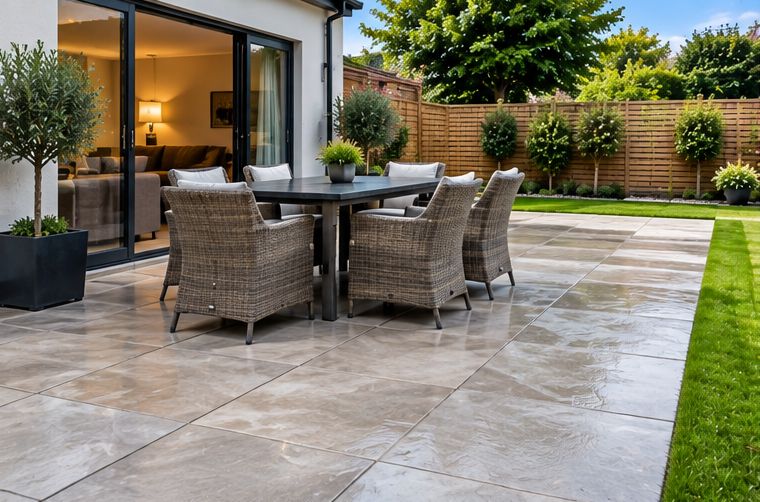
From October to March, many Merthyr Tydfil gardens barely dry out. Rain rolls down off the Beacons, days are short, frost comes early at this height and the sun sits low behind the valley sides. On paving, that combination grows algae, holds a film of water and turns sloping paths and back steps into a real hazard.
This guide looks at paving from the point of view of someone who has to walk to the bins on a dark, wet January evening. It covers which finishes hold their grip, how paving should be laid on the town’s sloping plots, and what you can do to keep existing paving safer.
Why paving gets slippery up here
Slippery paving is rarely just about the stone. In Merthyr Tydfil a few things stack up at once. Frequent rain keeps surfaces damp, and damp surfaces in shade grow green algae and black lichen spots quickly. Leaves and silt washed down from higher ground collect in low spots. Where a patio was laid flat or with a dip, water sits for hours and freezes overnight in a cold snap.
Steep ground makes it worse. A slight slope that is fine in summer becomes hard work when it is wet, and a set of back steps with worn, smooth treads is one of the most common trip and slip points we see on the older terraced streets. Solving it means looking at the surface, the layout and the water together.
Finishes that hold their grip
Some materials are simply better suited to a wet upland winter. These are the ones we tend to recommend in Merthyr Tydfil:
- Riven Indian sandstone. The naturally uneven, split face gives good grip underfoot. It does need occasional cleaning in shady spots.
- Textured or anti-slip porcelain. Porcelain absorbs very little water, so algae has less to hold on to. Choose a slab rated for outdoor use with a textured finish, not a smooth indoor-style tile.
- Granite with a flamed or textured face. Very hard wearing and grippy, and a good choice for steps.
- Block paving. The many joints give plenty of edges for grip, which suits paths and driveways on a slope.
Honed, sawn and polished finishes look sleek but can be slippery once wet, so we are cautious about them in exposed or shaded spots. For a fuller comparison, see porcelain, sandstone or concrete and our home guide on which patio paving copes with Welsh rain.
Laying for a hillside town
How paving is laid matters as much as what it is. Every patio and path should have a gentle fall so rain runs off rather than lying on the surface, and the fall should lead somewhere sensible: a border, a gravel strip, a channel drain or a gully. It must never lead towards the house.
On a sloping Merthyr Tydfil garden we often break a long path into shorter level runs linked by steps, rather than one long steep ramp of slabs. Steps should have even risers and treads deep enough for a whole foot, with a textured or contrasting nosing so the edge is easy to see in poor light. Our guide to garden steps in brick and stone explains how we set the rise.
Underneath, a well-compacted sub-base and a full mortar bed stop slabs rocking or sinking, which is what creates the lips and puddles people catch their feet on. How a patio should be laid covers that in detail.
Where the water goes next
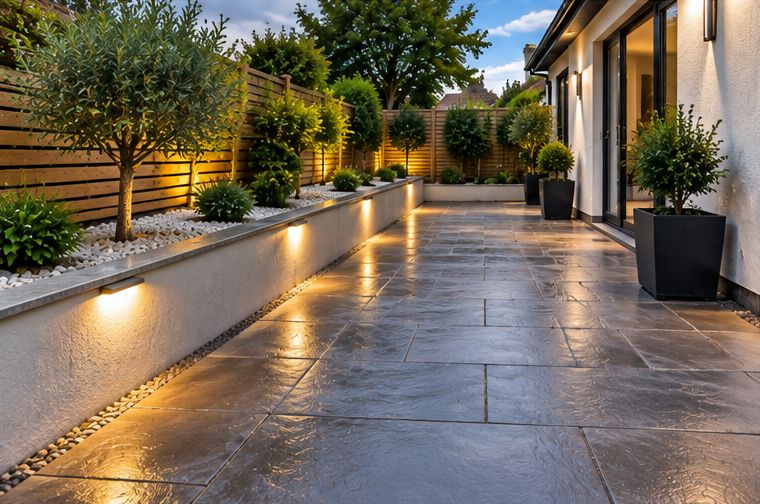
Shedding rain off a patio only helps if the ground beside it can take it. In a lot of Merthyr Tydfil gardens the soil is heavy and already saturated in winter, so a patio can simply move the puddle a few feet along. Where that is likely, we add a channel drain along the low edge, a gravel-filled trench or a connection to an existing surface water drain.
Permeable options are worth considering as well. Permeable block paving and well-built gravel paths let rain soak through into a deep stone base below, which reduces run-off down the slope. They are not a fix for ground that never drains, but they can help on a driveway or path. Read garden drainage solutions in Merthyr Tydfil if water is already a problem.
Keeping existing paving safe
If you have paving already, a few habits make a big difference through a Merthyr Tydfil winter:
- Sweep leaves and silt off in autumn before they break down into a slimy layer.
- Clean green and black growth off in late summer or autumn, so the paving goes into winter clean. A stiff brush and a suitable patio cleaner is usually enough.
- Keep joints filled, so weeds and moss do not take hold and water does not get under the slabs.
- Check steps for rocking treads or loose edges and get them fixed before the dark evenings.
- Use grit or a de-icer suitable for your stone on frosty mornings, checking the product will not mark it.
Our guide on how to clean and look after a new patio covers products and pressure washing.
When relaying is the better answer
Sometimes cleaning is not enough. If slabs have sunk, the patio falls towards the back door, or smooth concrete slabs are worn glassy, relaying is often the safer long-term answer. We can usually lift and reuse sound stone, correct the levels and add drainage at the same time. Why patios sink, crack or lift explains the common causes.
Tony and the team lay patios, paths, steps and driveways across the town, and you can read more on our patio paving in Merthyr Tydfil page and the main patio slabbing and paving page. For how paving fits into the wider garden, see our Merthyr Tydfil landscaping page. When you are ready, send us a message for free advice and a free quote.
Talk to T J Landscapes about your garden
Free quotes and honest advice across South Wales.
Questions People Ask
What is the least slippery patio material for Merthyr Tydfil?
Riven sandstone, textured anti-slip porcelain, flamed granite and block paving all keep good grip when wet. How it is laid matters too: a proper fall so water does not sit on the surface is essential.
Is porcelain slippery in the rain?
Smooth indoor-style porcelain can be. Outdoor porcelain with a textured or anti-slip finish is a different product and grips well. We only recommend slabs made for outside use.
How often should I clean my patio?
In a wet, shady garden, once or twice a year is typical, with a quick sweep of leaves in autumn. Sunny, open patios may need less.
Can you make my existing back steps safer?
Often, yes. We can reset loose treads, even out uneven risers, replace worn slabs with a grippier material and make the edges easier to see. Sometimes rebuilding the steps is the better option.
What affects the cost of new paving?
The area, the material, how steep the ground is, access for materials, how much needs digging out, and whether drainage or steps are needed. A free quote sets it all out.