
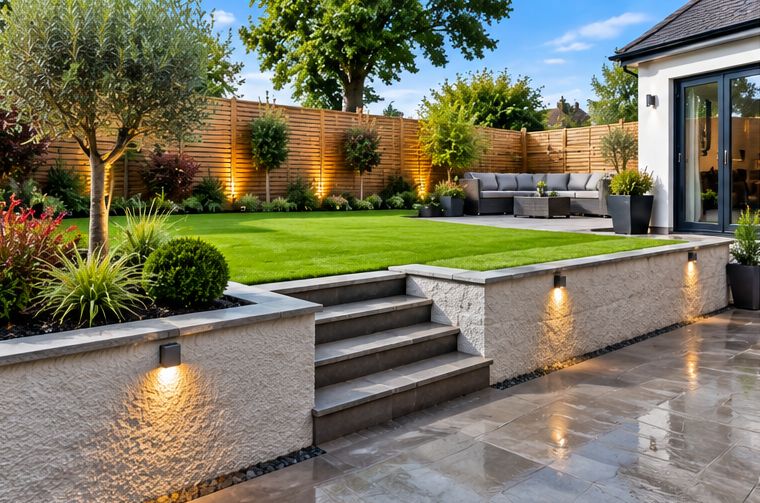
Walk around the older parts of Merthyr Tydfil and you see walls everywhere: stone walls holding up gardens above the pavement, brick walls between terraced yards, and block walls on newer estates where a plot was cut into the hill. Many have stood for a long time. Some are leaning, bulging or shedding their pointing, often because water has been building up behind them for years.
This guide is about the walls Merthyr Tydfil gardens rely on: how to tell when one is in trouble, what goes into a wall that will last on wet, sloping ground, and when to bring in more than a landscaper. Our brickwork and garden walls page covers the full range of walling we build.
Two very different jobs
A boundary wall marks a line and gives privacy. It mostly has to stand up to wind, weather and the odd knock. A retaining wall holds back a bank of soil, and in a town as wet as Merthyr Tydfil that soil is often saturated, which makes it far heavier and adds water pressure behind the wall.
The two can look alike from the front, but a retaining wall needs a wider footing, a stronger build and a way for water to escape. Treating one like the other is a common reason walls fail.
Signs a wall needs attention
If your garden has an older wall, it is worth looking at it properly once a year, ideally after a wet spell. Look out for:
- A lean or a bulge, especially in the middle of a long run.
- Cracks that run diagonally or get wider over time.
- Wet patches or staining on the face, showing water pushing through.
- Pointing falling out and stones or bricks working loose.
- Soil or the ground above the wall dropping or cracking.
- Tree roots growing close to the base.
A little loose pointing can be dealt with. A wall that is moving, particularly one holding up ground next to a path, a house or a neighbour’s garden, needs looking at sooner rather than later. Keep people away from it until it has been checked.
Letting the water out
Almost every failing retaining wall we see in the valleys has the same underlying problem: water with nowhere to go. Rain soaks into the bank, runs down to the back of the wall and sits there, pushing.
When we build a retaining wall in Merthyr Tydfil, drainage is part of the design. We lay a perforated pipe at the base behind the wall, backfill with clean stone rather than the dug-out soil, and leave weep holes through the face so trapped water can escape. Where there is a lot of run-off from higher ground, we may add a drain at the top of the bank too. Our guide to garden drainage solutions in Merthyr Tydfil looks at the wider picture.
Footings on valley ground
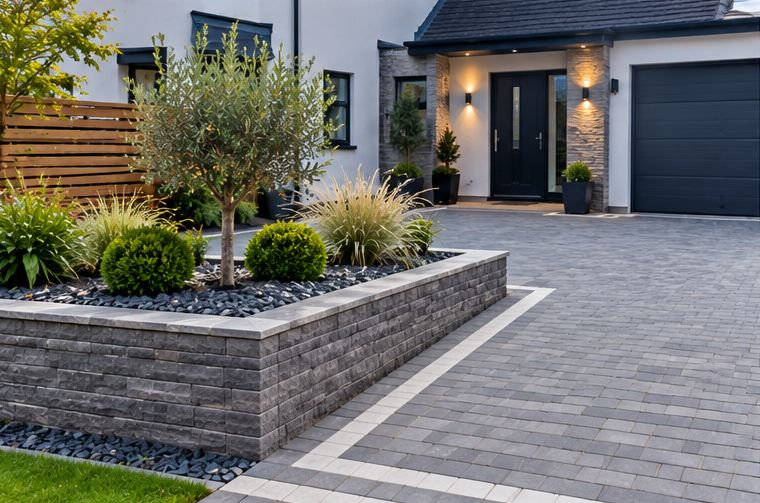
A wall is only as good as what it stands on. On steep Merthyr Tydfil plots the ground can change a lot across one garden, from firm subsoil to loose fill, and old gardens can hide rubble or the remains of earlier walls. We dig down to firm ground and pour a concrete footing sized for the height and job of the wall.
On a slope, footings are often stepped so the wall follows the fall of the land while each section sits level. Garden wall foundations: why they matter explains this in more detail.
Choosing a material that fits the street
In the older parts of town, stone is the natural choice where a wall faces the street or joins an existing stone wall. Reusing the original stone from a collapsed section keeps the look. Brick suits many terrace yards and boundaries, and a good hard brick with a proper coping sheds rain well. Rendered block is practical for a retaining wall hidden behind planting.
Sleepers are another option for lower retaining walls and are quick to build, though they will not last as long as masonry in wet ground. For bricks, copings and finishes, see choosing bricks and coping for a garden wall.
When to get engineering advice or check with the council
We are landscapers, not structural engineers, and we say so. Taller retaining walls, walls holding up a driveway or a building, and walls close to a public path or a neighbour’s property may need an engineer’s design. Some walls and some changes in ground level may also need approval, so check with your local council before work starts.
Where a wall sits on a shared boundary, talk to your neighbour early. Party wall rules can apply to some boundary work; if in doubt, take proper advice. When does a retaining wall need engineering advice? sets out the general points.
Walls as part of a terraced garden
Walls are rarely a job on their own in Merthyr Tydfil. More often they are the backbone of a garden cut into levels, with steps between terraces and raised beds built into the walls. Planned together, the walls, steps and drainage work as one system. Our guide to terracing a steep Merthyr Tydfil garden shows how that fits together, and the Merthyr Tydfil landscaping page covers everything else we do in the town.
Steps deserve the same care as the walls either side of them. In a wet climate, treads should be even, generous and slightly sloped so rain runs off, with a textured finish that does not turn slick with moss. We match the risers through a flight so nobody trips on an odd one out. Garden steps in brick and stone explains how we get the rise right.
A low wall can also become a raised bed, which lifts planting out of heavy, wet ground and gives you somewhere to sit at the edge of a terrace. Building brick raised beds and planters has ideas.
Talk to T J Landscapes about your garden
Free quotes and honest advice across South Wales.
Questions People Ask
Can a leaning wall be straightened?
Rarely in a way that lasts. A wall that has moved usually needs taking down and rebuilding with proper footings and drainage. We can often reuse the original stone or brick.
How high can a garden wall be without permission?
It depends on where it is, particularly whether it is next to a road. Rules also differ for retaining walls. Check with your local council before building, and we will flag anything we think needs looking into.
Can you repair old stone walls in Merthyr Tydfil?
Yes. Repointing, rebuilding a failed section and matching the stone are all part of our brickwork. Where the problem is water behind the wall, we will deal with that as well.
What affects the cost of a retaining wall?
Height, length, material, how deep the footings need to go, how much soil must be moved, drainage and access for materials. We explain each in a free quote. See also brickwork in Merthyr Tydfil.
How do I arrange a visit?
Use the enquiry form or call or message Tony. Photos of the wall from the front and the side are a great help.