
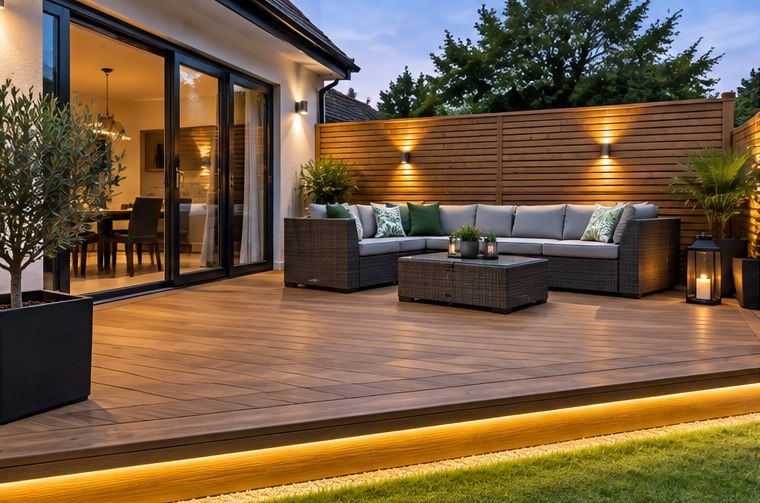
Some gardens resist every attempt at levelling. The ground drops away from the back door, there is rock a spade's depth down, or an old bank of fill makes digging a gamble. We see all three in Chepstow, where homes are built into slopes and many gardens have been reshaped more than once over the years.
In those places a deck is often the simplest way to get a flat, usable area. This guide looks at how decks are built on uneven ground, what to think about when a deck sits high above the garden, and the local points that matter in Chepstow. Our garden decking page covers the service in general, and our landscaping in Chepstow page shows how decking fits into a wider garden.
Why a deck can beat digging
Levelling a slope for a patio means cutting into the high side, building a retaining wall on the low side and removing whatever soil is left over. On a gentle gradient that is fine. On a steeper Chepstow plot it can mean a lot of excavation, a tall wall and plenty of spoil to carry out through a narrow passage.
A deck sits on posts or pads, so the ground underneath can stay roughly as it is. Less soil moves, less waste leaves the site and the finished surface can be set at whatever height suits the back door. It also works where roots from a nearby tree mean heavy digging would be unwise.
What sits under the boards
The part you walk on is the least important part of a deck on uneven ground. What matters is the frame and how it meets the earth. The usual options are:
- Concrete footings with timber posts, the traditional method, set to a depth that suits the soil.
- Adjustable pedestal or post supports, which can be raised or lowered to take up differences in level across the site.
- Ground screws, driven in rather than dug, useful where digging would disturb roots or services, though rock can stop them.
- Bearers fixed to a sound wall, sometimes used on one side, only where the wall is strong enough to take the load.
On a slope, the posts on the low side can be much taller than those near the house. Those tall posts need bracing so the frame cannot rack sideways, and the joists need sizing for their span. Our guide to raised decking frames, steps and balustrades goes into the detail.
Ground conditions around Chepstow
Ground varies a great deal around Chepstow, even between neighbouring gardens. Some plots are on reasonable soil, some hit stone almost straight away, and some sit on made-up ground where earlier owners have filled a dip. We dig trial holes where footings will go, because a post on soft fill can sink while its neighbour on rock stays put.
Where rock is shallow, we may bolt supports to it or use a shallow pad rather than trying to dig deep. Where the soil is soft or wet, footings go deeper or wider. It is also worth keeping an eye on old stone walls near the deck; if one looks tired, our guide to repairing old stone garden walls in Chepstow explains what can be done.
Height, privacy and permission
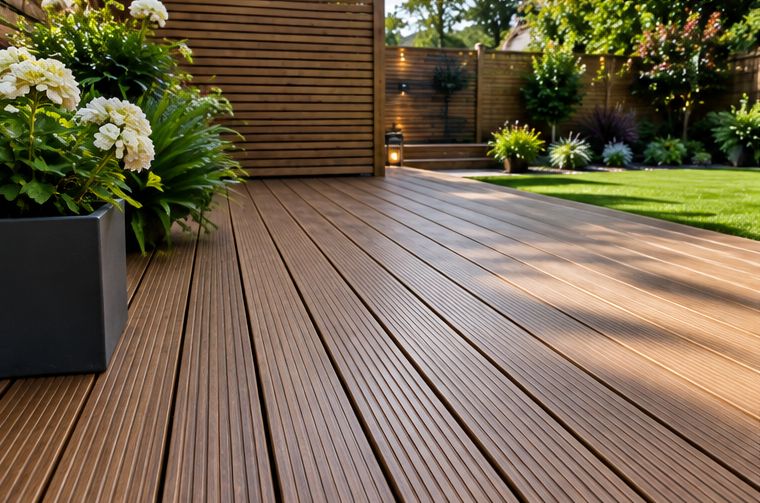
A deck built level with the back door on a falling garden can end up well above the ground at its far edge. That brings a view, but also questions. Will it overlook the neighbours? Does it need a balustrade? Will the space underneath become a damp, untidy void?
Raised decks, balconies and platforms can need planning permission above a modest height, and rules are different for listed buildings and homes in a conservation area. Check with Monmouthshire County Council before a raised deck is built. We are happy to explain the layout options, but the planning decision is theirs, and we always suggest asking early.
Dealing with the space beneath
Left alone, the ground under a raised deck can become a home for weeds, leaves and damp. Before the boards go on, we clear the area, lay a weed membrane with gravel over it and make sure rainwater still has somewhere to go. On a steep slope, water running under the deck must not wash soil from around the footings.
Some owners like to use the space. With enough height, the area under a high deck can store bikes, logs or garden tools, screened with slatted cladding that still lets air through. Good airflow keeps the frame drier and helps it last.
Timber or composite on a damp slope
Chepstow sits low in the Wye valley near the Severn estuary, and gardens in the shade of a hill or tall trees stay damp for much of the year. Grooved softwood can go slippery if it is not cleaned, while most composite boards shrug off algae better and need less upkeep, though they can still get slippery in shade.
Our home guide to composite or timber decking compares the two, and how to stop decking going slippery has practical tips.
Joining the deck to the rest of the garden
A deck on a hillside rarely stands alone. It usually needs steps down to a lawn, a path to a lower terrace or a retaining edge where it meets the bank. Planning those links with the deck avoids awkward drops later. If you are thinking about stepping the rest of the slope with timber, read terracing with sleepers on a Chepstow hillside.
When you are ready, ask for a free visit through the enquiry form. We will look at the ground, the access and the height, and suggest the simplest way to give you the flat space you want.
Talk to T J Landscapes about your garden
Free quotes and honest advice across South Wales.
Questions People Ask
Can decking be built straight onto a slope without levelling?
Yes. The frame is made level, not the ground. Posts or adjustable supports of different heights take up the slope, and the ground beneath only needs clearing, covering with membrane and gravel, and draining.
Is decking on a slope safe for children?
It can be, with a well-braced frame, balustrades wherever there is a meaningful drop, good grip on the boards and a sensible gap between spindles. We talk through these points when we plan the deck.
Can you build a deck over an old patio on a slope?
Often, if the patio is sound. The deck frame can sit on the slabs with packers or adjustable feet. Our guide on building decking over an old patio or concrete explains what to check.
What affects the cost of a deck on uneven ground?
Mainly the height of the frame, the number and type of footings, ground conditions such as rock or soft fill, balustrades and steps, the boards chosen and how easy the garden is to reach. We explain each of these in a free quote for your Chepstow garden.
How long does decking on a slope last?
About as long as any deck, provided water drains away, air can move under the frame and the timber is suitably treated. Our guide on how long garden decking should last has more detail.