
It is the question everyone wants answered first, and the honest reply is that we cannot give a fair figure without seeing the garden. That is not us being cagey. In Penarth especially, the things that decide the cost are rarely obvious from a description over the phone: how hard the wind hits the plot, what the old walls are like, how the ground falls and how everything gets in and out.
This guide walks through those factors so you know what we are looking at when we visit, and where there is room to adjust the plan. Our general guide to what affects the cost of garden landscaping in South Wales covers the basics that apply everywhere; here we focus on what makes Penarth gardens different. For the service itself, see our landscaping and garden design page.
Size, but also shape
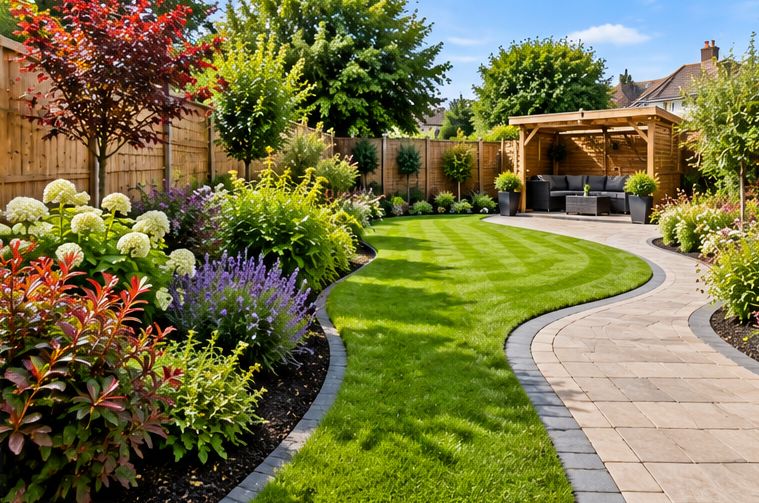
Many Penarth houses, particularly the Victorian and Edwardian villas, have long gardens, and length alone adds work. But shape matters as much as area. A long, narrow plot with a gentle fall is simpler to build than a shorter one split across several levels, and a garden with curved beds and paths takes more cutting and fitting than a rectilinear layout. A small front garden with a boundary wall, a path and steps up to the door can involve as much skilled work as a much larger back lawn.
It also helps to separate the whole plot from the part you actually want changed. Many Penarth owners keep a mature lawn or a well-planted border and put the effort into a new terrace near the house, which keeps the scope, and the quote, in proportion.
Building for the wind off the Channel
On sheltered streets, a garden can be built much as it would be anywhere else. On higher or seaward plots, exposure changes the specification, and that shows up in the quote:
- Fence posts set deeper and closer together, or concrete posts, with designs that let the wind through. See fencing that survives sea winds in Penarth.
- Stainless or coated screws, hinges and fixings that stand up to salty air.
- Shelter planting or screens on the windward side before the more delicate parts of the design.
- Firmer, deeper bases for raised decks and structures that catch the wind.
These add to the first outlay but usually save money over the life of the garden, because they do not need replacing after a few hard winters.
Materials that suit a period house
Penarth’s older homes tend to look best with materials that have some character, such as natural stone, reclaimed brick, clay pavers or traditional edging. The choice of material is one of the biggest single factors in a quote, and the range runs from plain concrete slabs to cut natural stone and porcelain. Our guide on which patio stone suits a Penarth Victorian villa compares the options.
Matching old work also takes time. Repointing a boundary wall in lime, sourcing reclaimed bricks to blend in, or laying a path in a pattern that suits the house all involve more labour than new work built from scratch. Restoring an Edwardian garden wall in Penarth explains why.
Slopes, levels and making the most of a view
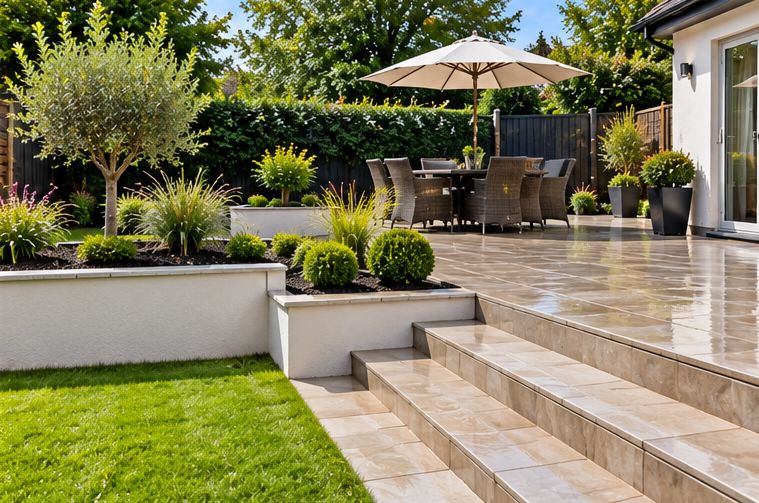
Some Penarth gardens fall away towards the sea or step down from the house. Levelling ground for a patio or lawn means digging out and moving soil, and where the change in height is significant it means building retaining walls and steps, which are among the more involved jobs in any garden. A raised deck to catch a view needs a solid frame, secure balustrades and sometimes a conversation about planning and privacy; see decking with a view.
Flat, open plots are the simplest. The more levels, the more walls, steps and drainage the design needs.
Getting in and out
Access is one of the biggest hidden factors in Penarth. Terraces and semi-detached villas often have only a narrow side passage, or no side access at all, so every bag of sub-base, every slab and every barrow of spoil has to go through by hand, sometimes through the house. Parking for a van or a skip on busy residential streets can take some planning too, and a skip on the road may need a permit from the council.
Where machinery can reach the back garden, a job goes much faster. Where it cannot, more of the work is done by hand, which takes longer. We always look at the route in and out on the first visit.
What is already there
Much of the cost in an older garden can come from what has to be dealt with before anything new goes in. That might be a long-overgrown plot to clear, an old concrete base to break out, mature trees to prune, or buried rubble that has to be dug out and taken away. Poor drainage on heavy ground may need fixing before a patio or lawn will last. Waste removal is a real part of any quote, and more so in a big, neglected garden; our guide on clearing a long-neglected Penarth garden explains what is involved.
Ways to spread the work
If the full plan is more than you want to take on at once, it can be split into stages. Clearance, drainage and structural work such as walls and levels usually make sense first, because they are disruptive and everything else sits on top of them. Paving, decking, turf and planting can follow in later phases. A clear overall design from the start means each stage fits the next and nothing has to be pulled up later.
We are also happy to suggest where a less costly material or a simpler layout would give a similar result. Tell us your priorities and a rough budget, and we will be honest about what it can achieve. You can see how we approach local gardens on our landscaping in Penarth page.
Talk to T J Landscapes about your garden
Free quotes and honest advice across South Wales.
Questions People Ask
Can you give me a rough price over the phone?
Not a reliable one. Exposure, access, levels and what lies under the surface all change the cost, so we visit, look at the garden and give you a clear written quote for free.
Does being near the sea make a garden more expensive?
Sometimes. An exposed Penarth plot may need sturdier fencing, better fixings and some shelter planting. A sheltered garden a few streets inland may need none of that.
Is natural stone always more expensive than porcelain or concrete?
Not always. Prices vary a lot between products and grades, and laying time differs between materials too. We can price more than one option so you can compare.
Will I need a skip?
Often not, as we take waste away ourselves on many jobs. For bigger clearances or excavations a skip may help, and if it has to go on the road, a permit from the council is usually needed.
How do I get a quote?
Ask for a free quote with a few details and photos if you have them. Tony will visit, talk through what you want and follow up with a clear price.