
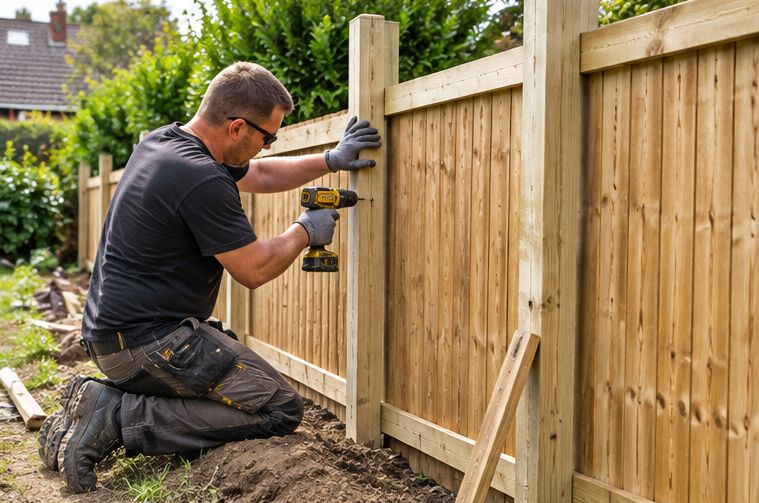
Inland, a fence mostly has to cope with rain and the odd storm. On the coast it is a different job. Gardens in Penarth that face the Bristol Channel, or sit on higher ground above the town, take repeated gales through the autumn and winter, and every gust arrives with a fine coating of salt. Fences that would last happily in a sheltered suburb can lean, rot or rust out far sooner here.
This guide looks at the local side of the problem: where Penarth fences fail, what we build instead and how to deal with period boundaries at the front of the house. For the general comparison of fence styles, our guide to fences in Welsh wind is a good companion, and our fencing services page shows what we fit.
Where coastal fences give up
When we are called out to a fallen fence in Penarth, the story is usually one of a few familiar ones. The wind did the damage on the night, but the weakness had been building for years.
- Timber posts rotted just below the soil, where wet ground and air meet, until one gust snapped them.
- Bright steel nails and screws rusted through, so boards and panels worked loose one by one.
- Solid panels on a long, straight run with nothing to break the wind, acting like a row of sails.
- Fences perched on top of old garden walls, levering the wall as well as the fence in every storm.
- Gates that caught the wind, swung hard against their stops and slowly pulled the hanging post over.
Let the wind through
The single most useful change on a seaward boundary is to stop fighting the wind. A fence with small gaps lets air pass, which cuts the load on the posts and stops the worst turbulence on the garden side. Hit-and-miss boards, slatted screens and trellis-topped fences all do this while still giving a good degree of privacy.
Where you do want a solid barrier, for instance beside a patio, keep it short or break it up with sturdy posts, and plant a hedge on the windward side if there is room. A hedge behind a fence, or a fence behind a hedge, is often the best of both. Our article on salt-tolerant planting for a Penarth garden suggests shrubs that will take the exposure.
Posts set to take a gale
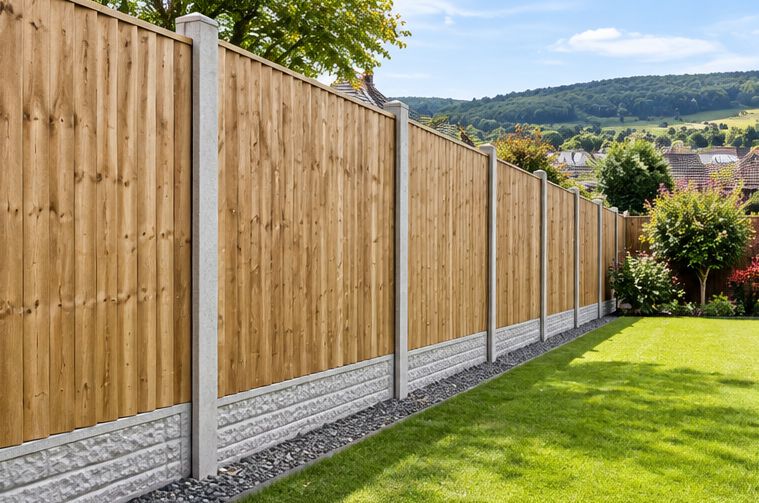
For the most exposed Penarth gardens we generally recommend concrete posts with concrete gravel boards. They do not rot, they are not troubled by salt, and a damaged panel can be lifted out without disturbing the post. Where timber posts suit the look better, we use heavy, well-treated posts and set them deep in concrete, with the top of the concrete shaped to shed water away from the timber.
Depth matters more on the coast, not less. We dig until we reach firm ground rather than stopping at a set measurement, which can mean going deeper in soft, made-up ground behind older houses. For more on the choice, see concrete posts or timber posts.
Fixings that will not rust away
Salt air is quick to find cheap steel. Ordinary nails and screws start to stain within a season or two and weaken long before the timber does. On coastal fences we use hot-dip galvanised or stainless steel fixings throughout, including the brackets, gate hinges, latches and bolts.
It is a small part of the cost of a fence and one of the biggest factors in how long it lasts in Penarth. When you compare quotes, it is worth asking what fixings will be used.
Gates on a windy plot
A garden gate is a door that the wind is always trying to slam. On exposed plots we hang gates on heavier posts than the fence itself, use strong hinges and fit a drop bolt or hook so the gate can be held open or shut on a wild day. A gate with a slatted design or a trellis top catches less wind than a solid one.
Side gates between tall villas often sit in a narrow gap that funnels the wind, so they take a real beating. If yours keeps dropping or sticking, the post is usually the cause. Our guide to choosing and fitting a garden gate covers the options.
Period front boundaries
At the front of many Penarth villas the boundary is a low brick or stone wall, sometimes with railings or piers. These are part of the character of the street, and a panel fence in their place rarely looks right. Where more privacy is wanted, a clipped hedge behind the wall usually works better than raising the boundary.
Parts of Penarth are conservation areas, and changes to front walls, railings or boundaries there may need consent. More generally, fences and walls beside a road are often limited in height without planning permission. Check with the Vale of Glamorgan Council before changing a front boundary; we are landscapers, not planners. If an old wall needs attention, see restoring an Edwardian garden wall in Penarth.
Keeping a coastal fence going
A little care each year makes a real difference by the sea. Rinse off salt and grime on the seaward face now and then, re-treat timber every few years, and keep soil, leaves and plants from piling against the boards. After a big storm, walk the line and check for loose boards or any post that has started to move, as these are far cheaper to deal with early. There are more tips in how to make a garden fence last longer.
Talk to T J Landscapes about your garden
Free quotes and honest advice across South Wales.
Questions People Ask
What is the strongest fence for a Penarth garden facing the sea?
Concrete posts and gravel boards with a sturdy slatted or hit-and-miss infill are hard to beat. They let some wind through, will not rot and cope well with salt. Close board on deep-set posts is a good alternative where you want full privacy.
Should I replace a leaning fence or just the posts?
If the boards and panels are sound, new posts can often save the fence. If the timber is soft or split right along the run, replacement is usually better value in the long term. Our guide to fence repair or replacement explains how we decide.
Are metal fences a good idea by the sea?
Some are. Well-coated aluminium and properly galvanised steel cope with salt air, but painted or bare steel can rust quickly in an exposed Penarth garden. Railings on period houses usually need regular painting to stay sound.
How high can my garden fence be?
As a general guide, fences away from a road are often allowed up to about two metres without planning permission, and lower beside a road, but conservation areas and listed buildings can change this. Always check with the council before building a taller fence.
Can you fit a fence on a sloping Penarth garden?
Yes. We either step the panels down the slope or rake the fence to follow the ground, depending on the look you want and how steep it is. See our Penarth landscaping page, then ask for a free quote and we will look at the boundary with you.