
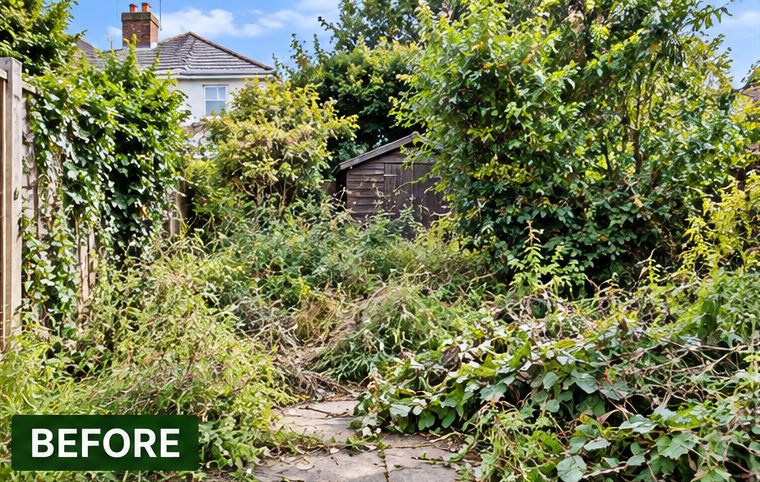
It does not take long. A couple of wet, mild years in Aberdare and a tidy garden becomes a thicket: brambles across the lawn, ivy up the walls, saplings in the borders and a shed you can no longer reach. People come to us after buying a house that has stood empty, after a parent has moved into care, or simply because life got busy and the garden slipped.
Whatever the reason, the steps are much the same. This guide explains how we approach a neglected garden in Aberdare, from the first look to the last barrow load. Our garden clearance page covers the service across South Wales.
Why gardens in the valley grow over so fast
Rain is the short answer. The Cynon Valley stays damp for much of the year, and damp, mild weather suits the plants that take over first: brambles, nettles, ivy, bindweed and self-seeded sycamore. Gardens backing onto wooded valley sides or open ground also get a steady supply of seeds blowing or spreading in from outside.
The shape of the plot plays a part too. On a sloping terrace garden, the upper levels are the hardest to reach, so they are often the first to be left, and growth then works its way down towards the house.
Start with a walk round
Before anything is cut, we walk the garden with you, as far as we can get. The aim is to agree three things: what you want gone, what you want kept, and what we need to be careful around.
- Keep: plants you like, old stone steps and edging, a favourite shrub, garden ornaments. Marking them with tape or string before the day helps.
- Remove: brambles, weeds, dead shrubs, self-seeded trees, rotten fencing, broken sheds and general rubbish.
- Take care: walls that the growth may be holding together, shared boundaries, anything that looks like asbestos sheeting, and signs of nesting birds or wildlife.
It is common to find things under the growth nobody knew were there: a path, a pond, old steps or a pile of rubble from past building work. We will talk to you as they turn up.
Three kinds of Aberdare clearance
The type of house changes the job quite a lot.
Behind a Victorian terrace, the garden is narrow and often stepped, with everything having to come out through the house or down a rear lane. Here the carrying takes as much time as the cutting, and old walls need handling gently. Our piece on garden walls and steps in Aberdare explains why those walls matter.
Around a larger older house, there is more space but also more to deal with: overgrown shrubberies, big hedges, mature trees that have spread, and sometimes several outbuildings. A clearance here is often combined with tree and hedge work.
On a newer estate, the growth is usually younger and the plot flatter, but we often find builders' rubble and compacted ground as soon as the surface is cleared, which affects what comes next.
How the clearance itself runs
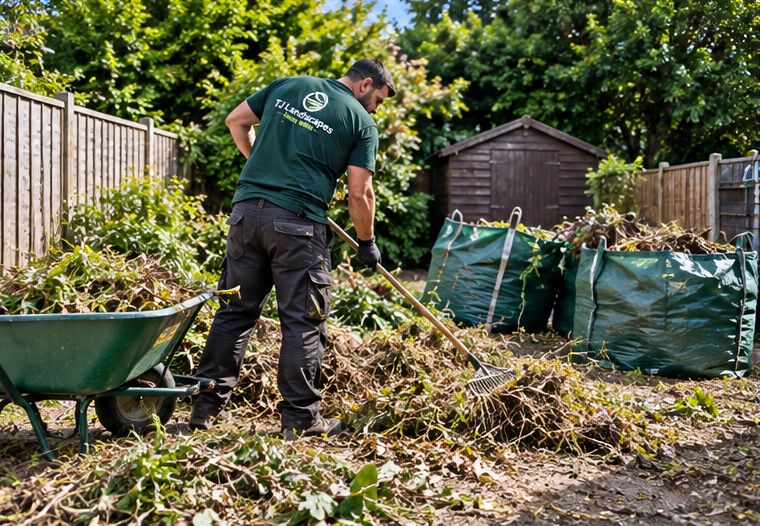
We usually work from the far end of the garden back towards the house, so cleared ground is not trampled over again and the exit route stays open. Top growth is cut first, then roots are dug out where they would regrow, particularly brambles and bindweed.
Green waste and hard waste are kept apart. Cuttings, roots and soil go one way; broken slabs, bricks, old fencing and dismantled sheds go another. Everything is loaded and taken away with us, not burned on site or left in a heap for you to deal with. Our guide to where garden waste goes explains why that matters.
Some things cannot go in with a normal clearance, such as suspected asbestos, chemicals and invasive plants like Japanese knotweed. The list is in our guide to what can and cannot go in a garden clearance. If you think you have knotweed, tell us before we start.
Access in Aberdare streets
Getting waste from the back of an Aberdare house to our van is often the part that shapes the day. A terrace with a usable rear lane is straightforward. One with no rear access means everything is bagged and carried through, so we protect floors and keep loads manageable. A house on the valley side may have steps down from the road, which adds time and effort.
Tell us about parking and access when you get in touch, and we can plan around it.
What to do once it is clear
A freshly cleared garden is the best time to decide what you want, because you can finally see the slopes, the walls and the light. Some people want a simple, low-maintenance finish so it does not grow over again; others use the moment to plan a proper makeover.
Easy next steps include weed membrane and bark or gravel on beds, a new lawn on prepared ground (see our guide to turf laying in Aberdare), or a small patio near the back door. For bigger ideas, garden makeover ideas for Aberdare homes is a good place to start, and the home guide to getting an overgrown garden back under control covers keeping on top of regrowth.
Getting a clearance quoted
The cost of clearing a garden depends on its size, how dense the growth is, how much hard waste and rubble there is, whether sheds or fences need taking down, access, and how far everything has to be carried. We explain this on a free visit.
See our garden clearance in Aberdare page and our landscaping in Aberdare page for more, or get in touch to arrange a time for Tony to come and look.
Talk to T J Landscapes about your garden
Free quotes and honest advice across South Wales.
Questions People Ask
Can you clear a garden at a house that is empty?
Yes. As long as we can get access, and someone can let us through the house if needed, the owner does not have to be there all day. Many Aberdare clearances are for empty properties before a sale or a new tenant.
Will the brambles just grow back?
They will try. Digging out the roots rather than just cutting the tops makes a big difference, and covering beds with membrane and bark or laying a lawn stops new growth taking hold.
Do you take the rubbish away?
Yes. Green waste, rubble, old fencing and dismantled sheds are loaded and taken away. A few items, such as asbestos and chemicals, need a different route, and we will tell you if we find any.
Can you clear the garden and then landscape it?
Yes, and it often saves time because we already know the ground. Tony and the team can go straight on to walls, paving, turf or fencing once the clearance is done.
How long does a clearance take?
It depends on the size of the garden, how overgrown it is and how the waste has to be carried out. We give you a realistic idea when we quote.