
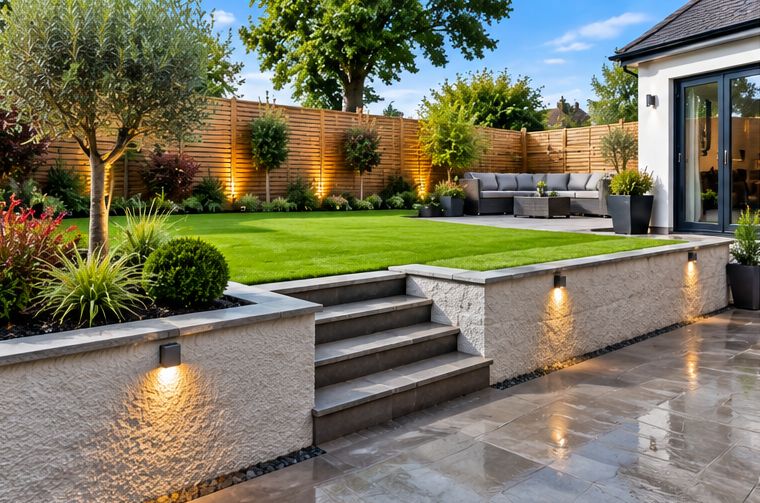
Walk along almost any street in Aberdare and you will see the same pattern behind the houses: gardens that climb or drop away, held in place by walls of stone, brick or block, with steps linking one level to the next. Many of those walls are decades old. Some are still sound, some are bulging, and a few are only standing out of habit.
This guide looks at the walls and steps we are most often asked about in Aberdare, how we decide whether to repair or rebuild, and what goes into a wall or flight of steps that will cope with valley weather. For the service itself, see our brickwork and garden walls page.
The walls you find in Aberdare gardens
The town's mix of housing gives it a wide range of garden walls, and each type has its own weak points.
- Old stone boundary walls around larger older houses. Often built with lime mortar, they can last a very long time, but ivy, tree roots and cement repairs over the years can loosen them.
- Retaining walls behind Victorian terraces, holding back the bank at the top or bottom of a narrow plot. These carry a lot of weight, especially when the soil behind is soaked.
- Block walls on newer estates, sometimes rendered, sometimes left bare. They are usually younger but not always built with drainage in mind.
- Low front walls and pier caps that take knocks from bins, cars and frost.
Knowing which type you have helps decide what the wall needs, and whether a patch will do or the whole run has to come down.
Signs a wall needs attention
Most walls give plenty of warning before they fail. The ones to watch in Aberdare are the retaining walls, because wet valley soil can press hard against them for months at a time.
Things to look out for include a lean or bulge, cracks that grow over a season, stones or bricks working loose, mortar that crumbles when you press it, and water running out of the face of the wall rather than through proper weep holes. A damp, green stripe at the base can also mean water is trapped behind.
A small area of loose pointing can usually be repaired. A wall that is leaning, bulging or holding back a lot of soil is a different matter. If you are unsure, our guide on when a retaining wall needs engineering advice explains when a structural engineer should look at it before any work is done.
Building a retaining wall that copes with rain
When we build a new retaining wall in Aberdare, water management is designed in from the start. The footing is dug to firm ground and sized for the height and load of the wall; our guide to garden wall foundations explains why this is the part you must not skimp on.
Behind the wall we place free-draining stone so water can move down instead of building up pressure. Weep holes are left along the base to let it out, and on some sites a perforated pipe carries it away to a suitable outlet. The top of the wall gets a coping that throws water clear of the face.
Taller walls, and any wall holding back ground near a house, a path or a neighbour's property, need careful thought and sometimes professional design. We will tell you honestly when a wall is beyond a straightforward garden build.
Steps that are safe in the wet
Steps get used every day, often in the dark and often in the rain, so comfort and grip matter as much as looks. Old garden steps in Aberdare are frequently uneven: one tall riser, one short, a worn tread tipping forward. That is how people trip.
We set out a new flight so every riser is the same height and every tread the same depth, with a slight fall on each tread to shed water. Textured slabs, riven stone or engineering bricks give better grip than smooth surfaces. On a long flight, a landing halfway breaks the climb, and a handrail is worth considering for older family members.
The home guide to garden steps in brick and stone explains the rise-and-going rule we follow. Steps usually tie in with a patio at the bottom or top, which our guide to patio slabbing for Aberdare terraced houses covers.
Brick, block or stone?
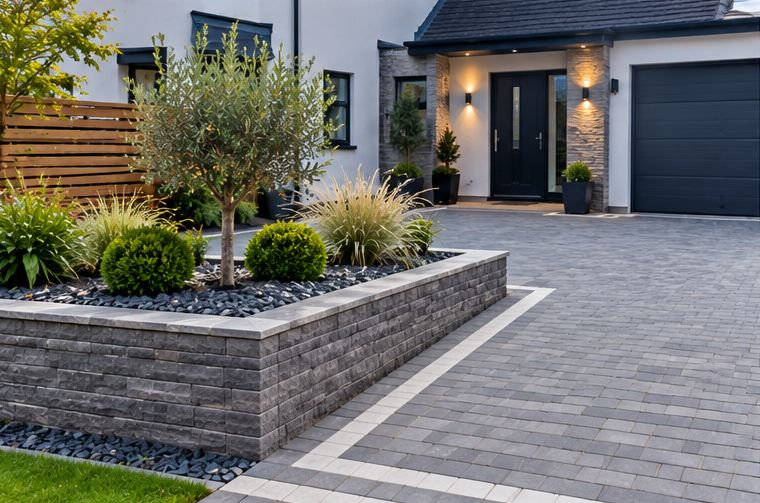
The right material usually follows the house. Behind an older stone-built property, new walls in stone, or at least faced to match, sit more comfortably than bright new brick. For a terrace, a mellow facing brick or reclaimed-look brick often suits. On a newer estate, a rendered block wall or a clean facing brick ties in with the house.
Whatever the face, bricks and coping need to handle frost and constant wet. Our guide to choosing bricks and coping covers what to look for.
Neighbours, boundaries and permission
Many Aberdare walls sit on a shared boundary or hold up a neighbour's garden. Before any work on a wall like that, it is sensible to talk to next door and agree what is being done. Party wall rules can apply to some boundary work, so if in doubt, take advice first.
Front walls beside a road, very tall walls and work near listed buildings or in a conservation area may also need permission. We are landscapers, not planners, so we always suggest checking with Rhondda Cynon Taf Council before building anything unusual.
Getting a wall or steps priced
The main things that shape the cost are the length and height of the wall, how much soil it holds back, the materials, access for barrows and deliveries (a rear lane or steps down from the road make a big difference), and how much old wall has to be taken down and removed.
For more on walls and steps in the town, see our brickwork in Aberdare page and our landscaping in Aberdare page, where we talk about splitting a slope into usable levels. When you are ready, ask for a free quote and Tony will come out to look at the wall with you.
Talk to T J Landscapes about your garden
Free quotes and honest advice across South Wales.
Questions People Ask
Can you repair an old stone wall rather than rebuild it?
Often, yes. Loose sections can be taken down and relaid, and poor pointing raked out and redone. If the whole wall is leaning or the footing has failed, rebuilding the affected length is usually the better answer.
Why is water coming through the face of my retaining wall?
It usually means there is no drainage behind it, or the weep holes are blocked. Water trapped behind a wall adds weight and pressure, so it is worth having it looked at before cracks or a bulge appear.
Can you build steps down a steep terraced garden in Aberdare?
Yes. On a steep plot we usually break the flight up with landings and plan the steps together with the walls on each level, so the whole slope works as one design.
Do I need permission to build a garden wall?
Most low garden walls do not, but height limits, walls beside a road, and properties in a conservation area can change that. Check with Rhondda Cynon Taf Council if you are unsure, and talk to your neighbour about any shared boundary.
Can a new wall be built as part of a bigger garden project?
Yes, and it is often the best way. Walls, steps, a patio and a lawn all depend on the same levels, so planning them together avoids digging the same ground twice.