
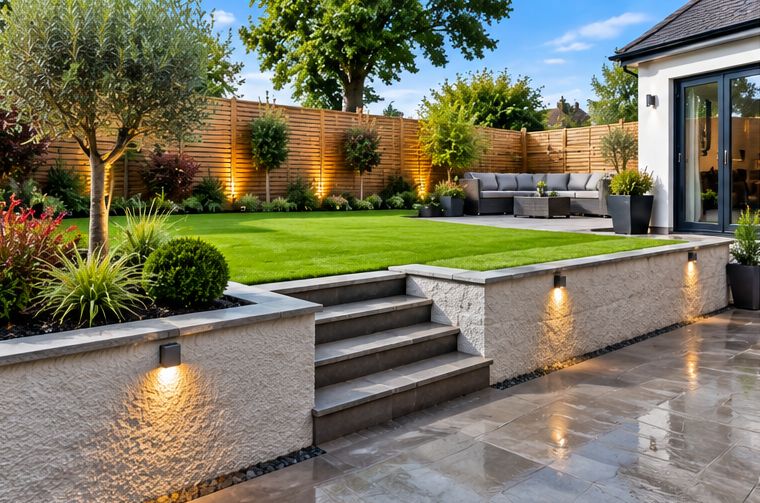
Most people who ask us about a makeover in Aberdare are not starting from a bare field. They have a garden that has grown tired: a patio that has sunk, a lawn that turns to mud every winter, a fence leaning at the bottom and beds nobody has touched for years. The question is less “what could go here?” and more “what should change first?”
This guide gathers the ideas we find work well across the Cynon Valley, from the long gardens behind Victorian terraces to the bigger plots around older houses and the newer estates. For an overview of the town and the way we plan for rain, see our landscaping in Aberdare page, and for the full design service, landscaping and garden design.
Start with a list of what stays
Before sketching anything new, walk round the garden and note what is worth keeping. An old stone wall, a mature tree that frames the view, a healthy hedge or a run of good paving can all anchor a new design and save work.
Just as useful is a list of what annoys you. A step that is too high, a corner that never dries, a shed in the sunniest spot: these tell us where the makeover will make the biggest difference. In a lot of Aberdare gardens, fixing two or three of those problems changes the whole feel of the place.
A sheltered seating area near the back door
The most used part of almost any garden is the bit closest to the house. A well-laid patio or deck there, with a little shelter from the wind that funnels along the valley, turns a garden you look at into one you sit in.
Think about when you will use it. Morning coffee wants the early light; evening meals want the last of the sun, which on a valley side can disappear behind the hill sooner than you expect. We look at where the light falls through the day before fixing the position. Our guide to patio slabbing for Aberdare terraced houses covers the narrow yards, and decking for Aberdare gardens compares timber and composite boards.
A lawn that copes with Cynon Valley rain
Plenty of families want grass for children and dogs, and a lawn can work well here if the ground underneath is right. A lot of soggy lawns on newer plots sit on compacted soil with very little depth of topsoil, so water has nowhere to go.
A makeover is the moment to fix that: dig out or loosen the compacted layer, bring in good topsoil, shape the levels so there are no hollows, then lay fresh turf. On really wet ground a land drain or gravel trench may be needed first. The guide on turf laying in Aberdare explains the groundwork in more detail.
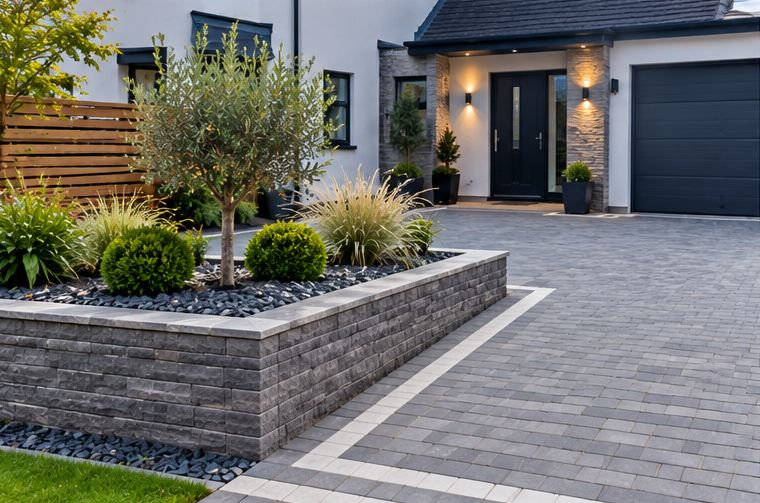
Planting for a damp, sheltered valley
Aberdare gardens tend to be moist and, lower down, fairly sheltered. That suits a wide range of shrubs, ferns, grasses and hardy perennials, and it means less watering than gardens in drier parts of the country.
- Raised beds: timber sleepers or brick lift roots out of wet soil and make weeding easier.
- Evergreen structure: a few evergreen shrubs keep the garden looking lived-in through the grey months.
- Bark or gravel mulch: suppresses weeds and keeps beds tidy with little effort.
- Right plant, right place: save sun-loving plants for the brightest corner and use shade-tolerant ones against high walls.
Making use of the hills
From many homes on the valley sides you can see green hillside beyond the back fence, and the land around Dare Valley Country Park is close by. A makeover can frame that rather than hide it. A lower fence or an open slatted section at the top of the garden, or a bench placed to face up the valley, borrows the view for free.
Where privacy matters more, planting can soften a tall boundary so it feels less like a wall. Our guide on choosing fencing for an Aberdare garden looks at the options.
Lighting, water and the finishing touches
Low-level garden lighting along steps and paths makes a sloping garden safer on dark winter evenings and lets you enjoy it after work. A small water feature adds sound and movement without needing much space. Neither needs to be elaborate to make a difference.
Paths deserve more thought than they usually get. In a long, narrow garden a path that runs dead straight from door to back gate makes the plot feel like a corridor; a slight dog-leg, or a path that widens into a small paved circle halfway down, breaks it into rooms. Use a surface with some grip, because moss and algae build up quickly on shaded paving in a wet valley.
Finishing touches such as a tidy bin store, a proper path to the shed and a gate that closes cleanly are easy to overlook, but they are what make a garden pleasant to use every day.
Doing the makeover in stages
Not every garden needs to be done at once. We often suggest an order that avoids undoing work later: clearance first, then drainage and walls, then hard landscaping, then turf and planting. That way nothing new is dug up for a job that should have come first.
Staging also spreads the disruption. Some Aberdare households prefer to have the patio and fencing done one year and the lawn and planting the next, once they have lived with the new layout for a season and know how they use it.
If a plot is badly overgrown, start with clearing a neglected Aberdare garden. When you are ready to talk about ideas, ask Tony and the team for a free quote and we will come and look at the garden with you.
Talk to T J Landscapes about your garden
Free quotes and honest advice across South Wales.
Questions People Ask
How long does a garden makeover in Aberdare take?
It depends on the size of the garden, how much groundwork is involved and the access. A simple patio and turf job is much quicker than a sloping garden that needs retaining walls. We give you an idea of timing with the quote.
Can you work with my own ideas or a design I have found?
Yes. Many customers come with pictures or a rough sketch. We will tell you honestly what will work on your plot, what might struggle in the Aberdare weather and where a small change would help.
What affects the cost of a garden makeover?
The size of the area, the materials, the slope, drainage, access and how much waste has to go. Our guide to what affects the cost of garden landscaping explains each one, and the quote itself is free.
Is a low-maintenance garden possible in the valleys?
Yes. Good paving, raised beds with mulch, a well-prepared lawn or artificial grass, and sturdy fencing all cut down the work. See how to plan a low-maintenance garden.
Do you take away the old materials?
Yes. Old slabs, broken fencing, soil and green waste are removed as part of the job, so you are not left with a pile at the end.